
How to Increase Ecommerce Sales Without Increasing Website Traffic
Most stores fail at this before they change a single page. The pitfall is not flat traffic. It is what flat traffic does to people. They panic, stack a discount banner on top of an exit popup, bolt an upsell onto checkout, and call it growth. The arithmetic of how to increase ecommerce sales without increasing website traffic is narrower and duller than any of that. Sessions multiplied by conversion rate multiplied by average order value. Freeze sessions and you have two variables left, not twenty, and most of what gets published on this topic touches neither.
So, the answer first: the boring version wins. Fix what your existing visitors already see, then make the people who bought once buy again. That is it. No new channel, no new audience, no clever hack that only works if you also quadruple ad spend.
People hear this brief and immediately reach for Google Analytics, Search Console, Semrush, Ahrefs, or Moz. Those tools tell you what happened last month. None of them sells anything, and refreshing a dashboard is not a growth channel. The same goes for the rest of the stack people confuse with the topic. A CRM keeps a customer you already won, an email platform brings them back, a chatbot deflects a question, a CMS lets you publish, a website builder lets you ship. Each one does a job. Only the ones that change what a visitor sees, or how fast they see it, show up in revenue per session.
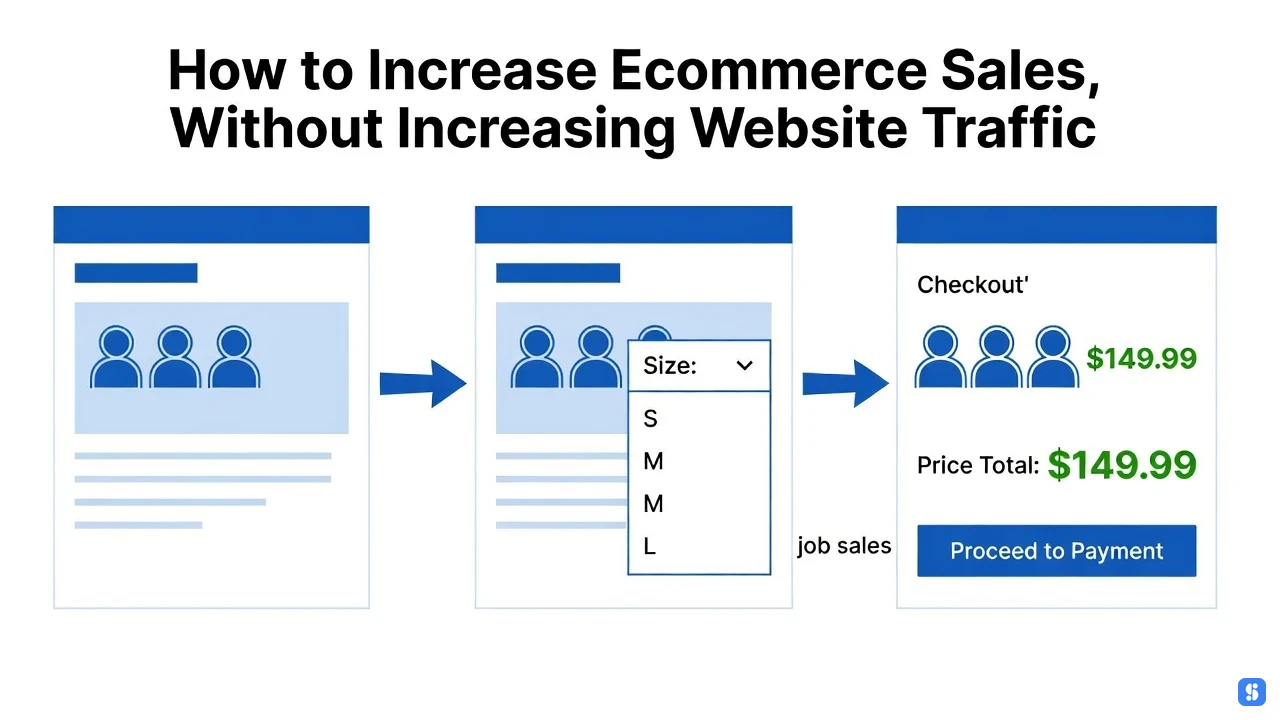
Most of the sales jobs on a storefront happen before checkout. Deciding whether to trust you. Finding the size chart. Checking whether the thing ships in time. Answering the top three objections directly on the product page is the job sales reps hate repeating, and your page should already be doing it for free, on traffic you already paid for.
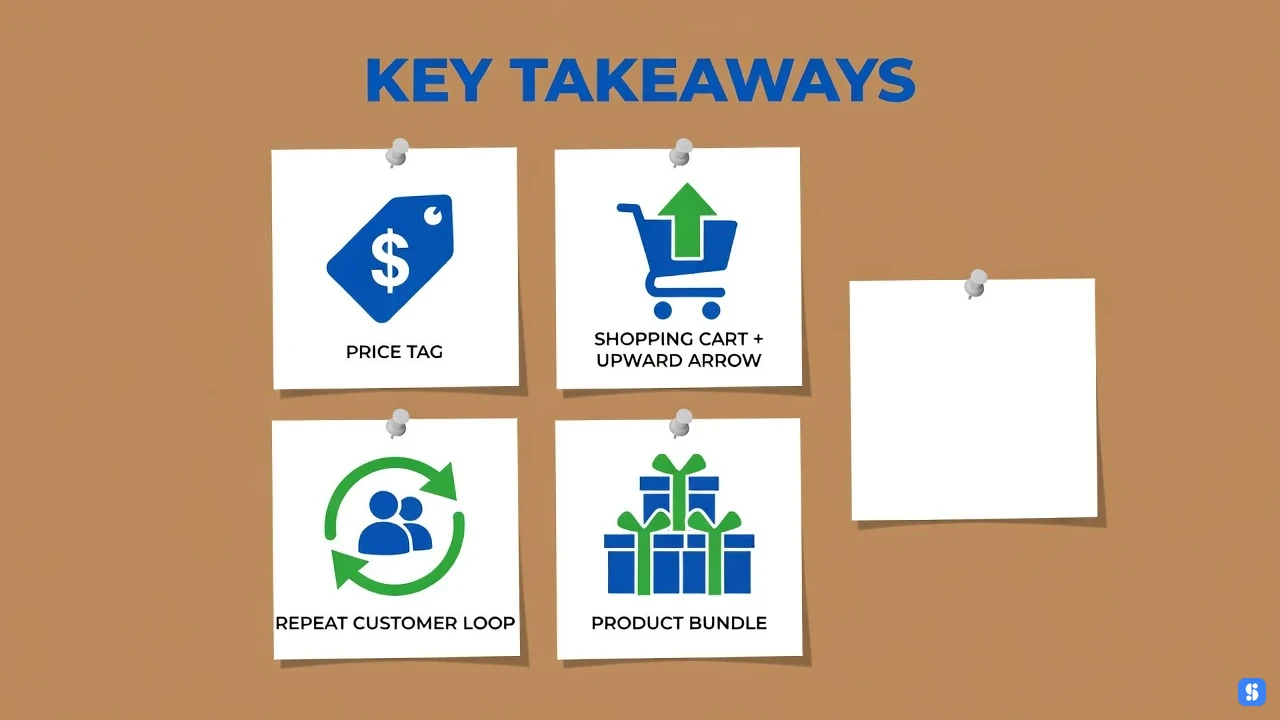
In practice the revenue hides in four places, and I'd rather name them plainly than dress them up:
Pages that exist but aren't indexed. You can't convert a visitor on a page Google or an AI engine won't surface.
Product pages that answer nothing. Thin copy, no specs, no comparison, no reason to pick you over the tab next door.
Internal search that returns nothing useful. Someone tells you exactly what they want and gets an empty grid.
Repeat purchase. The cheapest revenue you will ever earn is from someone who already trusts you.
The unglamorous part is that all four need to run on a schedule, not a burst of enthusiasm in March. Write a standard operating procedure (SOP) once: when a product page changes, the objection block, the internal links, and the structured data get checked with it. Teams without a dedicated analyst can run that loop without hiring a specialist, but the loop has to exist before the tooling matters.
I will be honest about where I am arguing against my own coworkers here. They want the interesting version, the one with a new channel and a slide deck. The stores I've watched actually move revenue per session did something much less interesting: they made the pages they already had load faster, say more, and get indexed. That is a boring quarter. It is also the only version that does not depend on traffic you do not have.
The most common failure is treating a revenue problem as a traffic problem. You already paid for the sessions you have. The leak is downstream. So here is the compressed version of how to increase ecommerce sales without increasing website traffic.
Fix the pages you own before adding pages. Thin product copy and dead-end category pages cap conversion no matter how many visitors arrive.
Write for extraction, not just ranking. AI answer engines quote specific, self-contained answers, so put the plain answer near the top of product and category pages.
Clear technical debt early. Broken canonicals, duplicate variants, and slow templates suppress everything else you do.
Measure per session, not per visit. Revenue per session tells you whether the work landed.
If you run this solo, there is a walkthrough for DIY AI SEO without a specialist. The next sections break each point down.
Why Is More Traffic the Wrong Lever for Ecommerce Growth?
Doubling traffic and doubling conversion rate produce the same revenue on paper. One costs ad budget and months of waiting. The other is work you can start this week. That asymmetry is why the useful answer to how to increase ecommerce sales without increasing website traffic is usually to fix the store you already have.
Traffic is a rented input. New visitors arrive with roughly the same average intent as the ones already landing on your site, so if 1 in 100 buy today, another 10,000 sessions buy you about 100 more orders. Conversion work compounds instead. It lifts every session from every channel, including the sessions you already paid for.
Notice who profits from that framing. Search Console, Google Analytics, Semrush, Ahrefs, and Moz all measure acquisition well and say almost nothing about a product page that loads slowly on mobile or a size chart nobody can find.
So the cheap growth sits in what you already own. Running this without a specialist is realistic. DIY AI SEO without a specialist covers the unglamorous version, and it beats a bigger top-of-funnel budget most quarters.
How Does Generative AI Disrupt Search, and What Does SIGIR 2026 Have to Do With Your Store?
The tradeoff nobody prices in: every sale that starts inside an AI answer is a session that never shows up in your analytics. So the work that most affects how to increase ecommerce sales without increasing website traffic stays largely invisible to the dashboard you check every morning. You get the revenue. You do not get the visit, the attribution, or the comfort of a rising line.
That is the disruption. Search used to be a two-step contract. Someone typed into the box that still reads "search Google or type a URL," scanned ten links, and clicked. Generative answer engines collapse both steps. The engine reads the intent, assembles an answer, and either names the store that should fulfill it or names nobody. There is no page two, no position eleven. There is only whether your product facts were the ones worth quoting.
For a store that already has traffic, three things change:
Query volume stops being the unit of value. One AI answer can satisfy hundreds of long-tail product questions that used to be hundreds of separate visits.
The citation becomes the shelf. Getting named for "best X for Y" behaves more like a placement in a storefront than a ranking on a results page.
Click-through drops while intent sharpens. Anyone who leaves the answer to visit you has already decided. Your job moves from persuading to confirming.
Now SIGIR. SIGIR is the ACM's main information retrieval conference, the venue where ranking and retrieval research gets argued out well before it reaches product teams. SIGIR 2026 is worth watching for one reason: what gets published there tends to surface in the retrieval behavior of answer engines a year or two later. I will be honest about the limit, though. I do not know what that program will hold, and anyone telling you precisely which paper will reshape ecommerce search is guessing. What I'd watch for is work on grounding, attribution, and how answer systems decide which sources to trust, because those three decide which stores get named and which get summarized into oblivion.
The omnibox matters here too. Most people now type full questions into it rather than navigating anywhere, and voice assistants do the same with less patience. You cannot improve for a query string you never see. That pushes the weight onto structure, schema, and unambiguous product facts, and away from keyword lists you have no way to measure.
If nobody on your team owns retrieval, close that gap before anything else. Small teams can handle it without hiring a specialist, which is roughly where most ecommerce operations actually sit.
Where Does the Revenue Actually Hide on a Site That Already Gets Traffic?
Search Console and GA4 describe the same store in two different currencies, and the gap between them is where the money sits. If you want to increase ecommerce sales without increasing website traffic, stop auditing acquisition and start auditing the pages you already rank for and never converted.
The revenue hides in three unglamorous places: product pages sitting on page two for buyer-intent terms, category pages with filtered or out-of-stock variants still indexed, and pages where the answer to "will this fit what I need" is buried under five paragraphs of brand story.
Pull your top 100 landing pages by impressions, then sort them by conversion rate ascending. That list, not your traffic graph, is your growth plan. Internal site search queries are the other tell: they show what shoppers wanted and couldn't find.
If nobody on your team owns that list yet, Azuqe for Solopreneurs, DIY AI SEO Without a Specialist is one place to start.
Ecommerce SEO: How to Increase Ecommerce Sales Without Increasing Website Traffic
The tradeoff is timing. How to increase ecommerce sales without increasing website traffic through SEO mostly means fixing pages you already have, and that work compounds slowly. Rewriting a product page that ranks in position eight is unglamorous and takes weeks to show up, while a paid push pays out tomorrow.
So do the page-level work first, because it is the cheapest sales you will ever buy. Rewrite titles and meta descriptions on pages with impressions but weak click-through. Put the buyer's actual question in the page copy instead of marketing adjectives. Add internal links from your strongest category pages to the products that convert. Deepen thin category pages with real comparison content.
Where it stalls: SEO cannot fix a bad price, a slow checkout, or missing stock. If your on-page setup is thin, start there, then stop fiddling and go fix conversion.
Optimizing for AI search is the cheapest way to increase ecommerce sales without increasing website traffic, because the crawlers that shape those answers already visit pages you rank for. You are not buying visitors. You are making copy you already own quotable.
Three things do most of the work. Put a plain-text spec block on every product page so it survives being lifted out of context. Answer the question in the first sentence, not the fourth. Keep entity naming identical across product pages, About copy, and schema, since answer engines reconcile brands by consistency, not by tagline.
Search Console tells you which queries you rank for. It says nothing about what ChatGPT repeated about your store. If you are handling this without a specialist, Azuqe for Solopreneurs, DIY AI SEO Without a Specialist covers that workflow.
Most teams wreck this by fixing a page, watching bounce rate improve, and calling it revenue. Getting better at how to increase ecommerce sales without increasing website traffic starts with one rule: pick a single metric per change and leave it alone for a full cycle.
From there, the practices that hold up:
Change the page, not the template. One variable at a time, or you learn nothing.
Separate AI-arriving sessions from search-arriving ones. They behave differently, and merging them hides both.
Read your copy out of context. If a product description only makes sense inside your layout, an answer engine will drop it.
Write the before state down. Nobody remembers last quarter's conversion rate, and you will want it.
None of this is complicated. It is just boring enough that teams skip it, then blame traffic they never bought. Smaller teams running it alone can use a leaner setup, which is what Azuqe for Solopreneurs, DIY AI SEO Without a Specialist is built around.
What Are the Most Common Mistakes?
The most common mistake is measuring the wrong number. Traffic is easy to pull from GA4 or Search Console, so it quietly becomes the scoreboard. Teams trying to increase ecommerce sales without increasing website traffic end up optimizing for sessions they never needed in the first place.
The rest tend to look like this:
Treating a conversion problem as an acquisition problem. If the people already landing on the site leave, more traffic just means more leaving.
Reading Search Console impressions as demand, without ever checking whether AI answers mention the brand at all.
Fixing pages nobody buys from because they are the easiest to edit.
Leaving rank trackers, analytics, and the CMS in separate tabs, so no single person owns the fix.
None of that needs a new tool. On small teams it usually needs one person who stops reporting and starts changing pages, which is roughly the argument for handling your own AI SEO without a specialist.
Frequently Asked Questions
How do I find conversion leaks if I am not adding traffic to test against?
You do not need new visitors to find leaks. You need segment comparison. Pull the last ninety days of sessions that converted and sessions that did not, then compare them on the variables you control: landing page, device, entry source, and whether a variant was in stock. The gaps usually cluster in one place rather than spreading evenly.
Start with product pages that get meaningful traffic and convert below your site median. That shortlist is where money leaks fastest, and it is also the hardest to argue about because the numbers are already sitting there.
Does email or SMS revenue count as sales without new visits?
Yes, and it is the cleanest version of the claim. A subscriber who opens a message and buys is a returning session attributed to a channel you own, not an incremental visitor from search or ads. The honest caveat is that email and SMS rarely create demand from nothing. They harvest demand your store already generated, which is exactly what How to Increase Ecommerce Sales Without Increasing Website Traffic is about.
If your list is small or stale, this route caps out fast. Fix the on-site experience first.
How long before on-site changes show up in revenue?
Days for pricing, shipping-threshold, and inventory-tag changes, because those act directly on the decision. Weeks for copy, imagery, and page-structure changes, since they need enough sessions to separate signal from noise. Be skeptical of anyone promising a clean read in 48 hours on a low-traffic page.
Do I need a CRM or a paid analytics suite to do any of this?
No. A CRM organizes customer relationships and pipelines. It is not a conversion diagnostic. Google Analytics and Search Console cover most of what you need to find leaks, and your ecommerce platform already holds the order data that matters most. Paid suites like Semrush, Ahrefs, or Moz answer a different question, how you get found, not why the visitors you already have are leaving.
Before buying anything, export your own order and session data and look at it. Most teams find three fixable problems in an afternoon. Smaller teams working without a specialist can lean on tooling built for that setup, like Azuqe for Solopreneurs, DIY AI SEO Without a Specialist, but the diagnostic habit matters more than the tool.
Is retargeting existing visitors cheating?
No, though it is not free money either. Retargeting re-engages people who already found you, so it raises revenue from a fixed visit pool, which is legitimate. The catch is that it gets expensive as your audience shrinks, and it cannot fix a product page that fails on first contact.
Treat it as a second pass, not a substitute for getting the first visit right.
Conclusion
Adding budget to a channel puts you in a bidding war with every other advertiser. Fixing the pages you already own puts you in a war with nobody. That comparison is why the honest answer to how to increase ecommerce sales without increasing website traffic keeps landing on the same unglamorous work: page structure, schema, internal links, and copy that answers the question before the reader leaves.
None of it is exciting. All of it compounds, and it keeps earning on traffic you already paid for once.
That's the boring answer, and I'd argue it beats the clever one most quarters. If you want the audit-and-fix half automated, Azuqe for Solopreneurs is a reasonable starting point. If your catalog is messier than that, talk to sales.
From our experience
In running Azuqe, we've found that teams trying to grow sales without more traffic often start by fixing what's already indexed, our continuous site audits flag technical SEO issues and rank them by potential impact, so the work goes where it can actually move rankings.
We've seen that losing organic traffic to ChatGPT and Gemini recommendations is a real pain point for the ecommerce operators we work with, which is why our Citation Ranking Dashboard tracks which sites AI engines cite most, along with citation trends and your own citation rate.
Our users consistently want to know whether a ranking change came from indexing or from traffic shifts, so our traffic monitoring correlates organic flows with indexing changes and ranking movements rather than reporting them in isolation.
One honest limitation we've run into: AI Visibility runs only cover ChatGPT, Gemini, and DeepSeek on Pro and Max plans, even though our marketing shows eight engines, that gap between the page and the product is something we still have to explain to users.
We've also learned that our pricing model has friction, billing is monthly only with no annual or prepay discount, and the free trial applies just to the first website, so anyone adding a second site is charged right away.