How Azuqe is better than its competitors
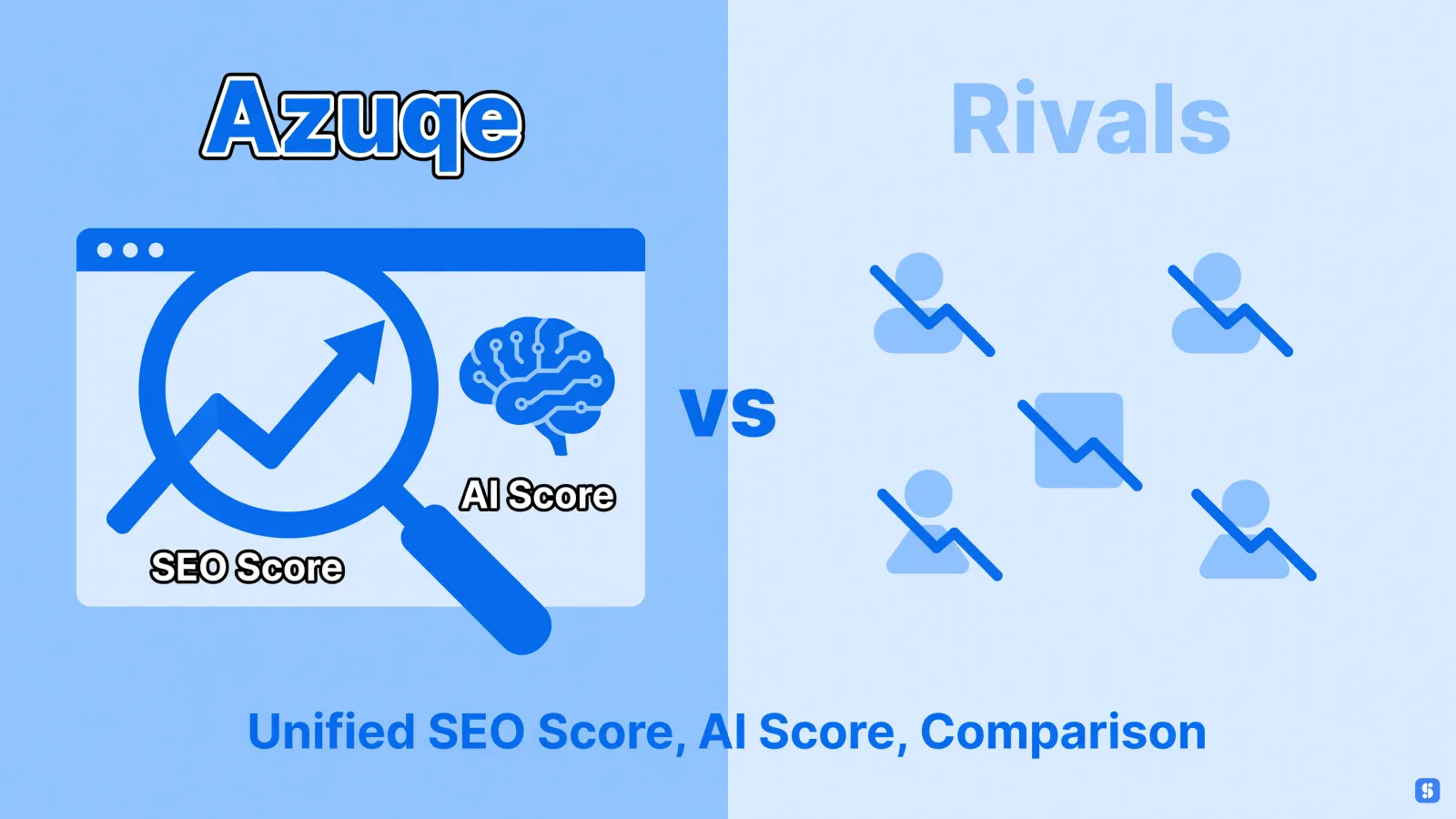
If you are weighing how Azuqe is better than its competitors, the short answer is that most tools track either Google rankings or AI visibility, never both. Azuqe was built for the reality that your brand now has to be found in two places at once: classic Google SERPs and AI answer engines like ChatGPT, Gemini, and DeepSeek.
That means one unified score, one dashboard, one workflow. The Citation Ranking Dashboard shows where your brand appears in AI responses, and the Automatic Fix Center handles the technical SEO issues other tools make you chase manually, no developer required. (see Azuqe vs Moz, Compare SEO suite)
We are not claiming Azuqe beats every competitor at every feature. But if your job is to monitor and grow visibility across Google and AI engines from one workspace, Azuqe is the only platform that starts there. (see Azuqe vs Semrush, Compare)
See how it stacks up in our full comparisons, or start with the platform itself.
How is Azuqe better than its competitors?
The short answer: Azuqe measures and fixes what the big SEO suites skip, your visibility in AI answer engines. Most platforms still track Google rankings and call it done. That was fine in 2019. It's a blind spot now, with a growing share of buying research starting in ChatGPT, Gemini, or DeepSeek, answers often get synthesized with no cited link at all. Azuqe is a unified SEO and AI visibility platform, one place for both. Its AI Visibility Tracking runs scheduled searches across AI answer engines. The Citation Ranking Dashboard shows whether your brand is named, cited, or missed entirely. Both metrics land in one number, the Unified SEO & AI Visibility Score, so you don't stitch together three tools to understand what a shift in ChatGPT answers did to your organic pipeline. Then there's the fix side, where the unglamorous value lives. Continuous Site Audits catch technical issues, and the Automatic Fix Center resolves a good share of them without you filing a ticket with your developers. With the WordPress plugin and Google Indexing API integration, fixes ship the day you find them. That's a workflow advantage, not a feature bullet. Is Azuqe better than its competitors at everything? No. Tools like Semrush and Moz hold far deeper backlink historical data, and if your whole job is classic Google SERP tracking, they remain mature and battle-tested. But for the job marketing teams actually have now, keeping the brand visible across Google and AI answers from one workspace, Azuqe is ahead of where its competitors are investing. We keep the side-by-side details on our comparisons page if you want to check the differences yourself.
How Azuqe is better than its competitors: one score for Google and AI search
Most competitors only measure half the search scene. Classic SEO suites track Google rankings and stop. Azuqe's AI visibility platform also watches where your brand shows up in ChatGPT, Gemini, and DeepSeek answers, then folds both into a single Unified SEO & AI Visibility Score. One number your team can act on, instead of two siloed reports that never talk to each other. The mechanics matter more than the dashboard. Continuous site audits run in the background and flag the technical errors that quietly drag down Google rankings. The Automatic Fix Center resolves most of them without a developer ever opening a ticket. Because Azuqe connects to the Google Indexing API and ships a WordPress plugin, fixes move from detected to live in a fraction of the time a handoff to engineering takes. What makes the score genuinely useful is the citation data underneath. The Citation Ranking Dashboard shows which AI engines mention your brand, so you can see whether you lost a ChatGPT recommendation or a Google position in the same weekly review. Content briefs and AI-drafted articles are built from that same ranking data, with real citations and your brand voice applied. That's how a single asset ends up performing across both engines at once. That workflow is the actual difference. The tool that unifies the data beats the one that makes you stitch it together yourself. See the fuller story in our Azuqe vs the competition comparisons.
Where the all-in-one bet pays off
The honest case for how Azuqe is better then its competitors isn't that every feature outshines theirs. It's that the features are actually connected, so the output of one tool becomes the input of the next. That is rare in this space, and it changes how a small marketing team spends its week. What you measure is what you publish. Azuqe tracks brand visibility across Google and AI answer engines like ChatGPT, Gemini, and DeepSeek, then feeds that visibility data into content briefs. The articles you draft are grounded in the same gaps the tracking just surfaced. Most tools make you export, reformat, and guess. The Azuqe vs the competition, Comparisons pages show how siloed those other workflows tend to be. The Fix Center removes the developer bottleneck. When a continuous audit finds a technical issue, Azuqe does not just hand you a report and a shrug. It queues the fix so you can apply it without touching code. For a team of three marketers, that is the difference between fixing a redirect in an afternoon and waiting two sprints. It writes with citations, not vibes. The content suite drafts articles in your brand voice and includes real citations. That matters because an AI visibility score is partly a citation score: if ChatGPT mentions your brand, the source needs to exist somewhere credible. The tradeoff is real. Azuqe then competitors means giving up point-tool depth in exchange for integration. If you already live in a mature enterprise stack, that is a genuine cost. But if you are drowning in disconnected subscriptions, the consolidation pays for itself. Start with Azuqe, AI Audits, Keyword Research & AI Visibility Tracking and see what falls out of your weekly routine.
Best practices for how Azuqe is better then its competitors
If you are evaluating how Azuqe is better than its competitors, drop the feature checklist and run a workflow test instead. Every tool in this space lists similar features on paper. The workflow is where the difference actually shows up. (see Azuqe vs Ahrefs, Compare SEO & backlinks)
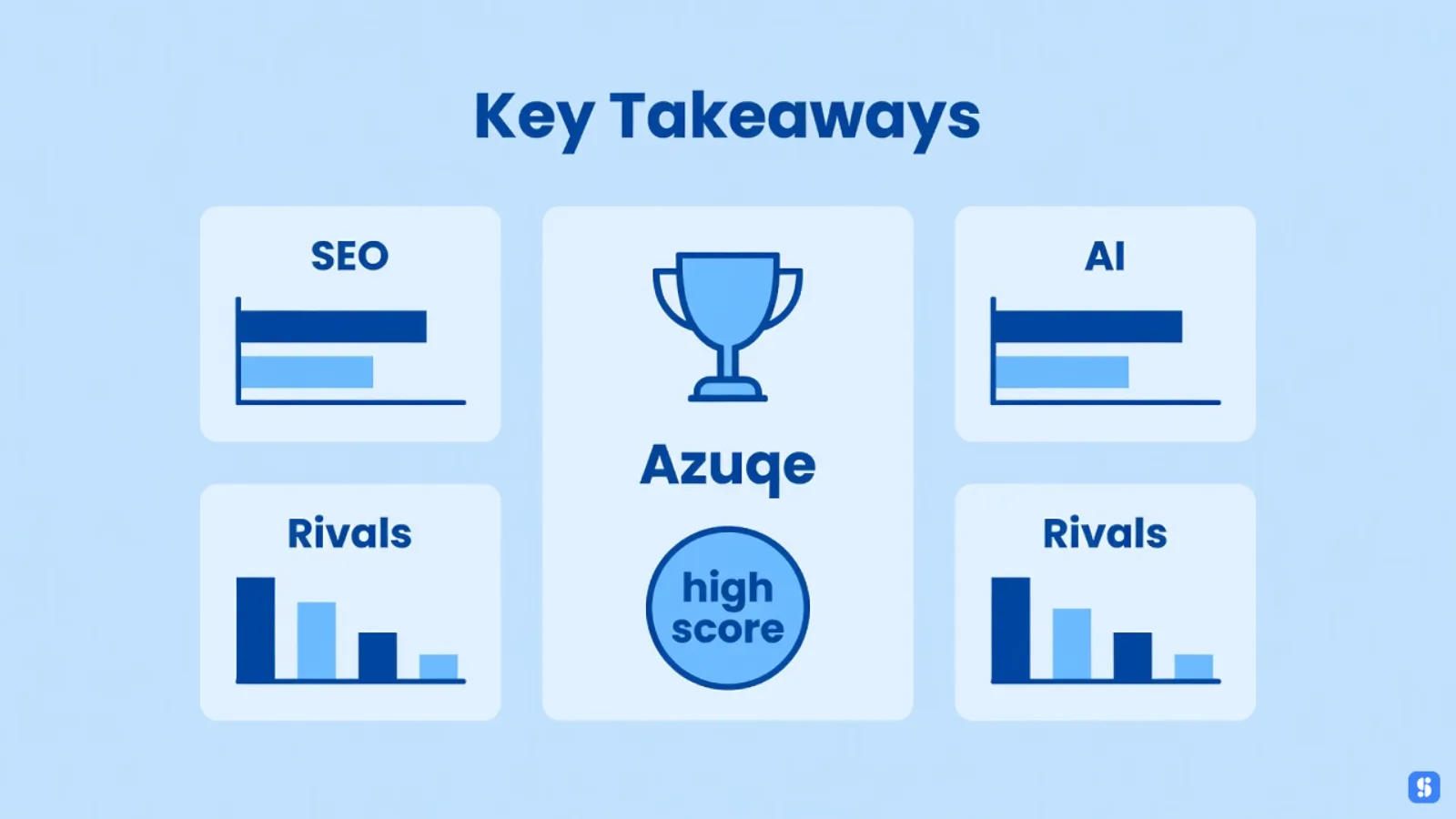
Key takeaways grid
The practices that matter to us:
Track the same keywords across Google and AI answer engines like ChatGPT, Gemini, and DeepSeek. If you only watch classic SERPs, you miss the traffic you are losing to AI recommendations. The Citation Ranking Dashboard keeps both in a single view.
Benchmark with one number. The Unified SEO & AI Visibility Score is not the final word on anything, but it gives your team a consistent metric to trend over time. That beats juggling six disconnected reports from three tools.
Automate technical fixes instead of assigning them to whoever has a developer ticket open. Continuous audits flag the issues, and the Fix Center resolves them without engineering time. This is the part that changes how your week actually goes.
Compare output quality, not just generation speed. Azuqe drafts articles with real citations in your brand voice, ready for review. See how far a draft gets before your editor has to intervene, then judge the tool on that.
Run the same project in Azuqe and in the competitor you are replacing. Publish a piece, fix a flagged issue, and measure both Google and AI visibility. The tool that gets the work shipped is the better choice. If you want to see how Azuqe then competitors stack up workflow by workflow, our Azuqe vs the competition, Comparisons pages walk through each one.
Common mistakes when Evaluating how Azuqe Compares to Competitors
The biggest mistake in any "how azuqe is better then its competitors" review is comparing the wrong job. Teams line up feature lists for Google rankings and stop there. That misses the real gap: AI visibility. Azuqe tracks brand citations across ChatGPT, Gemini and DeepSeek, then rolls Google rankings plus AI citations into one unified score. Skip that and you're measuring the old job, not the one you're hired for.
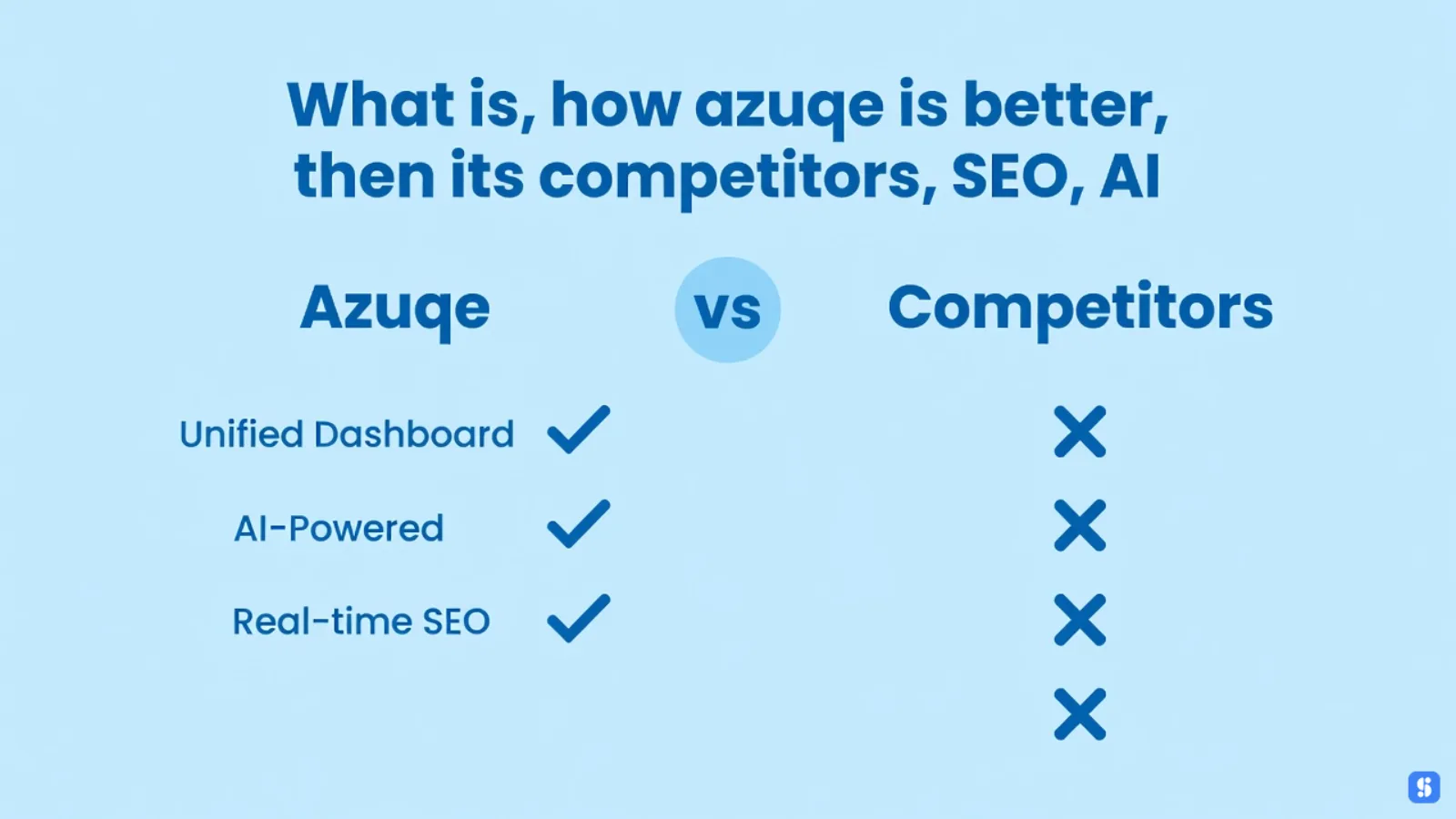
Azuqe advantage
Mistake 1: Judging by a single feature
Vendor comparisons love picking one feature, "X drafts faster," and calling it a win. But fast writing without technical fixes or citation tracking leaves content that ranks nowhere. Score the whole workflow, not the demo moment.
Mistake 2: Treating audits as reports instead of fixes
Crawlers that flag errors are common. Fixing them is not. Most audits hand you a list and wait for a developer. Azuqe's Fix Center resolves technical issues automatically, changing who does the work and when it gets done.
Mistake 3: comparing seat price instead of time to first result
Pricing tables get attention, but the metric that matters is how fast a team ships. When you weigh azuqe then competitors, measure what a month of the full workflow produces: audit, fix, brief, publish, track. Not the per-seat line item.
Judge the tool on the job you actually need done: rank in Google and get cited by AI engines from one workspace. That's where the Azuqe vs the competition comparison holds up, and where separate SEO, content, and AI-tracking tools start to look like a patchwork.
Real-World examples for how azuqe is better then its competitors
The fastest way to see how azuqe is better then its competitors is to watch a marketing team survive a week they'd normally lose to context-switching. Three scenarios come up again and again.
The AI visibility check. An SEO manager at a SaaS company notices organic traffic flattening while signups keep climbing. She runs one AI visibility run in Azuqe and finds her brand cited in ChatGPT answers for four high-intent queries, but missing from Gemini entirely. That single dashboard, not a folder of exported SERP screenshots, tells her exactly where to focus. Competitors that only track Google would miss this completely.
The fix that wouldn't wait for dev. A continuous site audit flags a breadcrumb schema issue and canonicals pointing at old URLs. Instead of opening a ticket and waiting a sprint, the team opens the Fix Center, applies the fix, and submits the pages to Google through the Indexing API integration. It's done before standup.
Content that ranks in both worlds. A content marketer drafts a comparison post in Azuqe's brief builder, which pulls in real citations and the brand voice, then publishes straight through the WordPress plugin. Run that same workflow with azuqe then competitors: elsewhere, the gap between the SEO tool and the publishing tool is where the work stalls and the citation context gets lost.
None of this is magic. It's fewer tools and fewer handoffs in the loop. On a small team, that's the difference between arguing about data and acting on it. See how the workflows line up across tools on our Azuqe vs the competition, Comparisons page.
What tools actually show how Azuqe is better than its competitors
The honest answer is that you should not take the comparison pages at face value. The tools to verify how Azuqe is better than its competitors are already inside the product, and you can reach them within the 5-day free trial on your first website. Most users publish their first article the same day they sign up, so the evaluation does not take long.
Four tools matter in that evaluation, and three of them are unique to Azuqe:
AI Visibility Tracking. This monitors your brand across ChatGPT, Gemini, and DeepSeek and reports where you appear in AI-generated answers.
Citation Ranking Dashboard. This shows how often your brand is cited by AI answer engines and which sources they pull from. No direct equivalent exists in most rival suites.
Unified SEO & AI Visibility Score. One number that combines classic Google rankings with AI visibility, so you stop juggling two unrelated dashboards.
Automatic Fix Center. Continuous audits feed a list of technical fixes that get applied without a developer.
What makes the comparison worth doing is the way the pieces connect. The content briefs and AI-drafted articles are built from the same citation data that the AI Visibility runs collect, so the writing loop is grounded in what answer engines actually reference. Compare that to a tool that only writes or only tracks Google rankings, and the edge becomes visible.
For the full breakdown, the Azuqe vs the competition page covers each rival, or start on Azuqe and run the trial yourself.
Frequently Asked questions
How is Azuqe better than its competitors?
Most tools treat SEO tracking and AI visibility as two separate problems. Azuqe combines them into one unified score that spans Google SERPs and AI answer engines like ChatGPT and Gemini, then pairs it with automatic technical fixes. Competitors still mostly track Google alone. That single difference changes how you work.
Does Azuqe only write content?
No. Content generation is one piece of the platform. It also runs continuous site audits, resolves technical issues through the Fix Center without needing a developer, and tracks citations across AI engines.
Can I keep using my existing tools?
You can, but teams usually end up replacing multiple subscriptions. One workspace, one score, one workflow. You can compare directly on our comparisons page.
How fast can we publish?
Most users publish their first article the same day they sign up. The five-day free trial covers your first website.
Conclusion: why the choice comes down to how azuqe is better then its competitors
The honest way to frame how azuqe is better then its competitors is simple: everything lives in one workspace. You track Google rankings, monitor citation rates in ChatGPT and Gemini, fix technical errors without a developer, and publish content that cites real sources. The tools we compared cover pieces of that. None of them close the loop.
Azuqe then competitors becomes a question of workflow, not features. You get one unified SEO & AI Visibility Score instead of stitching together four dashboards and hoping the numbers agree. The free trial on your first website is enough to test whether that loop actually holds for your team.
If you want the full breakdown, Azuqe vs the competition walks through each matchup. Or start inside the product at Azuqe and judge the workflow yourself.

Tushar, Btech. Profile. Last updated: 2026-08-09