Can Jev Improve Search Results? Only in One Narrow Sense
The tradeoff comes first, because it explains everything else: Jev can measurably sharpen a retrieval pipeline and still leave your search rankings exactly where they were, since those are two different problems that happen to share the word "search." So can Jev improve search results when you use it for reranking and RAG? In one place only. It changes which passages your model reads, and in what order it reads them. That is the entire claim, and it is a much smaller claim than the volume of writing around it suggests.

Separate the two meanings before anything else. "Search results" to an SEO team means a SERP: Google's index, your positions, the AI Overview citation you either earned or did not. "Search results" inside a RAG system means the candidate list your retriever returns before the model writes a single word. Jev belongs to the second category. Nothing about it crawls, indexes, or ranks a page on Google, and no amount of tuning will move a position on its own. Plenty of teams have bought into a reranker expecting organic traffic to shift, then spent a quarter confused about why it did not. (related: Azuqe, AI Audits, Keyword Research & AI Visibility Tracking)
A reranker takes a candidate pool and rescores it. That pool is its ceiling. If your retriever never surfaced the chunk holding the answer, a reranker has nothing to promote, and you get a beautifully ordered list of the wrong five passages. Most of the "Jev made things worse" stories I have seen trace back to this: the reranker did its job, the retrieval step did not. (related: Azuqe Blog, Search Marketing Tactics)
Where the narrow win is real: (related: Azuqe for Startups, Build Search Authority Early)
RAG answers that over-fetch. The retriever pulls 40 chunks, the model needs 5, and relevance scoring genuinely improves the answer.
Agent workflows that assemble context from several tools and need it compacted before the next call, rather than padded.
Documentation and support search where recall is fine but ordering is a mess.
What it never fixes: a document missing from the index, chunking that split one answer across three fragments, a query the retriever never matched, and every Google-side problem you actually get paid to care about, such as crawl budget, internal links, or thin content. Those live in a different toolchain. (related: Azuqe for Startups, Build Search)
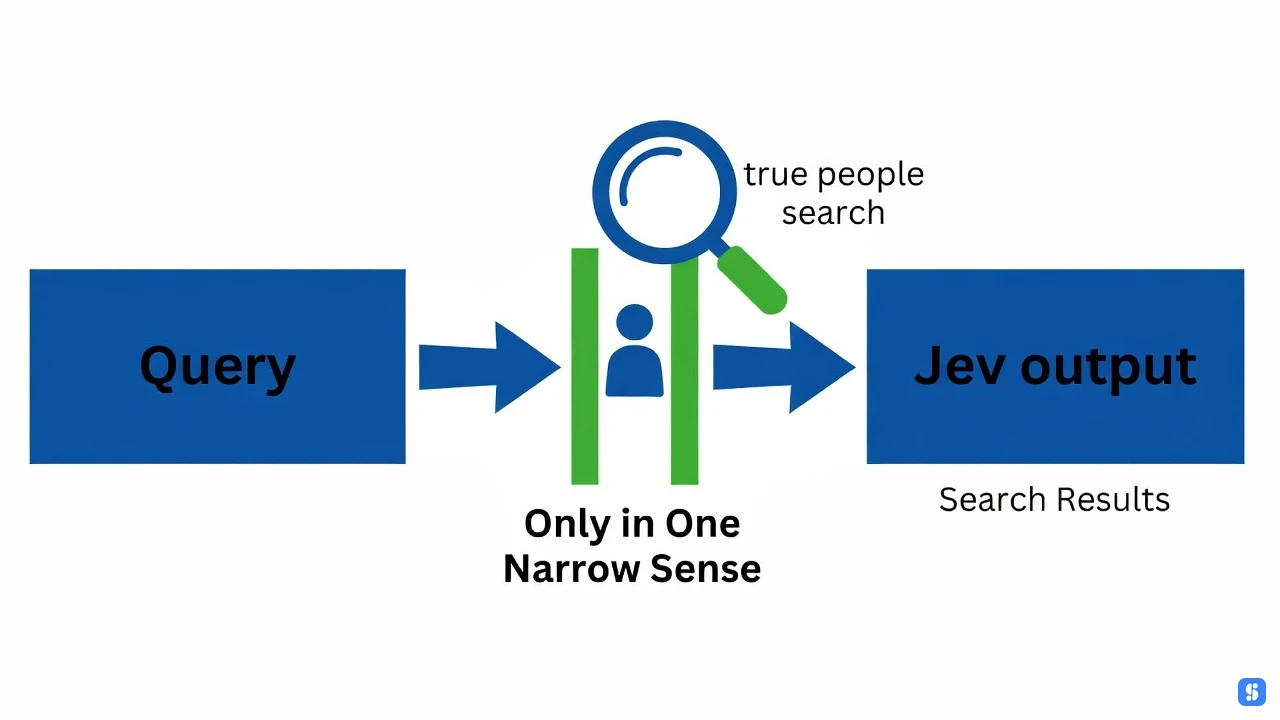
Which is why query sets built around the word "search" are so messy. Pull a report for a page like this and you will find a long tail with nothing to do with retrieval. true people search and fast people search are people-lookup queries. search party is either an idiom or a streaming listing. search google or type a url is the placeholder Chrome prints in an empty address bar. None of those visitors will ever care whether your reranker works. If those terms sit in your brief because a tool grouped them by the word "search," the brief is wrong, and no amount of context engineering repairs wrong intent.
To be clear about boundaries, since the tool category invites confusion: this has nothing to do with Google Analytics, Search Console, Semrush, Ahrefs, or Moz. Those read Google's index and report on it. Jev operates inside your own pipeline, on data you already retrieved. A CRM, a CMS, an email platform, or a website builder is not a substitute for it either, and none of them are what you are evaluating here. The overlap is alphabetical.
My honest position, and it is a debatable one: Jev matters far less than the attention it gets. Reranking is a real technique with a real but bounded payoff, and it sits downstream of decisions that matter more, like what you ingest and how you chunk it. Treat it as one adjustable part in a chain, not as a fix. The unglamorous details of where this chain breaks, and which repairs actually hold up under production traffic, are what the rest of this piece covers. If you want the wider context on how retrieval quality connects to visibility in Google and AI answers, the Azuqe Blog, Search Marketing Tactics & Case Studies has related write-ups worth skimming alongside this.
Key Takeaways
Short answer: Jev can improve search results for agents and RAG pipelines, not for classic SEO rankings. Whether you can use Jev to rerank and ground retrieval comes down to your data volume, your latency budget, and how honest you're willing to be about failure modes.
Jev is a reranking and context layer, not a replacement for your index or your AI audits and keyword research.
Reranking helps when your candidate set is already good. It cannot rescue bad retrieval.
Context compaction, evaluation, and agent integration are where most teams quietly stall.
Measure outcomes in AI answer engines, not just classic SERPs.
Skip it if your corpus is small and your recall is already fine.
Depth on each follows in the Azuqe Blog sections below.
Jev doesn't write answers. It sits between retrieval and whatever LLM you already pay for, ranking candidates and shaping the context they arrive in. So when people ask can Jev improve search results using reranking and RAG, the question is how well that layer orders candidates.
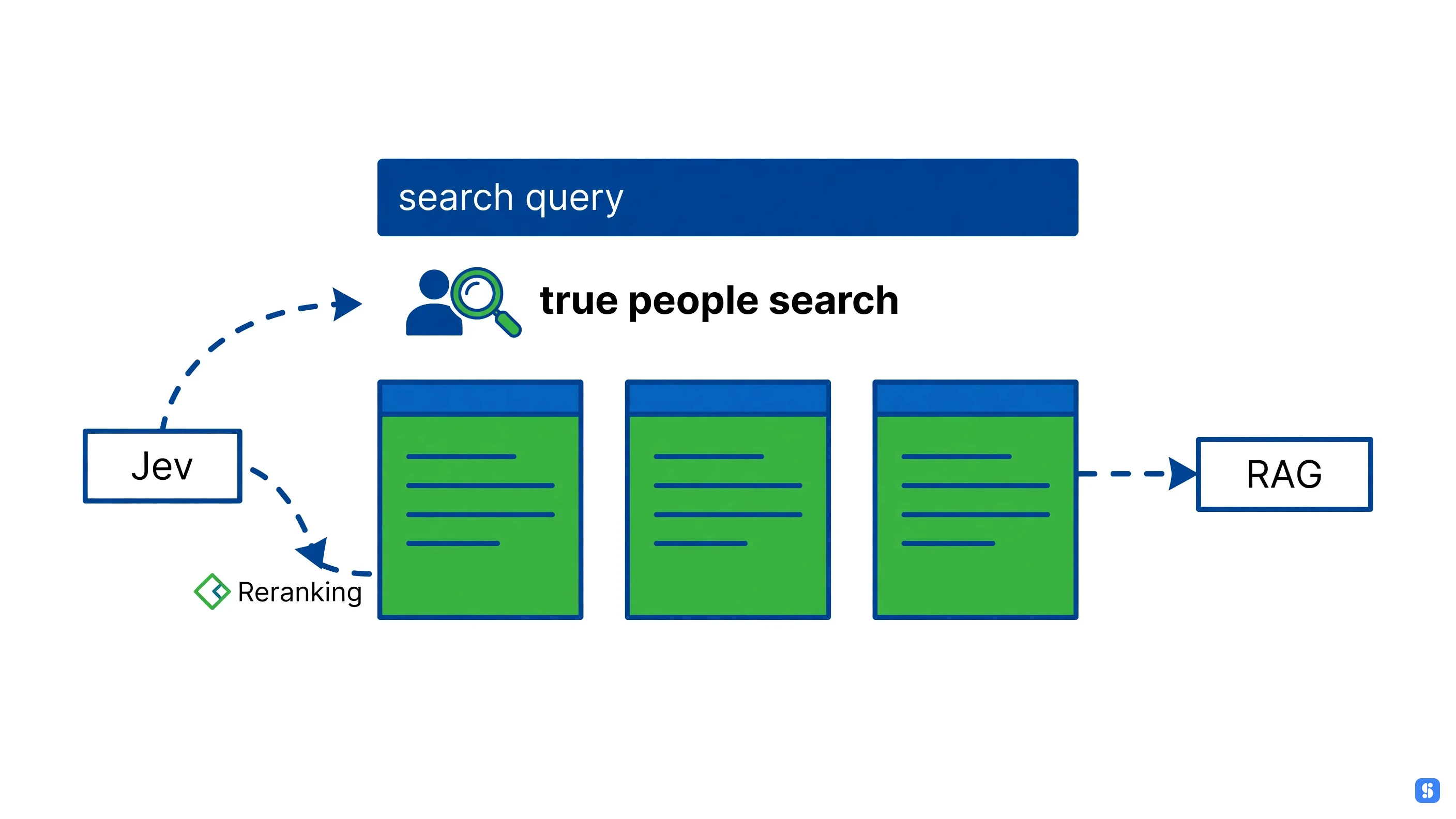
Three things happen mechanically. A retriever pulls a wide set of chunks. Jev scores each one against the query and the live conversation, pushing relevant chunks up and letting the rest fall. Then it compacts what survives, so the model gets less text that matters more.
The "is it another LLM" confusion is fair, and mostly a naming problem. Jev is a family of reranking and evaluation models, not a chat endpoint. You don't ask it questions. You hand it a query and a document set and get back an ordering.
That distinction changes your failure modes. A weak LLM gives you bad prose. A weak reranker gives you confident prose built on the wrong three paragraphs, which is harder to spot and nastier to debug. It's a theme we keep returning to on the Azuqe Blog, Search Marketing Tactics & Case Studies.
Can Jev Improve Search Results Through Reranking and RAG?
Yes, but the gain comes from the reranker, not from Jev being clever. In a RAG pipeline, retrieval fetches a pool of candidate chunks, then a reranker scores each candidate against the actual query and reorders them before the LLM sees anything. Jev is useful here because it can act as that scoring step, judging relevance in context rather than by keyword overlap. That is the whole tradeoff: better ordering, and every weakness of the pool it was handed.
A reranker cannot surface a document retrieval never returned. If your chunking splits an answer across three chunks, no scoring pass reassembles it. Reranking costs latency and money on every query, so a pipeline that reranks 50 candidates for a question with one obvious answer is just slower.
The practical pattern: retrieve wide, rerank narrow, then keep the top three to five chunks. Tune it by reading the outputs, which the Azuqe Blog, Search Marketing Tactics & Case Studies covers with worked examples. If you want to know whether any of it changes what people actually see, that is a separate question from whether the ranking improved.
Where Does Jev Quietly Break in Practice, and What Fixes Hold?
Reranking failures almost never show up in a ranking report. They show up as a confident answer citing the wrong paragraph. That's why anyone asking "can Jev improve search results using reranking and RAG" should measure retrieval order, not just final output quality.
The breaks are boring and repeatable. Chunking splits a table mid-row, so the reranker scores a fragment and throws it out. The index goes stale the moment a page is edited. Top-k is set so low the right passage never reaches the reranker at all. Thresholds get tuned on twenty queries, then shipped across thousands. Duplicated boilerplate chunks crowd out the one paragraph that answers the question.
What holds:
Re-chunk on semantic boundaries, and pass the parent passage to the generator, not the fragment.
Log retrieved and reranked order side by side, so you can see the swap.
Re-index on publish, not on a nightly cron.
Keep a frozen golden query set and re-run it after every prompt or model change.
Compaction is the sneakiest one. Trim context too aggressively and the citation survives while the evidence it pointed to does not.
For how these thresholds interact with visibility tracking, the Azuqe blog on search marketing tactics has worked examples.
What Does a Reranking and RAG SOP Look Like?
Every rerank failure I have watched traces back to a step nobody wrote down. So the procedure starts before retrieval, not after: freeze a query set, capture the raw candidate list, then capture the reranked list, and keep both. That single artifact tells you whether Jev can improve search results in your pipeline or just reshuffles what retrieval already handed you. Can Jev improve search results using reranking and RAG? Occasionally, but only when a control group exists to prove it.
Ours is deliberately boring:
Fifty real queries, frozen for a month. No additions mid-cycle.
Raw retrieval output logged before Jev touches anything.
Top five results per query scored pass or fail, by hand, same reviewer each time.
Rerank threshold set once, then left alone.
Corpus version and model config committed together, so regressions stay traceable.
Anything that moved gets investigated, not celebrated.
That last line does more work than it sounds like. Most teams celebrate a reranker in week one and abandon the log by week three.
Common Mistakes That Make Reranking Worse Than Nothing
The worst one is reranking a candidate set that never contained the right answer. A strong reranker over weak retrieval returns confident nonsense, and confidence is what makes it hard to catch. If you are asking can Jev improve search results using reranking and RAG, that failure decides the answer more often than model choice does.
Others show up constantly:
Tuning against five hand-picked queries, then shipping. Build the eval set from real logs, including the ugly ones.
Chunking so aggressively the answer spans three fragments, each scoring mediocre on its own.
Stacking rerankers. Two narrow passes on the same embeddings rarely beat one pass plus better retrieval.
Ignoring latency until week three. Two added seconds per query can kill the feature.
And the quiet one: treating top-1 as truth. Rank order is a suggestion, not a verdict. Log the gap between first and second. When they converge, the model is guessing and will not say so. If you want a starting structure, the Azuqe Blog, Search Marketing Tactics & Case Studies is worth a skim.
The honest cost of a reranking pipeline is the fortnight you spend tuning it and never checking whether an AI engine actually cites you afterward. So the real test of whether Jev improves search results using reranking and RAG is observational: can you point at a prompt, a response, and your URL inside it?
If you cannot, the reranking work is unverified. Build a fixed prompt set and run it monthly:
20 to 30 prompts your buyers would actually type, split across ChatGPT, Gemini, DeepSeek, and Google AI Overviews.
For each: does your brand appear, which URL is cited, and who gets cited instead.
Citation rate first, referral traffic second. AI referrals are small and often misattributed.
Two traps. Search Console will not show AI citations, and GA4 files most of them under direct or referral, so neither replaces this log. And a brand mention is not a citation, which is not a click.
Keep the prompt set frozen for 90 days. Change it and you have no baseline. For measurement habits that hold up, see our search marketing tactics and case studies.
Frequently Asked Questions
One tradeoff worth naming up front: every answer below is about tokens, and saving tokens buys latency and cost, not accuracy. Compact and rerank a pipeline that was already retrieving the wrong passage and you have simply made it cheaper to be wrong. With that caveat, these are the questions that come up most once people try to use Jev to improve search results using reranking and RAG in the same stack.
How does Jev compact context?
Compaction is a summarization pass, not magic memory. Jev rewrites a long conversation or retrieved document set into a shorter form that keeps the entities, dates, and constraints the model needs, then drops the rest. It runs before the completion call, so the model never sees the discarded text at all.
Where it breaks: summaries drift. If a price or a product SKU gets quietly rounded during compression, every downstream answer inherits the error. Pin identifiers in a block compaction cannot touch.
How does Jev help AI agents?
Agents burn context fast, because every tool call appends a result and most of those results are noise after the first read. Jev gives an agent one place to compress that history, rerank candidate passages, and score whether a response actually answered the question, instead of three glued-together services.
You do add a hop. An agent that compacts and reranks before answering has more places to fail, so log every compaction and rerank decision or a bad answer stays undebuggable.
How to use Jev for coding agents?
Same pattern, tighter tolerance. Code is not prose: a compacted function signature or a dropped import produces a bug, not a slightly worse summary. Keep file paths, function names, and error strings out of compaction, and rerank retrieved files by relevance before they reach the context window. Test on a repo you already understand before trusting it on one you do not.
What are the use cases for Jev beyond search and RAG?
Anything where context runs long and the answer has to stay grounded: support ticket triage, log and incident summarization, multi-turn research agents, batch classification over long documents, and evaluation harnesses that score agent output against a rubric. Reranking and compaction are generic primitives, not search has.
Search is the loudest use case, since AI answers made relevance visible to people who never thought about ranking before. For the operational side of that, the Azuqe blog covers tracking and evaluation workflows.
Conclusion
The honest tradeoff behind "Can Jev Improve Search Results? Using Jev for Reranking and RAG" is that reranking buys precision, not coverage. It cannot surface a document your retriever never fetched, and no amount of tuning rescues a chunking strategy that split your answers in half. The gains are real but bounded, and they show up on narrow question-shaped queries, not broad head terms.
If you take one thing from this, instrument before you fine-tune. Track whether your pages actually get cited, not just crawled, and treat retrieval quality as the ceiling you are working under. The Azuqe blog covers the measurement side if you want a checklist to run against.
From our experience
Our users consistently tell us the hard part isn't finding topics but shipping content that ranks in both Google and AI search, which is why we keep research, drafting, and indexing connected rather than separate.
We've seen that new pages often sit unindexed for a while, so tracking keyword positions across Google and AI engines alongside Search Console data is how we help teams tell whether indexing and optimization actually moved anything.
One limitation we're honest about: AI visibility tracking only covers ChatGPT, Gemini, and DeepSeek on Pro and Max plans, even though our marketing shows support for more engines like Claude, Perplexity, and Grok.
We've also learned the editorial calendar is editorial only, it spaces posts at a configurable cadence but doesn't enforce publish-by dates, and billing is monthly with no annual or prepay discount, while the free trial applies only to the first website.