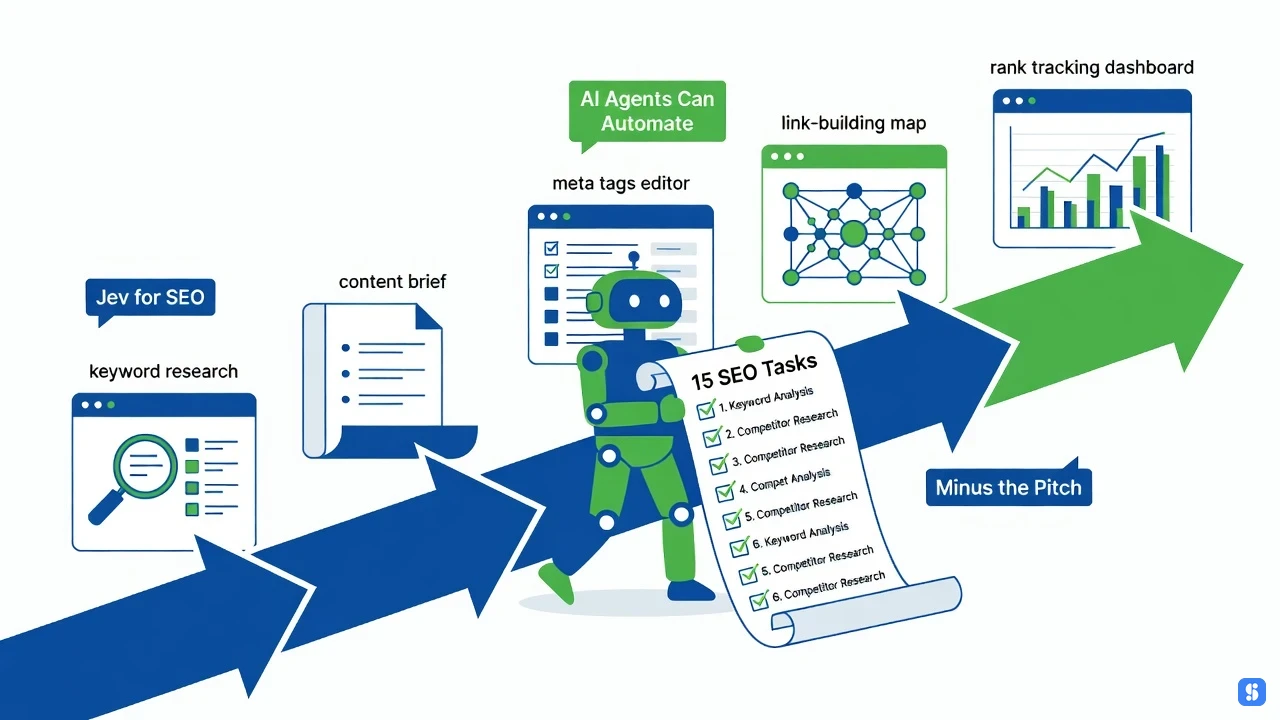
Jev for SEO: 15 SEO Tasks AI Agents Can Automate, Minus the Pitch
Ask an AI SEO agent what it changed and you get a log line. Ask whether any of it survived a month of crawling, editorial edits, and a site migration, and you get silence. That gap is the real argument about Jev for SEO: 15 SEO Tasks AI Agents Can Automate. It's a measurement problem before it's a tooling problem, and most teams never get past the tooling.
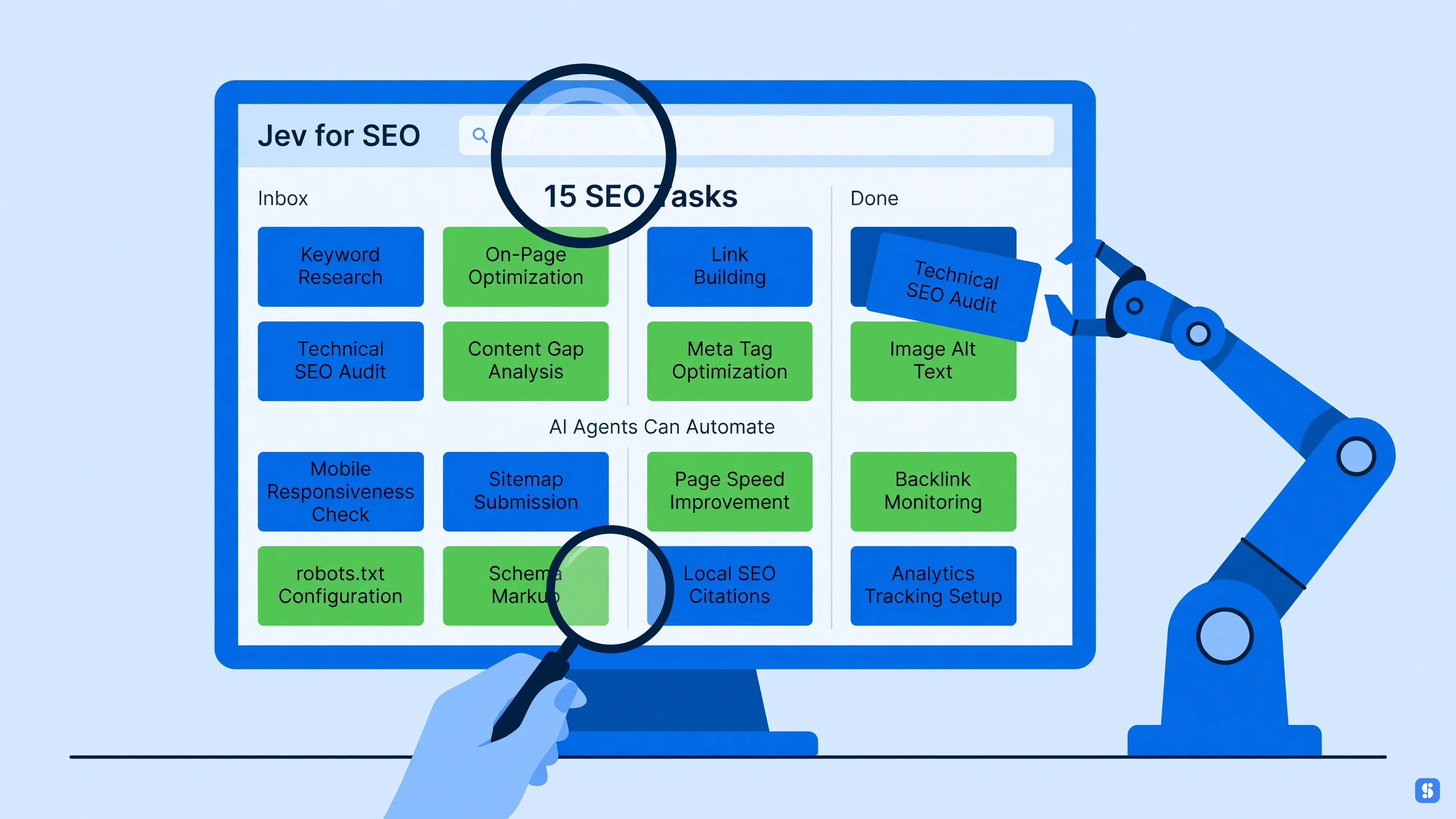
The 15-task lists overlap heavily: internal linking automation, keyword research and clustering, on-page optimization, technical SEO audits, schema markup generation, cannibalization detection, thin-content pruning, AI citation tracking. They recur because a crawler, a diff, or a query can validate the output. When the work needs taste instead, you get something plausible and spend the saved hours reviewing it. I've done that review. It is not a good trade. (related: Azuqe for Operations, Standardize Content Calendars & Tasks)
Scope decides more than model choice. A site's total addressable map, every URL, the queries it could win, the internal paths between them, is bigger than the team assumed when it handed over credentials. TAM here means the market you can actually reach. Agents fail at the edges: orphaned pages, near-duplicate posts, unclaimed translated URLs, tag archives that should have been noindexed two years ago. Draw the map first. Otherwise week one is the agent rediscovering your sitemap and calling it a win. (related: Azuqe, AI Audits, Keyword Research &)
Rewriting sentences shows the seam fastest. Title tags and meta descriptions are easy to generate and hard to judge. A rewrite can tighten a snippet while deleting the entity the page ranked for. Diff those sentences against the query they serve, not against house style.
Then the no-keyword pages: tag archives, thank-you pages, launch posts with no mapped query. Agents love them because there's no keyword to violate, humans ignore them because there's no visible upside. Both are wrong. They still get crawled, absorb internal links, and compete with the pages you care about. That competition is invisible until a ranking drops.
SOPs meaning here is narrow: documented steps, a named owner, a stop condition. Without a stop condition, an agent optimizes a page until someone notices the H1 reads like a press release. I have seen that happen twice. Write the procedure so the agent stops at a checkable artifact and a human signs off on anything that changes meaning.
The benchmark scores and per-decision cost claims floating around these SEO tools come from vendor harnesses run against vendor definitions of a correct decision. Nobody outside has reproduced them. That makes "automate 15 tasks" a capability claim, not a results claim. The distinction matters more than the number. Vendors test the narrow version where the answer set is fixed in advance. Your site is not that.
Where automation holds, it's duller than the pitch. Nightly crawls. Link suggestions approved from a queue. Structured data generated from a template and validated by rich results. Cannibalization flags routed to an editor instead of auto-fixed. If that queue-and-diff pattern is what you're wiring up, Azuqe for Operations, Standardize Content Calendars & Tasks covers the handoffs, and Why Did My Google Traffic Drop 15 Reasons And How To Fix It is the diagnostic for when an agent's changes correlate with a decline you can't explain.
The 15 tasks aren't the problem, the framing is. Treat each as a candidate for delegation with a verification step bolted on and the list earns its keep. Switch them all on and step away, and you'll be the person explaining why the site has thousands of new internal links and fewer rankings than last quarter.
Key Takeaways
Nothing on this list fails loudly. It fails quietly: an agent rebuilds internal linking across a few hundred pages, nobody reads the map, and three weeks later a traffic drop looks like it came from nowhere. Treat Jev for SEO: 15 SEO Tasks AI Agents Can Automate as a menu, not a mandate. Most teams skip that step and pay for it later.
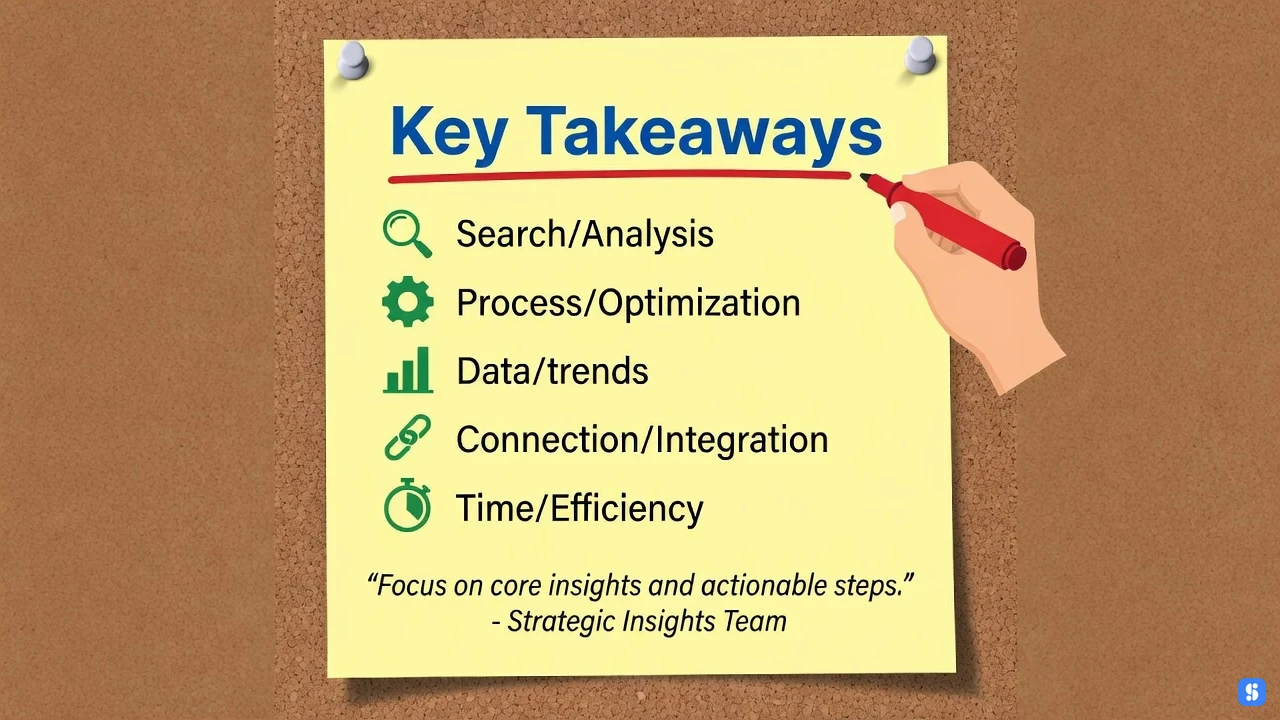
- Rule-bound, high-volume work holds up: internal linking, keyword clustering, schema markup, cannibalization detection.
- Judgment work does not: intent, brand voice, whether a page deserves to exist.
- Technical SEO and thin-content pruning pay off on a weekly review cycle. Nightly runs with no review are how mistakes compound.
- GEO and AI citation tracking are the least mature items here, and the ones most oversold.
If you only automate three things this quarter, pick the cheap and reversible ones.
Of the 15 SEO Tasks AI Agents Can Automate, Which Ones Earn Their Keep?
Line up the fifteen tasks in Jev for SEO: 15 SEO Tasks AI Agents Can Automate and you get roughly eight that earn their keep and seven that quietly cost more than they save. That split is not in the marketing. The dividing line is simple. Does the correct answer already exist before the agent starts?
Technical SEO audits, schema markup generation, internal linking, thin-content detection, cannibalization checks, and meta description variants all pass that test. The agent picks from a known set instead of inventing one.
Keyword research and clustering sits on the fence. An agent can group terms at scale, but it cannot tell you which cluster your brand is allowed to own. Anything needing a point of view, positioning, original data, or brand mentions worth citing, fails outright.
A workable AI SEO workflow puts the deterministic tasks on a nightly run and keeps judgment calls in a human review. That is a division of labor. It is not a headcount cut, and pretending otherwise is how teams lose people they needed.
Where Does Jev for SEO Quietly Break in Practice?
Demo and Monday morning diverge at the same three points, and the pattern is always the same. Jev for SEO: 15 SEO Tasks AI Agents Can Automate looks unstoppable on keyword research and internal linking, where the answer set is bounded and the machine can chew through 90% of pages. It stalls anywhere a decision needs a reason attached. The agent cannot give you one, so you end up writing the reason yourself.
Schema markup gets generated for pages that will never earn a rich result. Technical SEO audits surface duplicates the CMS created on purpose. Meta descriptions come back technically accurate and lifeless, so CTR sags. Cannibalization detection flags two pages ranking fine together, and someone deletes the wrong one. I have cleaned up after that last one.
The fix is unglamorous. Keep a human gate on anything customer-facing: meta descriptions, brand mentions copy, structured data types you cannot verify. Log every refusal instead of accepting it. Then read those logs weekly, not monthly. A bounded seo workflow with a review step beats an unsupervised one.
How Do You Define GEO, and Why Does It Change the Task List?
GEO is where the bill stops being predictable, and it is the reason half of Jev for SEO: 15 SEO Tasks AI Agents Can Automate exists at all. Generative Engine Optimization means getting your brand pulled into an AI answer instead of ranked in a list of ten blue links. That one shift moves the unit of work from a page to a passage, and most teams have not made that move yet.
Rank tracking becomes citation tracking. Keyword research turns into question fan-out, where one head term spawns dozens of sub-questions an engine can cite separately. Schema markup and structured data stop being polish and become entity disambiguation. None of that is optional anymore. And technical SEO now includes making content cheap enough to fetch and parse that an engine bothers.
Internal linking, meta descriptions and clustering survive mostly unchanged. Citation monitoring doesn't, and nobody has a clean SOP for it yet. GEO doesn't replace the old task list. It stacks on top of it.
An unattended agent is faster than you and just as confident when it's wrong, so an SOP only earns its keep if the bad runs are cheap to catch. The version that holds for Jev for SEO: 15 SEO Tasks AI Agents Can Automate is unglamorous: one agent, one job, one human checkpoint before anything ships.
In practice that chain is keyword research and clustering into briefs, briefs into schema markup and meta descriptions, then a writer. Internal linking runs weekly, after the link map stops changing, never mid-rebuild.
Two rules matter:
- Anything touching a live URL gets a diff review first.
- Structured data gets validated before deploy. Broken schema markup is worse than none.
Log every run: what it changed, what it refused, why. When traffic dips later, that log is what tells you whether the agent did it, which is why why did my Google traffic drop starts with it.
What Are the Most Common Mistakes When Agents Run Unattended?
Unattended agents fail at the edges of their own rules, not in the middle. Run Jev for SEO: 15 SEO Tasks AI Agents Can Automate as a nightly job and the mechanism is always the same: it optimizes toward whatever signal it can read, and quietly misreads everything it cannot.
The repeat offenders:
- Rewriting meta descriptions on pages already earning clicks. Nothing breaks. The numbers just drift down.
- Keyword research without intent checks. Clusters get built from volume alone, so commercial and informational terms land in one brief.
- Internal linking that ignores page priority. Every orphan gets a link, including the ones you wanted gone.
- Schema markup pushed without validation. Structured data that contradicts the visible page gets ignored, and nobody tells you.
Log every change with the old value attached. In an unattended SEO workflow, the diff is your only alibi.
Where Does a Platform Like Azuqe Actually Fit?
Here's the honest framing. Agents are good at narrow, deterministic jobs: internal linking maps, schema markup, cannibalization sweeps. They're bad at remembering what they did last week. That gap is where a platform fits. Azuqe runs continuous site audits, tracks brand mentions across Google and AI answer engines, and rolls both into a single visibility score, so the fifteen SEO tasks AI agents can automate have somewhere to land instead of scattering across tabs.
Where it doesn't fit: deep keyword research and backlink prospecting still belong in dedicated SEO tools built for exactly that, and no agent replaces the judgement call on which pages deserve links. Azuqe's pull is the unglamorous middle: automatic fixes without a developer, Azuqe for Operations, Standardize Content Calendars & Tasks, and content briefs with real citations. Pro runs $49/seat/mo, Max $149/seat/mo, with a 5-day free trial.
Frequently Asked Questions
Every question below comes down to the same tradeoff: agents are cheap and fast where the answer space is closed and verifiable, and unreliable where a task needs taste or context. Most bad experiences with Jev for SEO: 15 SEO Tasks AI Agents Can Automate come from pointing a closed-world tool at an open-world problem.
Is Jev AI SEO better than other AI SEO tools?
Better at a narrow band, worse nearly everywhere else, and the band is narrower than the marketing suggests. It is strong where the possible answers are known in advance: internal linking at scale, schema generation, cannibalization detection, thin-page flagging. It cannot write a word, cannot explain its reasoning, and stalls the moment a task needs judgment it was not given.
So better depends on the comparison. Against a general model on an open-ended content task, it loses. On a mechanical job run nightly across thousands of URLs, the general model is the expensive choice, and that cost gap is the entire pitch. It just applies to maybe six of the fifteen tasks.
Where do Search Console, Ahrefs or Semrush stop and an AI agent start?
They stop at measurement. Search Console reports what already happened on Google. Ahrefs and Semrush hand you queryable datasets for keyword research, backlinks, and competitive gaps. None of them act. You read, then you go make the change in a CMS or a theme file.
An agent starts where the action is machine-verifiable and reversible: emitting structured data, rebuilding internal links across a template, flagging near-duplicate URLs, drafting meta descriptions for review. Not strategy, and nothing you cannot roll back.
One boundary worth naming. Search Console only sees visits that arrived as a search result. Someone who opens a browser to "search google or type a url" and clicks a bookmark never shows up in that data, so the intent picture you hand the agent is already partial. The agent inherits the blind spot and acts on it confidently.
How do you build an AI SEO agent from scratch?
Pick one task, not a whole SEO workflow. Then:
- Define the exact input and output. If you cannot express the output as structured data, the task is too fuzzy for an agent.
- Hand-build an eval set of 30 to 50 examples you have already graded.
- Wire it read-only first and let it produce recommendations for a month before it writes anything.
- Log every decision with the input behind it, so failures are findable.
- Gate writes behind a review queue, then relax the gate only where the eval set holds.
Start with internal linking or schema markup. Both have verifiable outputs and both break loudly. Freshness checks are the classic trap in the other direction: ask an agent to google how old a page is and it will trust a last-modified header from 2019 while the copy was rewritten last month. Any task where the ground truth lives in a field instead of the rendered page is suspect.
Whether this is worth building in-house versus buying, I honestly do not know. If your team already runs a documented SEO workflow, an agent is a small addition. If it does not, you are automating chaos and you get faster chaos.
How long before an AI SEO agent shows results?
It splits by task type. Fixes that only need Google to re-crawl and re-evaluate, such as structured data errors, broken internal links, or duplicate titles, can move within days to a few weeks. Anything touching rankings for competitive head terms takes a quarter or more, and by then you have shipped fifteen other things, so attribution becomes storytelling. If traffic dropped and you cannot tell why, that diagnostic work comes before the agent work.
What you can measure honestly: pages fixed, links corrected, and how often AI answers now mention the brand. Brand mentions move faster than rankings, and they are the part of the list most teams under-track.
Conclusion
Jev for SEO: 15 SEO Tasks AI Agents Can Automate is worth the setup only if you accept the tradeoff: you swap hours of manual work for a smaller stack of judgment calls you cannot delegate. Keyword research, schema markup, meta descriptions, and internal linking run fine unattended.
Cannibalization and thin-content pruning need a human, because a model that prunes a duplicate it misread costs more to undo than the task saved. Keep the narrow wins, skip the bold claims, and audit output weekly instead of trusting the pitch. When rankings slip, work backwards before rewriting anything, as in this traffic drop breakdown.
Start small. Automate one task, measure it for a month, then add the next.
From our experience
In running Azuqe, we've found that AIM coordinates a team of specialized SEO agents, Scout, Scribe, Medic, Sleuth, Herald, and Sentinel, to handle keyword analysis, content optimization, technical diagnostics, competitive intel, and publishing guidance.
We've seen that automated performance audits check Core Web Vitals across mobile and desktop at once and return clear steps to improve load times, without needing a headless testing setup.
One honest limitation we've run into: AI Visibility runs only cover ChatGPT, Gemini, and DeepSeek on Pro and Max plans, even though our marketing shows support for eight engines.
Our users consistently tell us that slow indexing of new pages and the lack of automated technical fixes are real pain points, which is part of why we lean on agents like Medic and Sentinel.
We've also learned the hard way that our free trial only applies to the first website, additional sites are charged immediately, and billing is monthly only with no annual or prepay discount.