Why your SEO strategy is Broken without Continuous Site Audits
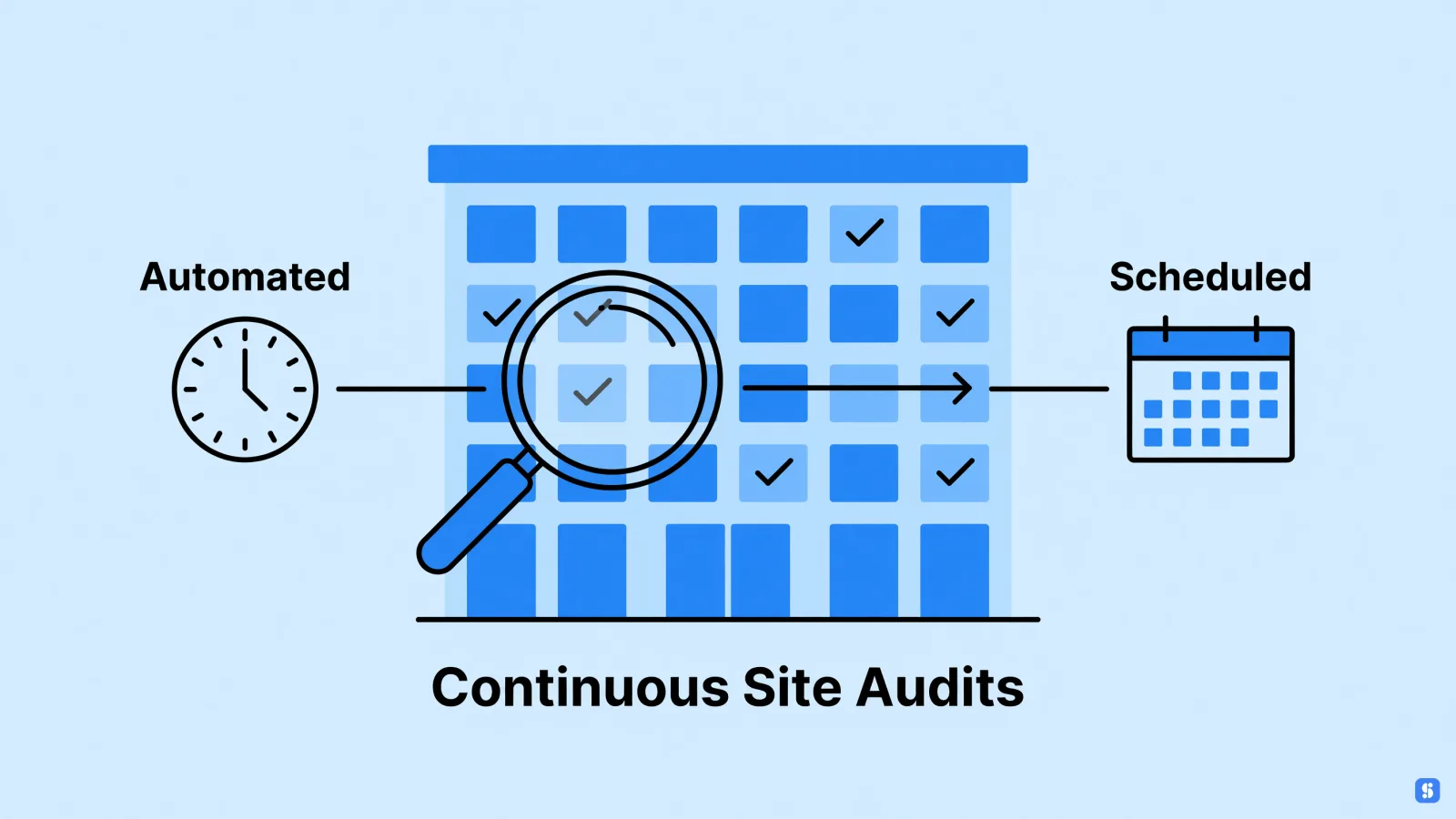
Continuous site audits are the only way to keep up with how fast a live site actually changes. They run on a schedule, check your technical health automatically, and flag new problems the moment they appear. A one-off crawl is a snapshot, and it goes stale within days. Ship a new page, swap a template, or let a plugin update itself, and that snapshot starts lying to you.
Annual or quarterly audits tell you what was broken two months ago, not what is broken right now. You want a system that tells you what broke since yesterday, not a report. (see Azuqe for Agencies, Manage Multiple Client Sites)
The difference between a One-Time Audit and a Continuous One
A one-time audit crawls your site, dumps findings into a PDF, and then everyone forgets about it until the next scheduled panic. A continuous audit runs on a schedule, watches the same set of technical checks, and surfaces new issues as they appear. (source: Introducing the AI)
Skipping continuous audits compounds. A broken internal link here, a missing meta description there, and your crawl budget evaporates on error pages instead of pages that could rank.
How Often should You Actually Run a Site Audit?
Run one every time you publish or after any significant site change, and at minimum weekly for your core crawl. Daily is overkill for most sites unless you are at enterprise scale. (see Azuqe for Agencies, Manage Multiple Client Sites)
On Azuqe's SEO Max plan, continuous audits run up to 30 times per month per site, which is enough for daily checks during active publishing sprints. You're not trying to audit more. You're trying to catch what broke since yesterday, so a small issue never becomes a ranking problem.

crawling spider icon
Key Takeaways: what You need to Remember about Continuous Site Audits
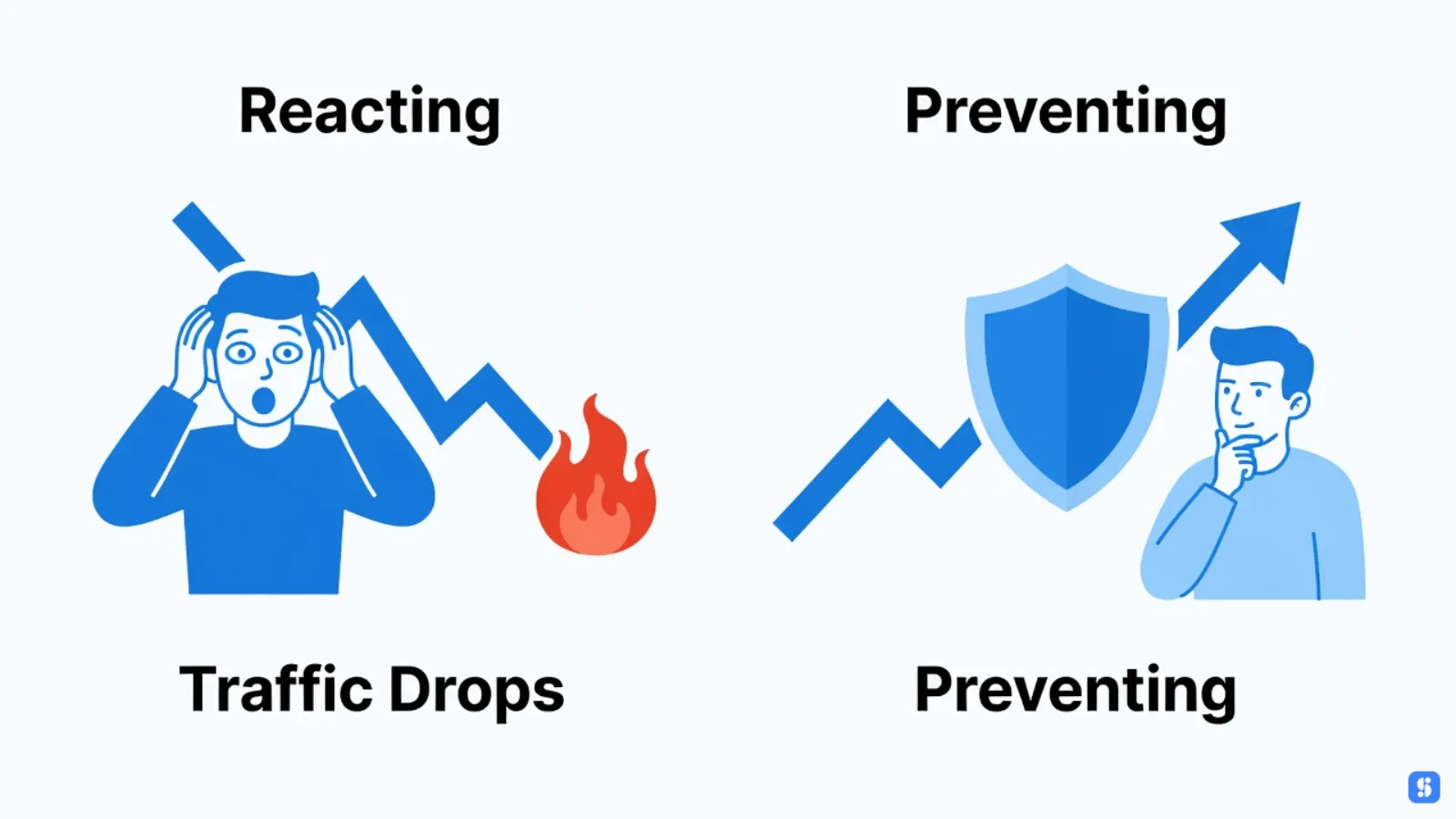
Continuous site audits let you prevent a traffic drop instead of reacting to one. But after running them for a while, you learn the audit isn't the deliverable. The fix is. (source: SEO AI Visibility | Lead the Search &)
Most technical SEO issues come from changes you make, not from tools discovering them. A template swap, a redirect rule, a plugin update, the next crawl catches your own mistake before Google does. (source: Profound Alternative for Page-Level Website Audits)
AI visibility sits on a separate layer from classic SEO. You can have a perfect Google score and be invisible to ChatGPT and Gemini. A continuous audit that works checks both, because fixing one won't fix the other.
Automation only works if it ends in a fix. A report that needs a developer to interpret it becomes a bottleneck. The Fix Center is the actual product here. (source: The AI Visibility Audit: How to Check)
You don't need more data. You need fewer, prioritized actions. A unified score tells you what matters right now, so you can ignore the rest.
What Actually Breaks on your Site between Audits
Continuous Site Audits exist because the gap between manual checks is where rankings quietly die. The issues that show up are rarely dramatic. They're boring, cumulative failures that only surface once they've already cost you.
The Silent Killers: Crawl errors and Orphan Pages
The usual suspects between audits:
404s from deleted products, especially pages that still have backlinks. One good 404 bleeds authority slowly.
Redirect chains from URL changes. Link equity leaks at every hop.
Orphan pages after a nav redesign. The content exists, but nothing links to it, so search engines treat it like it does not exist.
Slow pages from unoptimized images. Nothing crashed. It just got worse.
None of these trigger alerts in analytics. They're silent by design. A continuous audit surfaces the delta between last week and this week so you can fix a redirect chain before it becomes a ranking loss. Azuqe's automatic site audit tracks these changes and routes them to a Fix Center.
shield icon
Why your AI Visibility Score Drops without You Touching a Thing
AI visibility fails differently. ChatGPT and Gemini don't crawl your site the way Google does. They rely on citations and mentions across the web. If a key article loses its citation source, or a mention gets replaced by a competitor, your visibility in AI answers drops while your Google rankings stay fine.
That's why Azuqe tracks a separate AI visibility score. The fix for AI invisibility isn't a meta tag. It's a citation strategy. You can't fix what you can't see, and a continuous audit is how you catch that delta early.
Step 4: Track the Unified Score, not Individual Metrics
The final step is what makes Continuous Site Audits sustainable: stop tracking fifty metrics and track one unified score. A unified score blends your Google rankings with AI visibility across ChatGPT, Gemini, and similar engines. When the score drops, investigate. When it holds, you're fine. That's the only way to run continuous audits without alert fatigue.
Azuqe's Unified SEO & AI Visibility Score does exactly that. It gives you a single number that reflects both classic SERP performance and AI answer engine recommendations. Instead of asking "did this meta description change hurt us?", you ask "did the score move?" and dig in only when it does.
And this closes the loop on automation. Automation isn't about running the crawl on a schedule. It's about connecting detection to fix to verification. The Azuqe Fix Center handles the remediation, and the unified score verifies the fix actually moved the needle. Watch one number, trust the system, and intervene only when that number tells you to.
The Automatic Fix Center: why Detection without Fixes is Just a Report
Continuous Site Audits only earn their keep when findings turn into fixes. The Automatic Fix Center is the difference between a tool that tells you what's wrong and one that makes it right.
It automates the technical fixes that eat your week: 301 redirects, canonical tags, meta description rewrites, structured data corrections. For marketing teams without a developer on call, this is the unlock. You don't file a ticket for a redirect. You review the change, click fix, and it ships.
What the Fix Center can Automate for You
The loop works like this: the audit finds an issue, the Fix Center proposes the exact change, you approve it, the fix is applied, and the next audit run verifies it. No spreadsheet handoff.
Compare that with the manual alternative. An SEO manager exports an issue list, emails the dev team, follows up twice, and the redirect ships two weeks later. By then the 404 has been costing rankings for a month.
When You Still need a Human (and a Developer)
The honest tradeoff: not everything can be automated. If your site has a fundamental architecture problem, like a JavaScript-rendered site crawlers can't read, no fix center saves you. That needs a developer. The Fix Center handles recurring, well-understood errors. It doesn't pretend to be an engineer.
Use Azuqe for mechanical fixes, and budget your developers for the problems that aren't.
How does a Continuous Site Audit Differ from an AI Visibility Audit?
A Continuous Site Audit measures how well your site is built. An AI visibility audit measures how often your brand gets named. Mix the two up and an SEO team ends up with a flawless technical setup and zero brand mentions in AI answers.
Traditional SEO audits check technical health: crawlability, indexation, page speed, internal linking. AI visibility audits check something else entirely: whether ChatGPT, Gemini, or DeepSeek recommend your brand when users ask questions.
The mechanics differ too. Google discovers your site through links and sitemaps. AI engines build answers from the corpus of the web, which includes your content but also how others cite you. You cannot sitemap your way into an AI answer.
Google Crawls your Pages. AI Engines Cite your Brand.
Crawlability gets you into the index. Citations get you into the answer. One is a technical barrier, the other is a reputational one, and they call for different fixes.
What the Citation Ranking Dashboard Actually Tells You
The Citation Ranking Dashboard is Azuqe's answer to this. It tracks where your brand appears in AI-generated answers and which sources are being cited. This is not a vanity metric. It is a leading indicator of AI-driven traffic.
The practical implication: you can have a flawless technical audit and zero AI visibility. Track both, which is why Azuqe combines them into a single unified score. If you are only running a technical audit, you are flying blind on half of your organic presence.
Best practices for Maintaining Site Health over Time
Continuous Site Audits only earn their keep when they make you act faster. The trick is to fold them into workflows you already run, rather than treating them like a separate chore you check off once a week. After shipping this for a while, three practices keep coming back as the ones that matter.
Make the Audit part of your Publishing Workflow
Every time a new article goes live, the audit runs automatically. That way, issues surface while the change is still fresh in your head, and you can trace a problem in minutes instead of digging through weeks of history.
Set Alert Thresholds that Don't Desensitize You
If your inbox gets pinged for every slow page, you will start ignoring the alerts entirely. Instead, set alerts for a meaningful drop in the unified score, not for single-metric blips that resolve on their own.
Review the Unified Score Weekly, not Daily
A 15-minute weekly review of the trend line and the top fix-center items catches most problems before they ever touch your rankings. Daily checks just turn into background noise, and noise is where real issues hide.
Most users publish their first article the same day they sign up for Azuqe. That same speed should apply to fixes: if a fix takes longer than a week to ship, your process is the bottleneck. The goal is not zero issues. The goal is zero issues you don't know about.
Common mistakes that Make Continuous Site Audits Useless
Most teams break continuous site audits before the tool even gets a chance to work. The failures are rarely technical. They are process failures, and they tend to repeat in three predictable ways.
Mistake 1: Treating the Audit as a Quarterly Event
The most common mistake is running a full audit quarterly, exporting the PDF, and doing nothing until the next quarter rolls around. The audit becomes a ritual, not a system. If your audit does not feed into a fix workflow, it is a waste of money. A continuous audit only matters when the output lands somewhere actionable, like Azuqe's Fix Center, and actually gets resolved.
Mistake 2: Ignoring the AI Visibility Layer
Newer and more dangerous: assuming a strong Google ranking means you are visible everywhere. AI engines are a separate channel. If you are not tracking citations in ChatGPT and Gemini, you are missing the fastest-growing segment of organic discovery. Your Google rankings and your AI answer engine presence can diverge sharply, and a technical audit alone will not show you that gap.
Mistake 3: Chasing Every issue Instead of the High-Impact Ones
The perfectionist trap. Teams try to fix every flagged issue and burn out. Tools like Azuqe help by surfacing only issues that matter, but you still need the discipline to ignore the low-impact ones. Prioritize what affects revenue, crawlability, or citations. Skip the rest.
The unflattering truth: most audit failures are not tool failures. They are process failures. The tool works. The team does not act on it. So if you only take one thing from this section, take this: an audit without a fix workflow is a screenshot of a problem you already knew you had.
Frequently Asked questions about Continuous Site Audits
Continuous Site Audits sound more complicated than they are. These are the questions marketing teams actually ask us, answered directly.
What is a continuous site audit?
A continuous site audit is an automated, recurring scan for technical issues like broken links, crawl errors, missing metadata, and schema problems. Instead of running once as a one-time project, it runs on a schedule so problems get caught the day they appear, not the month after.
How often should you perform a site audit?
At minimum, weekly. If you publish daily or run frequent promotions, audit daily. Azuqe's SEO Max plan includes up to 30 audits per month, which covers daily checks for most sites without burning engineering time.
What are the key components of a continuous site audit?
Crawlability checks, indexation status, internal link integrity, page speed signals, structured data validation, and increasingly, AI visibility tracking across engines like ChatGPT and Gemini. The last one matters more every quarter, and most traditional audit tools still ignore it.
How can you check if AI assistants recommend your site?
Use a citation tracking tool. Azuqe's Citation Ranking Dashboard monitors where your brand appears in AI-generated answers and which sources are being cited, so you can see whether ChatGPT and Gemini actually reference your content. Most teams are surprised by what they find.
How do you prioritize issues found in a site audit?
By business impact, not severity score. A 404 on a revenue page matters more than a slow blog post. The Automatic Fix Center handles the common fixes automatically, so you only spend human time on the complex problems that actually need judgment.
Conclusion: Stop Auditing, Start Fixing
Continuous Site Audits only earn their keep when they feed into a fix workflow. Detection without remediation is just a report, and you already have too many of those.
The next step is concrete. Set an audit schedule that matches your publishing velocity, connect it to a fix center that automates the recurring issues, and track the unified score that blends Google and AI visibility so nothing slips through. Azuqe does all three in one workspace.
You do not have an SEO problem. You have a workflow problem. The audit is not the product. The fix is.
Try the 5-day free trial on your first website. Most users publish their first article the same day they sign up. Your fixes should move just as fast.
From our experience
In running continuous site audits, we've seen the Fix Center become the most-used feature, clients catch technical issues like broken schema or slow Core Web Vitals before they ever dent their unified visibility score.
We've noticed that pairing continuous audits with our AI Visibility Tracking reveals a pattern: sites that fix technical debt quickly tend to hold their rankings in ChatGPT and Gemini, not just Google, but the audits only cover those three engines on Pro/Max, so users on lower tiers miss that insight.
Our users consistently tell us the hardest part isn't finding issues, it's prioritizing them; the audit's automatic fix suggestions cut that decision time dramatically, though we admit the monthly-only billing means some teams hesitate to scale beyond their first site.
One honest limitation we've observed: continuous audits flag hundreds of minor issues on larger sites, and without a developer, the Fix Center handles most, but we still see users overwhelmed by the volume, so we've learned to surface only the top-impact fixes by default.
Integrating Google Search Console and GA4 into the audit loop gives a clearer picture of what actually matters, but the free trial only covering your first website means agencies testing us on multiple client sites hit a paywall sooner than they'd like.