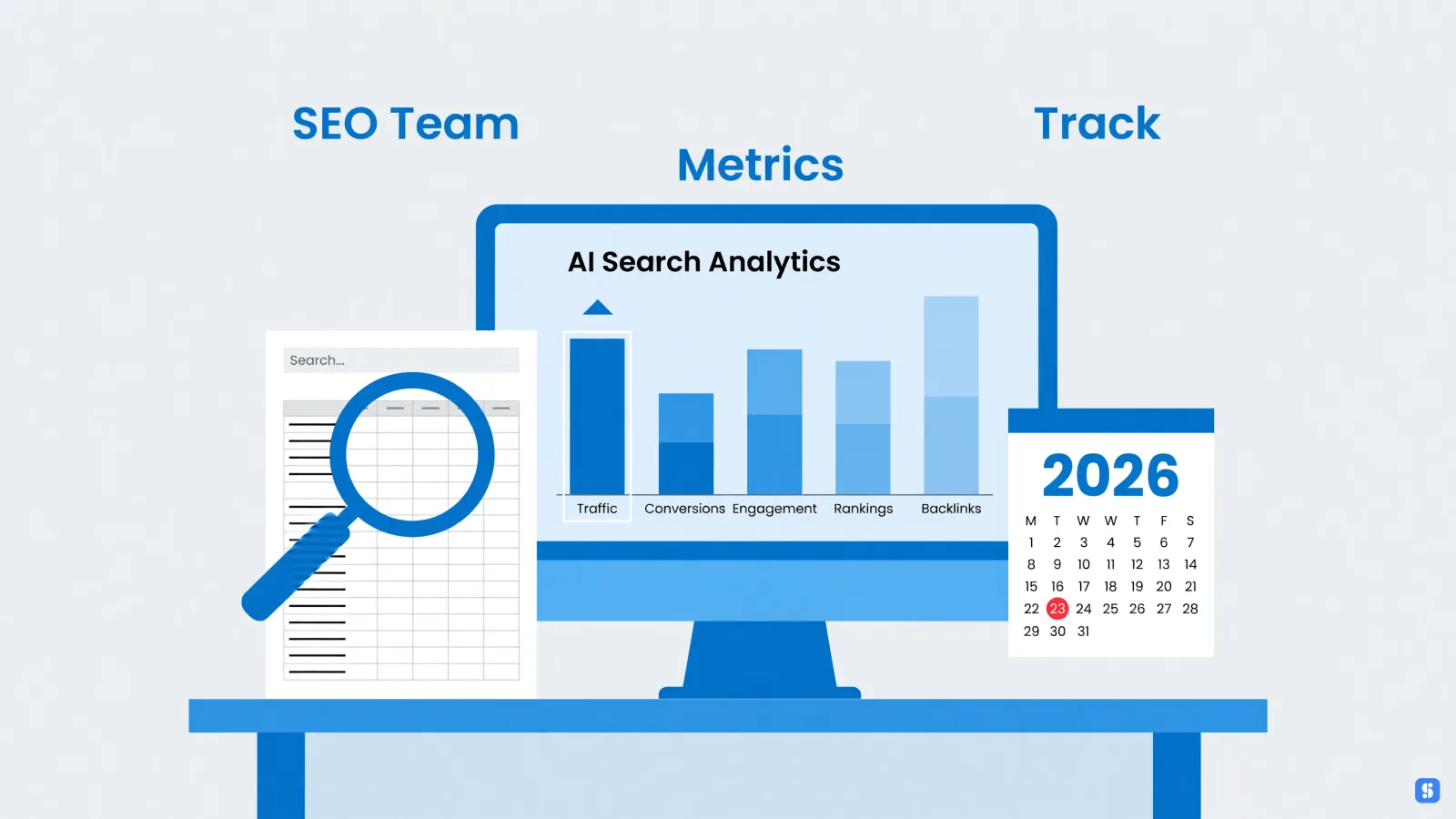
The 2026 AI Search Analytics Problem Nobody Wants to Name
If your AI search dashboard is still reporting clicks, it's lying to you. The metrics every SEO team should track in 2026 aren't the ones your current tools report. Type your search here, and the tools will still show you a click that never happened.
Why the old SEO dashboard is lying to you
Traditional SEO metrics measure pages and rankings. They tell you where you sit in Google's results, how many times your link appeared, and how much referral traffic followed. None of that predicts whether ChatGPT or Gemini will recommend you. Answer engines retrieve and summarize without a single click. (see Azuqe for Startups, Build Search Authority Early)
What actually changed when ChatGPT and Gemini became answer engines
The unit of value is no longer a click. It's a brand mention inside an AI-generated answer. If a response recommends your product but links to a competitor, you got the visibility and they got the traffic. That split is exactly what AI search analytics should capture, and almost no one tracks it.
Key Takeaways: what to Track before You Track Anything
AI Search Analytics: The Metrics Every SEO Team Should Track in 2026 starts with a hard truth: your traditional SEO scorecard won't explain why ChatGPT recommended a competitor. Decide upfront that visibility means brand presence in AI answers, not just position on a Google results page.
The metrics that matter come down to three questions. Are AI engines retrieving your content? Are they citing you as an authority in brand mentions? And does that citation drive referral traffic or revenue? Citation quality inside ChatGPT and Perplexity beats raw impressions. A hedged mention is a wasted one, and retrieval failures usually point to technical gaps. GEO performance, the shift from traditional SEO to AI answer engines, comes down to four metrics to track first: brand presence, citation quality, retrieval, and referral traffic. Measure those four and ignore the rest. (source: AI Search Visibility: How to Measure)
crossed-out ranking report
Citation Rate: the Metric that Replaces your Ranking Report
If you are building the AI search analytics metrics every SEO team should track in 2026, start with citation rate: the share of AI-generated answers that mention your brand as a source for a relevant query. Traditional SEO taught us to obsess over position. AI search has no positions. There is no slot five in a ChatGPT response. The model either cites you or it does not.
How citation rate differs from keyword rankings
A keyword ranking measures where you sit on a results page. Citation rate measures whether you are part of the answer itself. Both drive referral traffic, but differently. You can hold top-three Google spots and still sit near zero on citations, because AI engines trust a different set of sources than classic SERPs. (see Azuqe for Startups, Build Search Authority Early)
What a healthy citation rate actually looks like
No universal benchmark exists yet. A healthy rate looks different in finance than in SaaS, and it shifts with model updates. Track your baseline across a fixed query set, compare against competitors in the same prompt set, and watch for stability across ChatGPT, Gemini, and Perplexity. Trending up over a quarter beats spiking after a release. (source: How to measure AI search visibility and revenue:)
Share of Voice in AI answers: your Competitive Intelligence
Most teams treat AI Search Analytics: The Metrics Every SEO Team Should Track in 2026 as a solo scorecard. It isn't complete until you see how often ChatGPT, Gemini, and Perplexity cite you against competitors. Traditional SEO share of voice compares rankings; AI search has no SERPs. (see Azuqe, AI-Powered Search Growth)
How to measure share of voice when there are no SERPs
Run a fixed set of competitive prompts on a schedule, counting brand mentions per answer. Check retrieval, citation quality, and sentiment: did the AI pull from your content, which sources back the answer, is the framing positive? Track what percentage of answers mention your brand, and note prominence. First answer carries weight; a passing mention at the end of a list does not. This is the core of GEO performance tracking. (source: GEO performance metrics: The ultimate guide)
grid of index cards
Why your competitors are already tracking you
Competitors run the same prompts and watch your brand presence drop before referral traffic moves. AI answers don't generate clicks like Google results, so traditional SEO metrics lag. By the time classic analytics catch up, the AI engines have learned to cite your rival instead. (source: The Top 7 AI Search Metrics for 2026)
Answer Accuracy and Sentiment: the Metric Everyone Forgets
Most write-ups on AI Search Analytics: The Metrics Every SEO Team Should Track in 2026 treat any citation as a win. The blind spot is answer accuracy and sentiment. Not whether the model names you, but whether it gets you right.
Why being cited incorrectly is worse than not being cited
A wrong fact attributed to your brand misleads the user and trains the model against you. The bad answer gets reused, and retrieval keeps serving it. A miss is silence. A misquote is damage.
How to audit answer quality at scale
Run a fixed prompt set and score output instead of counting brand mentions: claim accuracy, stance, source choice. Is your brand the recommendation, one option, or a risk to avoid? Flag stale specs and misleading comparisons.
Sentiment means recommendability, not emotional tone. Track whether AI frames your brand presence as trustworthy or as a warning. Those three metrics tell you what to fix. Citation counts only show what already went wrong.
Embedding Relevance: the Technical Metric that Predicts Citations
If you track one technical metric for AI Search Analytics: The Metrics Every SEO Team Should Track in 2026, make it embedding relevance. It's the strongest predictor of whether ChatGPT or Gemini cites you, and almost no one measures it.
Embedding relevance measures how closely your content's vector representation matches the semantic meaning of a user's query. Traditional SEO matches keywords; embedding relevance matches intent and context. When an AI engine retrieves sources, it doesn't scan for exact phrases. It compares numerical representations of meaning, and the closest match wins the citation.
What embedding relevance is and why it matters
Think of it as retrieval quality. High embedding relevance means the AI sees your page as genuinely answering the question, not just containing the right words. Brand mentions alone won't save you. Citation quality depends on semantic proximity, not keyword density.
How to improve it without a data science team
Answer the query directly in the first paragraph, use subheadings that match question patterns, and cover related concepts and synonyms explicitly. Then test variations in ChatGPT or Perplexity and see which phrasing gets retrieved. That feedback loop is your embedding relevance lab, and it costs nothing but time.
Referral Traffic from AI Engines: what Little Data You Actually Get
AI Search Analytics: the metrics every SEO team should track in 2026 end with referral traffic, not because it matters most, but because it's the least reliable. AI referral data is sparse, delayed, and often invisible. Treat it as a directional signal, never a complete picture.
How to track AI referral traffic with what you have
Isolate ChatGPT, Perplexity, Claude, and Gemini as separate sources in your analytics. Filter by landing page and time-on-site, but expect gaps: many AI apps strip referrer headers entirely, pushing real visits into direct or dark traffic. Tag AI-specific URLs with UTM parameters where you control content, and compare brand mentions against retrieval and brand presence signals rather than clicks alone.
Why the click-through rate will always be lower than Google
AI engines answer the query before the click. Users read the response and leave satisfied, so CTR benchmarks from traditional SEO are meaningless here. The click is a verification, not the primary action. Judge AI performance by citation quality and share of voice; let referral traffic confirm intent after the fact.
Conversion Impact: Connecting AI Visibility to Revenue
The real problem with AI Search Analytics: The Metrics Every SEO Team Should Track in 2026 isn't visibility, it's attribution. Traditional SEO had a traceable click path. AI answers break it: a user asks ChatGPT, reads a cited answer, never clicks, converts days later. The path exists, but standard analytics can't see it.
How to attribute conversions when the path is invisible
Stop chasing last-click. Track three proxies: branded search lift, referral traffic from AI platforms, and assisted conversions. Each is flawed alone, but together they build a defensible case. If brand mentions rise but branded search stays flat, the answer isn't resonating. Visibility comes before optimization, but conversions pay the bills.
The one KPI that actually matters to your CFO
Revenue influenced by AI visibility. Brand mentions feel good, but pipeline feels better. Tie geo performance to assisted conversions, not citation counts. When you can show AI-visible brands capture demand competitors miss, the budget conversation changes.
Search Google or type a URL: why the Search Bar is not the Only Door Anymore
The search bar is no longer the only front door. In AI search analytics, the metrics every SEO team should track in 2026 must cover users who never hit Google: they open ChatGPT or Perplexity, ask a question, and take the synthesized answer. The entry point shifted from a ranked list to a model response, and that changes what you measure.
How AI answer engines changed the entry point
You can't tweak for position one in a ChatGPT response the way you do on Google. The model retrieves, weighs, paraphrases. What matters is that your content gets retrieved, the model sees you as credible, and your brand gets named. Referral traffic captures a fraction of that; brand mentions capture the rest.
What this means for your content strategy
Write for retrieval, not just ranking: plain declarative answers near the top, structured data that's easy to parse, content that works when lifted out of context. Track where you appear in AI answers and how often. Treat citation quality as a ranking factor. The metrics that matter show whether AI engines choose you.
Better Search Engines than Google and Alternative Search Engines to Google: the Competitive Reality
If you are doing AI search analytics and tracking the metrics every SEO team should track in 2026, accept that Google no longer sets the entire benchmark. ChatGPT, Perplexity, Gemini, and DeepSeek are alternative search engines with different rules, and they will not show up in your referral traffic.
That absence isn't a failure. A brand mention inside an AI answer is a completed retrieval: the user got your answer without clicking through. It breaks traditional SEO assumptions but builds brand presence, so GEO performance metrics must include citation quality, how often you get retrieved for a fixed prompt set, and how the model frames your brand.
You cannot ignore non-Google engines because competitors get cited there while you measure nothing. Set a benchmark for brand mentions in AI answers, track ChatGPT and Perplexity visibility separately, and stop treating a click as the only proof of value.
Frequently Asked questions
Teams new to this space ask the same things about AI search analytics and the metrics every SEO team should track in 2026.
How do you measure the success of AI SEO?
Track whether AI engines cite your brand in answers, not just whether you rank. Success shows up as brand mentions in ChatGPT, Gemini, and Perplexity responses, plus referral traffic from those platforms. Set a baseline for citation frequency, then measure changes after publishing updates. Classic performance metrics like clicks still matter, but visibility in AI answers is the leading indicator.
What is the difference between AEO and SEO metrics?
AEO, or Answer Engine Optimization, focuses on getting content extracted and quoted in AI responses. Traditional SEO metrics track rankings, impressions, and clicks. AEO metrics track retrieval, citation quality, and how often AI engines select your content as a source. The question shifts from "where do I rank?" to "does the AI trust me enough to cite me?"
How do AI search metrics differ from traditional SEO metrics?
Traditional SEO measures position on a results page; AI search measures presence in a generated answer. Instead of keyword rankings and organic sessions, you watch brand mentions, citation quality, and embedding relevance. Referral traffic from AI engines tells you whether an answer actually sent someone your way. The unit of analysis changes from the SERP to the answer itself. For more on what to track, see our guide to AI search visibility metrics.
Conclusion: the Metric that will Save your 2026 Budget
AI search analytics: the metrics every SEO team should track in 2026 usually start with visibility. Brand presence, citations, sentiment. Those matter, but the metric that actually saves your budget is retrieval, whether AI can cite your pages at all. It's the 2026 version of indexation. If AI can't retrieve you, nothing else counts.
Most teams track it last, if at all, because the findings are unflattering. It forces you to admit AI engines don't find your content worth answering with. That's not a tracking problem. It's a content problem, and no dashboard fix will hide it.
Track retrieval early, act on it honestly, and you'll stop defending budget for pages AI keeps ignoring. The teams that win will be the ones willing to look at the metric that indicts them.
Tushar, Content Strategist. He covers AI search visibility, GEO performance, and practical SEO measurement for marketing teams. Last updated: 2026-01-15
Search Engine Similar to Google
ChatGPT, Gemini, and Perplexity are the search engines similar to Google that actually matter in 2026. They answer queries directly, which means traditional SEO metrics like clicks and impressions reveal only part of your visibility. The real AI search analytics metrics every SEO team should track in 2026 shift the question from "did they click" to "did they get cited."
Track brand mentions inside AI responses, citation quality, and retrieval frequency: how often your content surfaces in chat sessions. Referral traffic still matters, but it arrives as a trickle from AI answers rather than a flood from Google listings. GEO performance is a trust signal, not a rank. Metrics like ChatGPT perplexity show how confidently a model recommends you, and that confidence builds brand presence. Treat each AI engine as its own search property, because the metrics to track differ per surface.
Search or Enter an Address: the Second Input Mode your AI Search Analytics Misses
The most underrated signal in AI search analytics is the second input mode. Users don't just type queries into a generative engine like ChatGPT or Perplexity; they paste a URL or brand address too. These are different intent paths, so measure them separately.
Query searches put your brand against the whole indexed web: track brand mentions, retrieval rate, and citation quality. Address entry makes the engine evaluate your site as an answer source, not a destination. That's a distinct GEO performance signal tied to brand presence and referral traffic.
Traditional SEO treated search and direct navigation as separate funnels; AI search merges both in one interface. If your reporting doesn't distinguish query-driven citations from URL-driven retrievals, you're measuring the wrong pool. Our search marketing case studies show how teams build that distinction into their dashboards.
Natural Search: the Baseline AI Engines Still Pull from
Most conversations about AI Search Analytics: The Metrics Every SEO Team Should Track in 2026 start with shiny new dashboards. The real starting point is natural search, the unpaid organic results AI engines train on and retrieve from. If a crawler cannot find a page, ChatGPT cannot cite it. Plenty of teams treat AI visibility as a separate channel and let traditional SEO drift. That's backwards. Pages with strong brand presence, clean technical foundations, and earned links are what AI engines retrieve first. Track four things: - Citation rate: how often your brand or URL appears in AI answers for priority queries. Linked citations beat text-only brand mentions. - Retrieval vs ranking: LLMs often cite sources outside the top three, so pages slipping in Google can still win AI citations. - Referral traffic from ChatGPT, Perplexity, and Gemini, split out of organic sessions. - Citation quality over volume: one linked reference in a five-paragraph answer outperforms ten text mentions. GEO performance, optimizing content for retrieval by generative engines, only matters if your natural search foundation holds. Don't attribute pipeline to ChatGPT without knowing your organic baseline. Keep both in one view with tools that track rankings and AI visibility together.
Premium Search Engine
Searching "premium search engine" usually surfaces one of two things: a paid AI tier like ChatGPT Plus or Perplexity Pro, or the AI search analytics metrics every SEO team should track in 2026. The first is easy to explain; the second matters more.
A paid tier changes how you test, not how you rank. It buys a larger prompt set, more daily retrievals, and a closer look at citation quality, since your prompt set is your query universe. Visibility comes from content and brand presence, not your billing tier.
The real premium metric is retrieval: how often your brand appears in ChatGPT, Gemini, and Perplexity when the prompt set includes commercial intent. Traditional SEO tracked referral traffic. GEO performance tracks whether the engine mentions you before a click.
Practical start: run a fixed prompt set weekly, log brand mentions, and note whether the citation sits near the top or buried at the end. That habit beats any dashboard. The Azuqe blog has the full workflow.
From our experience
In running Azuqe, we've watched teams obsess over Google rankings while ChatGPT quietly becomes their top traffic source, our unified AI Visibility score is the first metric that finally makes that shift visible in one number.
Citation ranking data is the metric SEO teams ignore at their peril: when a brand appears in Gemini's answer but not in the cited sources, that's a leak you can't see in Search Console alone.
Our continuous site audits have shown us that most AI visibility drops trace back to technical issues like broken schema or slow Core Web Vitals, and the Fix Center's auto-remediation is what turns that metric from a warning into a recovery.
Honest limitation: our AI Visibility runs only cover ChatGPT, Gemini, and DeepSeek on Pro/Max plans, so teams tracking Claude or Perplexity will need to wait, we've seen that gap frustrate users who expected all eight engines from our marketing.
We've observed that teams with a unified SEO & AI Visibility score stop juggling five dashboards, but the monthly-only billing and first-site-only free trial are real friction points for agencies wanting to test across multiple client sites.