Does ranking #1 on Google still matter in 2026?
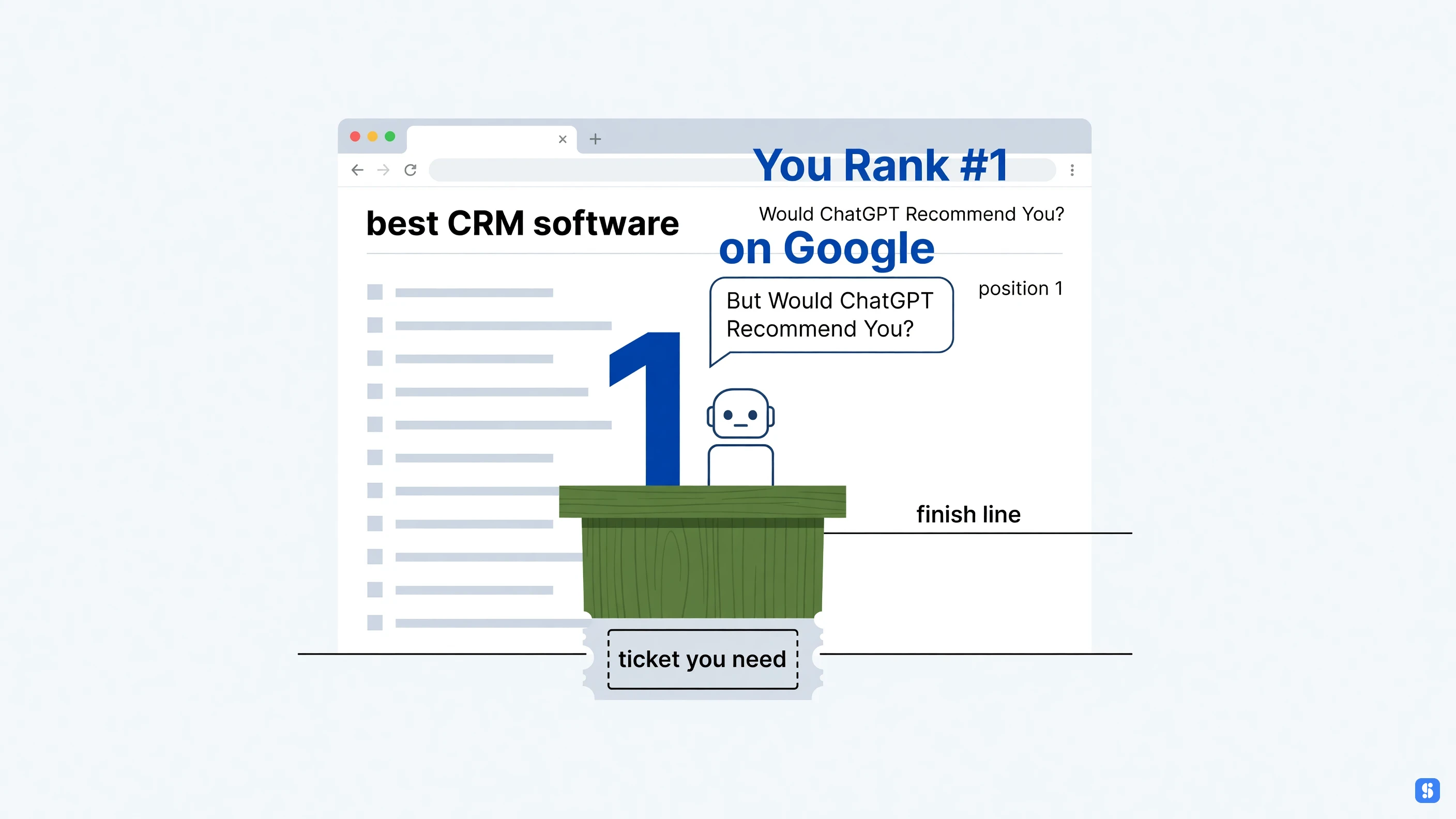
A ranking is a position in an ordered list. An AI recommendation is your brand pulled into a synthesized answer and cited as a source. Google gives you the slot; ChatGPT decides whether your name belongs in the sentence it writes back. That gap is what "You Rank #1 on Google. But Would ChatGPT Recommend You?" is about.
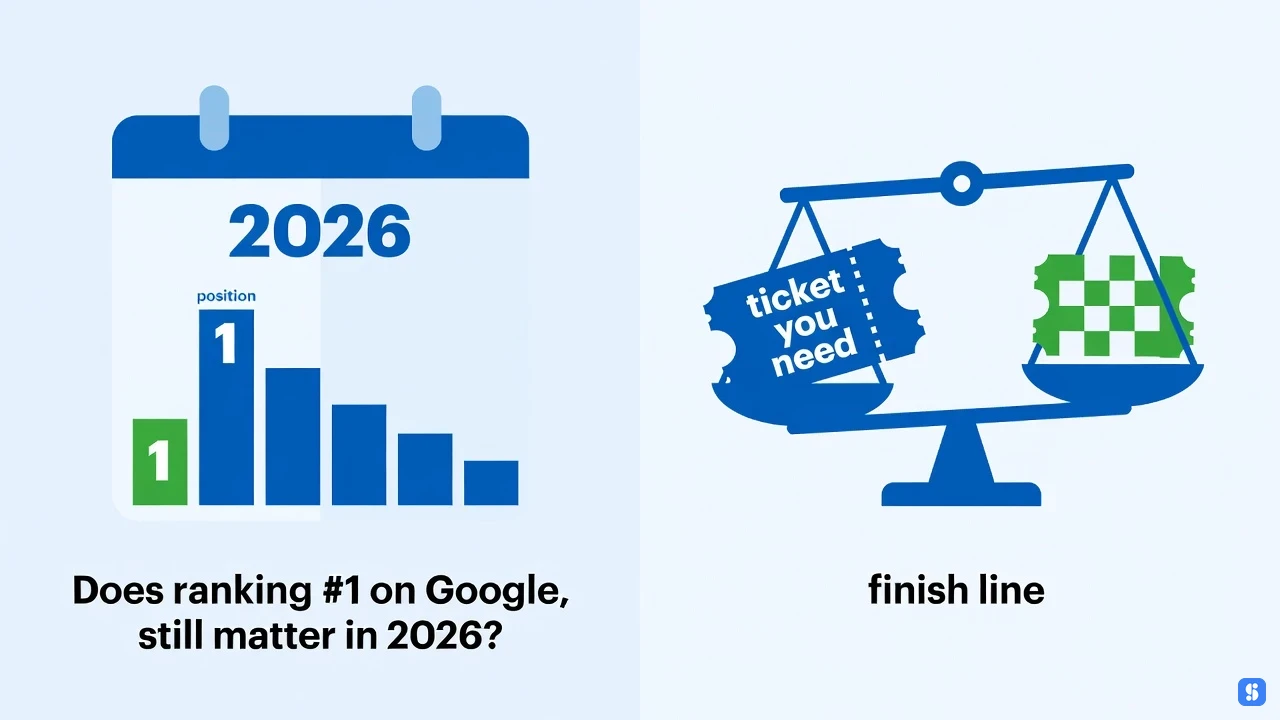
Rankings are not dead. Anyone in digital marketing saying otherwise is selling something. But position one stopped being the finish line. It is now the ticket you need before an engine will consider you, and nothing more.
The old workflow was to search Google or type a URL into the address bar. More questions now get answered inside ChatGPT, Gemini, and AI Overviews before a results page ever renders. Different mechanics, different inputs.
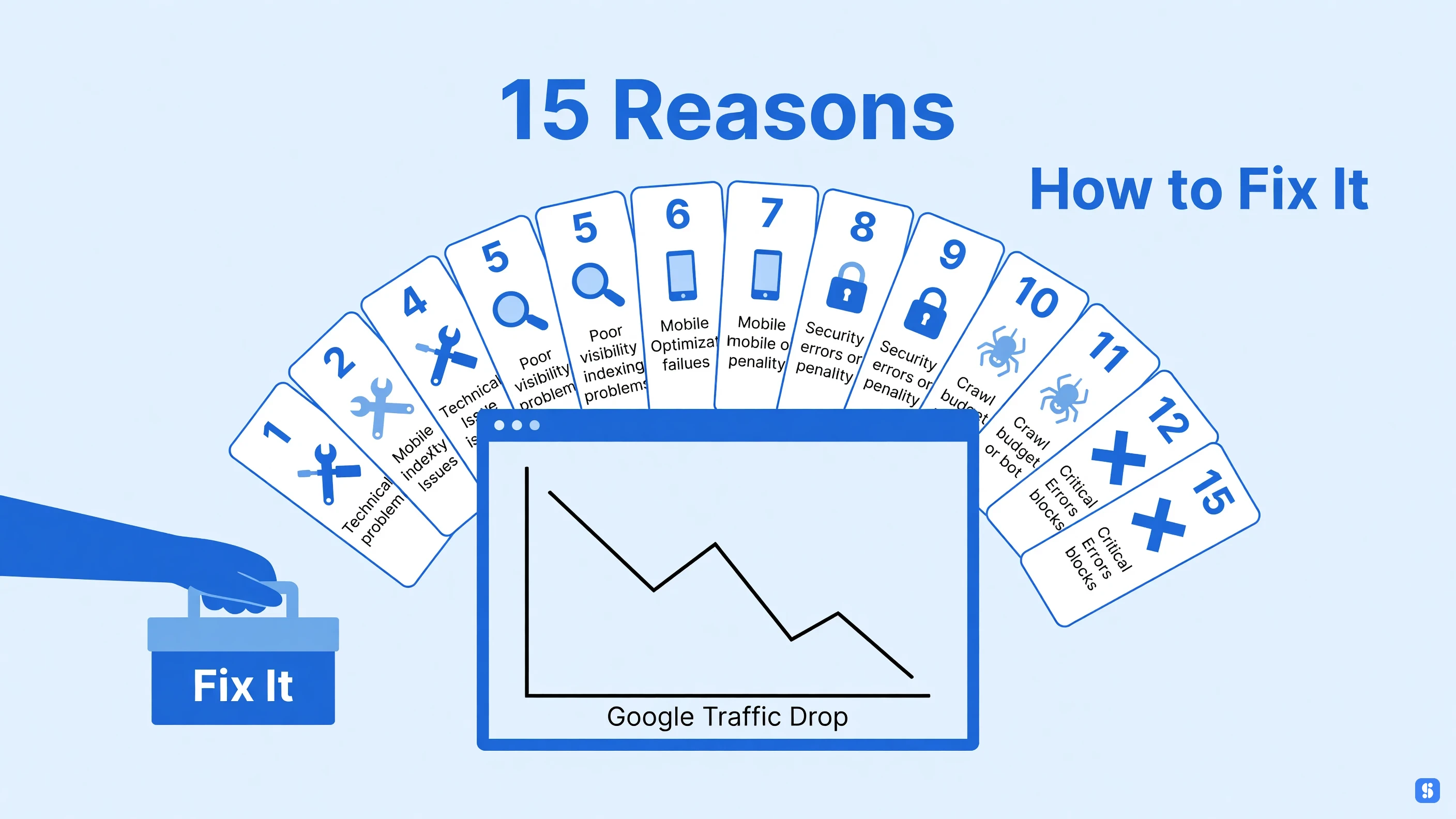
The teams getting hurt are not the ones ranking poorly for a keyword in Google. They are the ones with great rankings and no citations. Flat impressions on a page that still holds position one is the signature. It is worth reading against a broader traffic drop pattern before blaming an algorithm update.
What follows: how discovery moved, how to measure AI citation share, what to do when an AI Overview goes to a competitor, how to spot a manufactured #1, and how to verify a claim before you sign.
Key Takeaways
The pitfall that costs the most is treating a #1 ranking as proof that buyers actually see you. You Rank #1 on Google. But Would ChatGPT Recommend You? Is a question plenty of teams still cannot answer, because position tracking and AI mentions live in entirely different places.
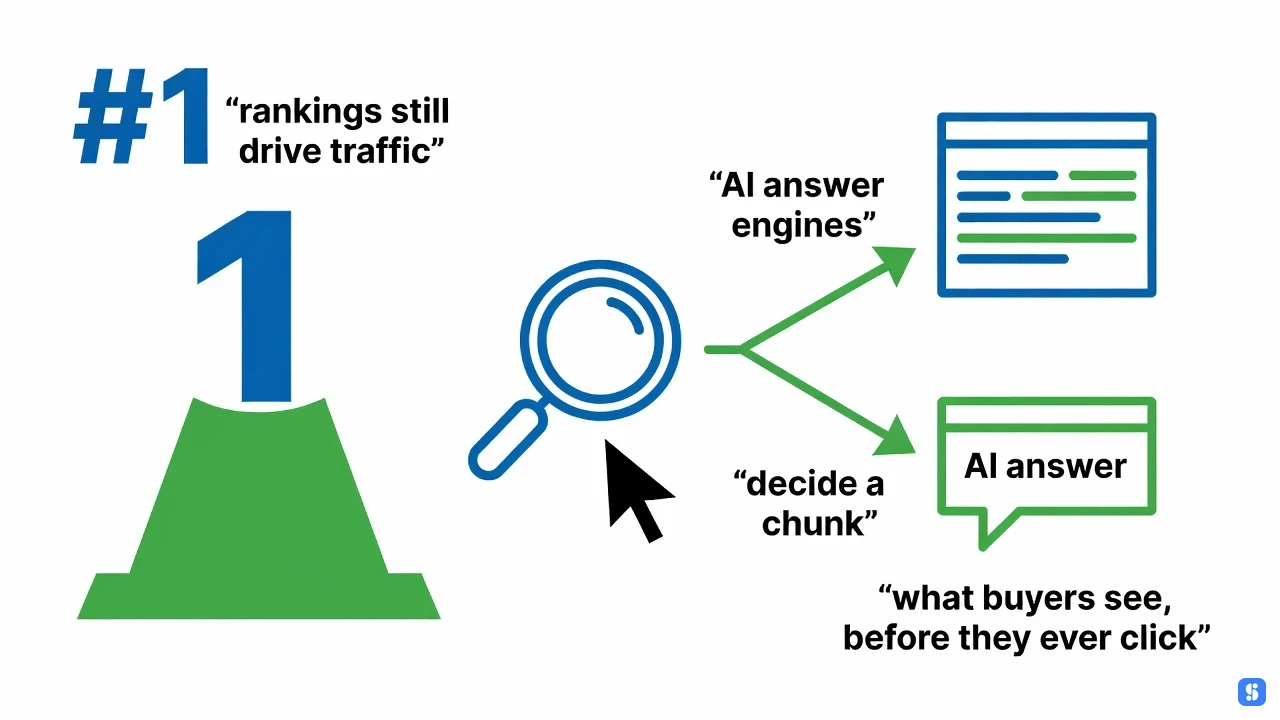
Being found on Google still matters. AI answer engines now shape what buyers read before they ever click.
Add AI citation share as a metric: how often your brand shows up as a cited source in AI answers for the prompts you care about.
AI Overviews and chatbots favor pages that answer the question in plain language near the top and are corroborated by third-party sources.
Audit #1-ranking case studies and guaranteed-placement contracts: which keyword, what date range, what traffic and revenue change, which clause.
Rank trackers, Google Analytics, and Search Console measure positions and clicks. None of them tell you whether an AI engine mentioned you.
When impressions and clicks fall while rankings hold, that is usually the signal, not a ranking problem. Why did my Google traffic drop walks through the diagnosis.
Ranking is retrieval. Google matches a query to a URL and orders a list. Recommendation is synthesis. A model pulls a handful of sources, writes one answer, and cites a few of them. That gap is the whole story behind you rank #1 on Google, but would ChatGPT recommend you?
Position one buys you a seat in the candidate pool. It does not buy you a sentence in the answer. Citation turns on three things Google never asks about: how quotable the page is, how clearly your brand is described, and how many other sources say the same specific thing. Corroboration outweighs position. One page insisting you are the best loses to five independent pages, a review thread, a docs page, and a social media comment saying something consistent and concrete.
Entity clarity is the quiet failure. If a model cannot confidently say what you do, for whom, and at what price, it skips you and cites a company it can describe. Format also beats authority at the margin. A two-sentence answer under a question heading is easier to lift than 900 words of warm-up.
Be fair to rankings, though. Pages that rank get crawled, linked, and cited, so the two are correlated. Abandoning Google to chase AI visibility is its own mistake, and a common one. If traffic is already sliding, start with Why Did My Google Traffic Drop 15 Reasons And How To Fix It.
Where else are buyers searching besides Google?
Skipping the non-Google surfaces is a tradeoff, not a neutral choice. Spread yourself thinner and nothing lands. Ignore them and buyers drift to whichever competitor the AI names. Bing, DuckDuckGo, Brave, and YouTube still send real traffic, and ranking #1 on Google while ChatGPT recommends someone else is a distribution problem, not a ranking one.
Bing matters more than its share suggests. Among search engines other than Google, it earns the most attention for the least effort, since several AI products pull from its index. Verifying your Bing presence is a ten-minute job with outsized payoff. Then the answer engines people describe as a search engine similar to Google: ChatGPT, Gemini, Perplexity, DeepSeek. That comparison holds for input and breaks on output. There is no list of ten results to defend, just one answer with three to six citations.
Your entity profile travels across all of it. Consistent naming, a real About page, structured data, and third-party mentions do more here than another keyword-optimized landing page. Google Ads buys placement. None of this does.
Keep perspective. You do not need to be everywhere, just findable where your buyers already are. If traffic already slipped, why did my Google traffic drop is the faster diagnostic.
Citation share only becomes measurable once you decide what counts. Define it first: AI citation share is the percentage of your tracked prompts where your brand is named or linked as a source. Split brand mentions from link citations, because the two behave differently and lumping them together hides the trend you care about. If you rank #1 on Google but ChatGPT recommends someone else, this is the number that tells you whether that is a one-off or a pattern.
Then build the fixed prompt set: 20 to 50 real buyer questions pulled from sales calls, Search Console queries, and support tickets, segmented by intent into problem-aware, comparison, brand, and pricing.
Freeze the variables. Same models, same cadence, same wording, logged out or the same account every time. Small rewordings move results more than most people expect, and prompt drift will make a real trend look like noise.
Log per prompt: date, model, cited yes or no, where you appear in the answer (first citation versus a mention at the bottom), who else was cited, and which URL won. Give every prompt a stable ID so the sheet survives rewording. Run weekly for the first month, then monthly. AI answers are volatile enough that single snapshots lie.
Read it next to your Google rankings. The gap between position 1 and citation share is the actual story, and no rank tracker or analytics platform will surface it for you. When a page slips, run the traffic drop checklist in parallel.
Name the uncertainty honestly: there is no industry-standard definition of citation share yet, and every team computes it slightly differently. Write your definition down, keep the method fixed, and stop arguing about it. This is what Azuqe's AI Visibility Tracking and Citation Ranking Dashboard do: one prompt set across Google SERPs and AI engines, into a single score. Plans start at $49/seat/mo on SEO Pro and $149/seat/mo on SEO Max, with up to 12 AI visibility runs a month and a 5-day free trial on your first website.
What do you do when you rank #1 but a competitor wins the AI Overview?
An AI Overview loss is a formatting problem, not a ranking problem. The model had the same question, the same index, and a choice of sources, and it picked a competitor whose page handed it one clean sentence to lift. That is how you can rank #1 on Google and still lose the recommendation in ChatGPT or Gemini.
Confirm it before rewriting. Check incognito, on mobile, in the country that matters, with two or three phrasings. Overviews shift by wording, location, and device, so one desktop screenshot proves nothing.
Then read it closely: which URL it cites, which sentence it lifted. That sentence is your specification.
The winning formats repeat:
A short definition under a question heading
A comparison table with named options
A numbered list with real item names
A plain "best for" sentence
Cut the narrative runway. Put a quotable answer block near the top and support it below; an answer buried in paragraph fourteen may as well not exist.
Build corroboration: a review site, partner doc, or community thread repeating the same claim gives the model consensus, and consensus makes a citation stick. Update the existing URL rather than publishing a near-duplicate, which splits the entity signal.
Watch zero-click patterns. "How old is" queries are worth little at position 1, and local SEO queries behave the same way once the answer sits above the results.
Log the prompt and re-check in two to four weeks. If nothing moves, the page was not the problem.
How can you tell if a #1 ranking was manufactured?
Start with Search Console. A manufactured #1 looks flawless in a screenshot and ugly in the data. Split branded from non-branded queries, then hunt impression spikes that collapse within weeks, and check whether the keyword sends clicks or only impressions. Whether you rank #1 on Google but ChatGPT recommends someone else is a question about real demand, not a vanity position.
Traffic quality gives it away faster than ranking reports, and it is the part of digital marketing trends nobody writes about. Direct sessions lasting seconds, near-zero engagement, a bounce rate at 100%, visitors whose location does not match the market you supposedly rank in. If the ranking already collapsed, the causes overlap with Why Did My Google Traffic Drop 15 Reasons And How To Fix It.
Then the link profile:
Velocity spikes with no editorial reason
Exact-match anchor text dominating the profile
Sitewide links from unrelated sites
Sister domains sharing an IP or registrar
Index dates clustered into one week
Ask for the raw link list with placement URLs and dates, then sample ten to twenty yourself. A vendor who cannot produce it did not earn a ranking you can keep. Click-farm signatures look like impressions rising while conversions stay flat, odd referral sources, sessions under five seconds, and a position that evaporates when you pause the relationship.
Write the methodology down: what you checked, the date, the tool, screenshots attached. That is what makes the finding provable to a client or a CFO.
One related trap: running your own drafts through a ChatGPT detector and treating the score as evidence. Detection tools guess at authorship. They say nothing about whether a ranking is real or a page will get cited.
Best practices for verifying a #1 ranking claim before you sign
A verifiable #1 ranking claim carries six fields: exact keyword, monthly search volume, country and device, date range, organic traffic delta, and revenue or pipeline delta for that same period. A case study missing any of them is marketing, not evidence. That gap is where "you rank #1 on Google, but would ChatGPT recommend you?" claims quietly fall apart.
Check whether the keyword is branded. Ranking first for your own brand plus a city, or your brand plus reviews, is not a case study and never was. That is a trophy from a race with one entrant.
Rank tracker screenshots are easy to stage. Search Console screenshots with a visible date range are harder to fake. Ask for those, and ask what share of total organic traffic the #1 term carried. Fifty searches a month does not move revenue from any position, and if the numbers don't hold later, it surfaces as an unexplained Google traffic drop.
Red flags worth walking away from:
Guaranteed #1 position language
A fixed timeline, like first page in 30 days
Payment tied to a ranking report you cannot audit
Vendor ownership of content or links after you leave
Auto-renewal with a cancellation window measured in months
Then ask for the tracked keyword list as an exhibit to the agreement, a clause letting you reject individual links, defined data ownership and handover terms, and a written definition of position 1 versus top of page. Those two phrases are not the same thing. If the vendor won't define the metric in writing, the guarantee is the product.
What are the most common mistakes with #1 rankings and AI visibility?
The first mistake is a measurement one. Someone watches a position hold at #1, assumes visibility is intact, and never checks whether an AI engine actually names them. If you're asking "You rank #1 on Google, but would ChatGPT recommend you?", nothing in your rank tracker, Google Analytics, or Search Console answers it. Those tools are good at positions, clicks, and queries. None of them tells you whether a model cited you, and stretching them into that job produces confident nonsense.
The deeper error is optimizing for a position instead of an answer. Position is an input. Being the source the answer quotes is the outcome. You can hold #1 and lose every recommendation because your page says "trusted industry leader" instead of a concrete sentence a model can lift.
Then the predictable cluster:
Publishing drafts with no first-hand data, no named sources, no specifics.
Chasing one head term while ignoring the forty smaller questions buyers type while deciding.
Manufacturing links to force a #1, then paying twice when the profile gets re-audited.
Letting duplicate and thin pages split the entity signals a model uses to decide who you are.
Stack confusion: your CMS, CRM, social scheduler, and email platform share a budget line and have zero bearing on whether ChatGPT recommends you.
Fix the boring stuff and conversions follow. Traffic falling while rankings hold is usually intent or cannibalization, not an algorithm grudge, which is worth walking through in Why Did My Google Traffic Drop 15 Reasons And How To Fix It.
Frequently Asked Questions
Ranking #1 on Google is really two different achievements. A branded term you can own by Friday, and a commercial keyword that takes a year of compounding work. Neither one answers whether ChatGPT would recommend you, and most of the questions below exist because people mix the two.
How long does it take to rank #1 on Google?
There's no fixed number. It depends on competition, domain history, whether your content answers the query better than what's already there, and how your internal links point at the page. Anyone quoting a timeline in days is selling a report, not a result.
Can you rank #1 on Google in 24 hours?
Sometimes, for a branded or near-zero-volume term. That isn't the flex it sounds like, since those same easy rankings tend to get recycled into case study material.
Why did my page drop from #1 on Google?
Check these in order: intent shifted and your page no longer matches it, keyword cannibalization from another page on your site, a competitor overhauled their page, a core update landed on your niche, or AI Overviews absorbed the clicks rather than a competitor taking the spot. Why Did My Google Traffic Drop 15 Reasons And How To Fix It covers the diagnostic side.
What is the #1 search on Google, and who is the #1 Googled person?
No one has a stable answer, including Google. The company doesn't publish per-term volumes, and the closest public thing is the annual Year in Search roundup, which changes yearly. Anyone offering a permanent answer is guessing.
Does ranking #1 guarantee traffic and sales?
No. It depends on query intent, how many SERP features sit above the organic results, and whether your conversion path works once someone arrives. A #1 position can still produce almost no clicks.
Conclusion
A #1 ranking and an AI recommendation are two different currencies, and only one of them shows up in revenue. Ranking first gets you considered. Getting cited gets you recommended. The gap between the two is where most teams are quietly losing ground, and it is the only real answer to "You Rank #1 on Google. But Would ChatGPT Recommend You?"
So do this week's version of a ranking report: pick twenty buyer prompts, run them through ChatGPT and Gemini, and log who gets cited instead of you. That displacement list beats another position-tracking export, and it matters more when rankings hold and Google traffic drops anyway.
The fix is rarely a new content strategy. It is a plain answer block, a consistent entity, and third-party sources willing to say the same thing. Unglamorous, and it holds longer than any guaranteed #1 you could buy.
From our experience
While running Azuqe, we've found that teams often have no idea whether ChatGPT, Gemini, or DeepSeek mention their brand at all, so we track where each engine cites a brand and score each run against the prompts we set.
We've seen classic SERP rankings and AI citations pull in different directions, so we fold both into a single visibility score per page or domain instead of reporting them separately.
Our users consistently want to know which sources the AI engines lean on, so the citation dashboard shows the sites cited most, whether that citation trend is steady, rising, or falling, and where their own citation rate sits.
We've learned that content optimization is only useful if you can tell whether it moved anything, so our optimization runs connect back to real rank tracking rather than stopping at the editor.