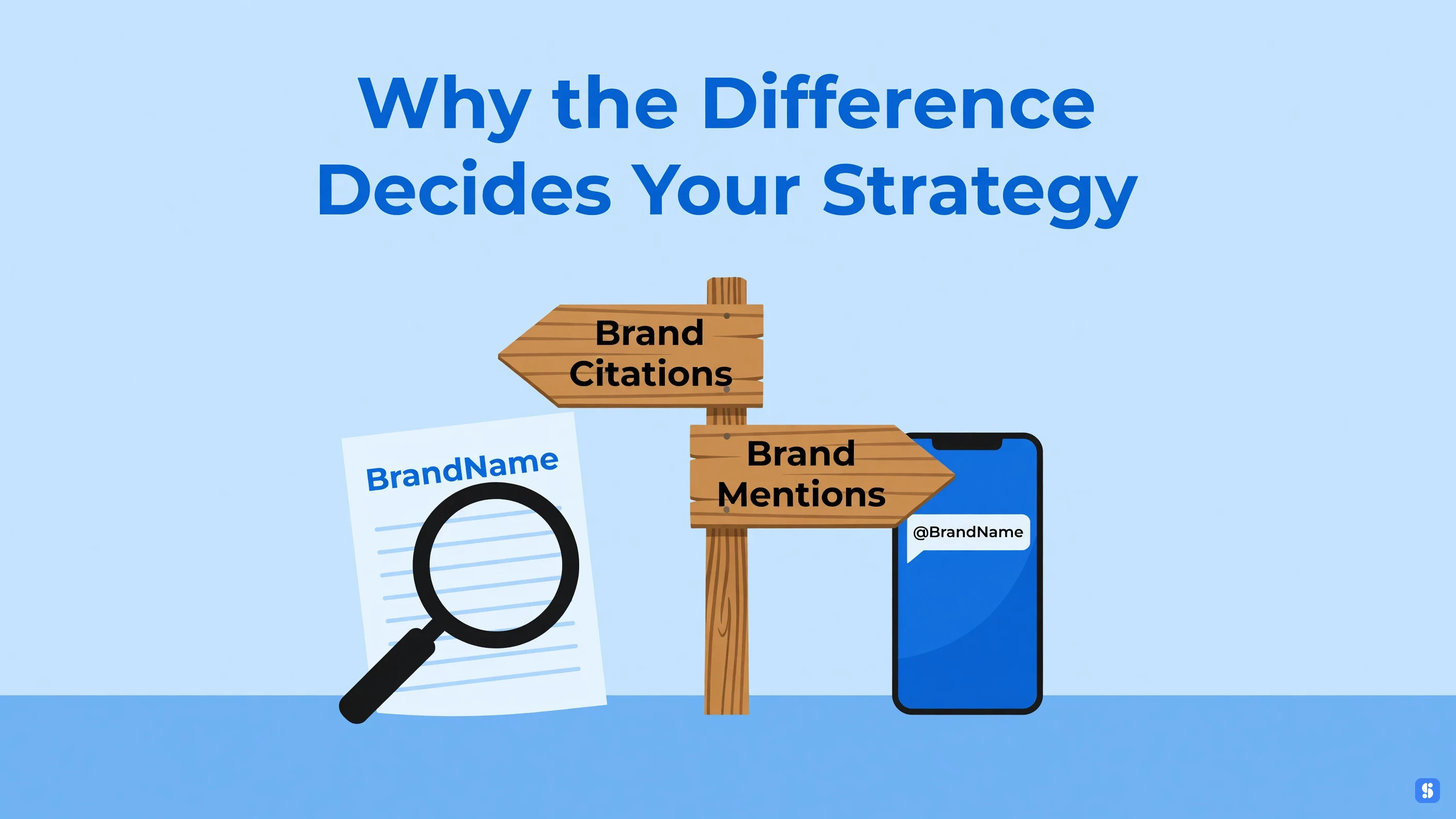
Measure the wrong number and your strategy follows it. Brand citations vs brand mentions is a measurement problem before it is an optimization problem. A brand mention is your name appearing somewhere inside an AI answer. A brand citation is that engine pointing to a specific URL as the source for what it just said. ChatGPT, Perplexity, and Gemini do both, at very different rates. Watch only one and you get a story about your visibility that isn't true.
Why the difference decides your strategy: ChatGPT names brands roughly three times more often than it links them, and fewer than a quarter of brand mentions arrive with a citation attached. Mentions come mostly from training-data co-occurrence, meaning your brand shows up because it sits near a topic often enough. Citations come from retrieval, the live search step that pulls specific pages into an answer.
Signal | What it is | Where it comes from |
|---|---|---|
Mention | Brand named in the answer, no link | Training data, co-occurrence |
Citation | A URL referenced as the source | Retrieval and RAG |
That gap is why "are we visible in AI?" is the wrong question to ask. You can be mentioned constantly and cited never, which looks like winning and converts like losing.
Worth saying plainly: Google Analytics, Search Console, Semrush, Ahrefs and Moz measure your own domain's performance, not how answer engines talk about you. None of them separate these two signals, so the confusion usually starts with the tools people already have open.
Key Takeaways
The trap is treating mentions and citations as one number. They answer to different levers. Brand citations vs brand mentions: why the difference decides your strategy comes down to which signal you can actually move this quarter.
Key points:
Mentions grow from training-data co-occurrence. Citations come from retrieval, so they appear and vanish faster.
Mentions outnumber citations roughly three to one in ChatGPT answers, which makes a healthy citation rate look bad.
Keep citation tracking, including llm citation tracking, in a view separate from sentiment and share of voice.
Earned, third-party sources win most citations. Your own pages rarely earn one alone.
Check brand visibility per engine: ChatGPT, Gemini, Claude, and Perplexity swing differently, and averages hide that.
Log both weekly, then fix whichever is falling.
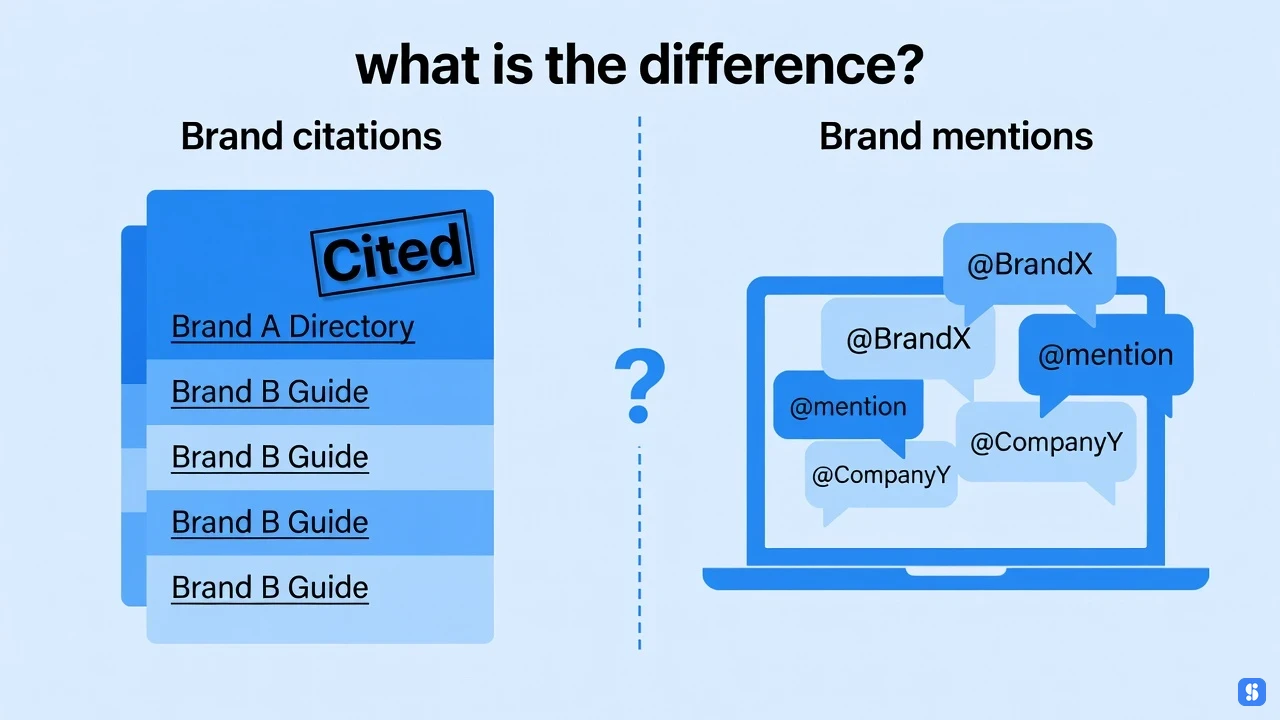
Brand citations vs brand mentions: the side-by-side that decides your strategy
Mentions and citations come from two different machines inside an AI answer engine. A mention is generated text: the model writes your brand name because your entity sits close to the topic in its training data. A citation is a retrieval artifact, a page pulled into context at answer time that the model chose to point at. That gap is the brand citations vs brand mentions difference. The levers that move each one are not the same levers.
Side by side, brand mentions vs citations split like this:
What produces it: mentions come from training-time co-occurrence, citations from retrieval at query time.
Who controls the source: nobody controls a mention; whoever owns the quoted page controls a citation.
Volume: ChatGPT mentions brands roughly 3x more often than it cites them, and only about 1 in 4 mentions arrives with a citation attached.
Failure mode: no mention means you do not exist in the answer; no citation means you exist but someone else gets the click.
Tracking unit: mentions get counted per prompt, citations per source URL.
Stability: cited domains churn, with about half of them changing month to month.
That makes them two separate columns in any honest dashboard. Marketing agencies usually collapse them into one AI visibility number, count the mention as the win, and then can't explain why pipeline didn't move. The same prompt on ChatGPT and Gemini can mention you in the prose and cite a competitor's page right underneath.
Treat citation tracking as a source-level job and mention tracking as a prompt-level job. Related signals, not interchangeable. Build around whichever one is missing.
What is a brand mention in AI search, and why do they outnumber citations?
Mentions cost the engine nothing. Citations cost it something, and that asymmetry is the whole reason the brand citations vs brand mentions difference decides your strategy. It also explains why AI answers name far more brands than they link to.
ChatGPT mentions brands roughly 3.2x more often than it cites them. That is a 3-to-1 gap between being named and being pointed to as a source, and it shows up across most tracked prompts.
A brand mention is any appearance of your name inside an AI answer. No URL, no link, no click. Mentions come from training data, where your brand co-occurs with a topic often enough that the model treats the pairing as settled background knowledge.
A citation is a source the engine retrieves at answer time and attaches to a claim, usually through a live search step. It takes up room in a finite answer, so engines ration it.
Three things push mentions ahead:
Mentions are already in the weights. Citations need a retrieval pass, a ranked source, and available space.
Naming four brands is low risk. Pointing at one page is an accuracy claim.
Citation sets churn month to month, so no engine wants to depend on them.
For SEO, the implication is unglamorous. Mentions grow from being talked about. Citations grow from pages that state a fact cleanly enough to be lifted verbatim.
Chase mention volume alone and you'll keep watching your brand get named with nothing next to it. That's visibility with no traffic behind it. LLM citation tracking only helps if it keeps the two numbers apart.
What counts as a brand citation, and how do AI engines decide who gets one?
A mention is cheap to earn and easy to keep. A citation costs you control, because someone else has to choose your words. That asymmetry is the practical core of the Brand Citations vs Brand Mentions: Why the Difference Decides Your Strategy argument. It explains why two brands with similar mention volume can sit at wildly different levels of brand visibility.
A citation counts when the answer names your brand and attaches a source beside a specific claim. Not a logo in a reference list. Not your domain appearing somewhere in the footnotes. The attribution has to touch the sentence doing the work. That's why citation tracking at the domain level misleads: domains get credited, passages get cited.
How do the engines choose? Two stages, roughly. Retrieval pulls a small set of passages for the query, then the model writes an answer and attaches sources to it. You clear the bar when one passage matches the query, names your brand in the same few sentences as the claim, and lives on a third party page the retrieval system already trusts. Your own homepage rarely clears that third gate, no matter how well it ranks in Google.
Citations are per-answer, not per-brand, which is why they churn. A comparison page earns a citation for "best for small teams" and nothing for "cheapest." Query type shifts everything: single-brand prompts tend to cite what they mention, while commercial prompts pull from review sites, docs, and forum threads instead.
If you track one thing, track which passage got cited. Mentions tell you whether you exist in the answer at all. Citations tell you whether that answer survives a buyer clicking through to check it.
How do you track mentions and citations without conflating them?
The split is mechanical: two counters over one fixed query set. Track mention rate as the share of AI answers that name your brand, and citation rate as the share that link to a source you own or earned. Sentiment sits on top as a third layer. Any brand citations vs brand mentions dashboard that merges those into one visibility number hides the exact thing you need to act on.
The practical version:
Write 30 to 50 prompts your buyers actually type, not your own brand name.
Run them on a schedule across ChatGPT, Perplexity, and Gemini, because the engines disagree with each other.
Score every response: brand named yes or no, source cited yes or no, which URL, and tone.
That produces four buckets, and each one points somewhere different. Mentioned and cited means you are solid. Mentioned only is usually a content and entity problem. Cited only means your pages get retrieved but the model never names you, which is why separate llm citation tracking beats guessing. Neither one is a prompt gap, and prompt gaps are cheaper to close than most teams assume.
What not to reach for: Google Analytics and Search Console see sessions and impressions, not whether ChatGPT said your name. Ahrefs, Semrush, and Moz track backlinks, rankings, and SERP has. Real visibility signals, wrong object. Social listening tools catch human mentions, not model output. To track brand mentions in AI answers you need something that queries the engines and stores the responses, whether that is a script, a spreadsheet, or a dedicated visibility tool.
One warning before you draw conclusions: single runs are noise. Re-run before you believe anything.
(The same partitioning instinct shows up in Divide Array Into Arrays With Max Difference, if you enjoy that sort of problem.)
If you can only fund one program this quarter, fund mentions. Citations carry more trust, but they sit downstream of being known at all, and optimizing for the thing downstream first is how teams burn six months on outreach that never converts.
That ordering is what makes Brand Citations vs Brand Mentions: Why the Difference Decides Your Strategy less of a coin flip than most people treat it. Mentions come from co-occurrence: your brand appearing next to a category term across enough of the text a model learned from. Citations come from retrieval, the live sources an engine pulls when it answers. A model cannot retrieve a brand it never learned.
ChatGPT mentions brands roughly three times more often than it cites them, and only about a quarter of those mentions arrive with a citation attached. The gap is normal. It is not a failure.
But mentions alone rarely move revenue. On commercial queries, the citation is what turns recognition into a recommendation with a link a buyer can follow. If your category is high-intent, a mention rate without citations is a lead leak.
Practical order:
First: earn mentions. Third-party pages, earned media, a clean entity, consistent naming.
Second: convert mentions into citations on 10 to 15 commercial prompts you actually care about.
Track both separately. A visibility tool that blends them into one score hides which one is missing.
Flip the order only if you are already mentioned constantly and cited rarely. That is a source problem, not an awareness problem.
One caution: half of cited domains change month to month, so do not chase individual citations. Track brand mentions vs citations as a ratio over time, and expect the ratio to move between ChatGPT, Gemini, and Perplexity. The trend is the signal.
Frequently Asked questions
A citation is a link an AI engine attaches to its answer. A mention is your brand's name showing up in that answer with nothing attached. Everything else in the brand citations vs brand mentions difference decides strategy follows from that one asymmetry.
Do mentions or citations matter more? Mentions, for reach. Citations, for proof. Most teams track both in one dashboard and lose the signal, so keep them separate. How stable are they? Not very. Cited domains rotate constantly, so a single run tells you almost nothing. Why do mentions outnumber citations? Mentions come from training-data co-occurrence. Citations come from retrieval.
How should I track brand mentions and citation tracking together? Snapshot weekly, log sentiment as a quality layer, and compare each run against your last one. A brand visibility tool that separates mentions from citations shows which one is moving.
Brand citations vs brand mentions: the difference decides your strategy, and it decides it faster than most teams expect. Mentions are the volume signal. Citations are the rare confirmation. Roll them into one number and you hide which one you actually earned. Track the wrong one and you fund the wrong work. Citation tracking on a brand nobody mentions yet is a dead end, and chasing mentions with zero citations leaves your AI answers thin.
So build the boring habit. Pull brand mentions vs citations separately every week, watch whether ChatGPT and Gemini keep naming you across consecutive runs, then fix the third-party pages feeding both. Sources you don't own are where citations come from, and that is unglamorous, slow work.
That's the whole argument. Not exciting, but it holds.
From our experience
In running Azuqe, we've found that teams lose organic traffic not just to Google competitors but to ChatGPT and Gemini recommendations, which is why we track brand visibility across classic SERPs and AI answer engines in one unified score.
We've watched users struggle to manually track and fix SEO issues across multiple tools, so our continuous audits classify findings into Critical, Warning, and Info tiers and ship them to GitHub as issues.
Our users consistently tell us their SEO stack feels fragmented with no unified visibility, which is why we combine SERP rankings and AI citation metrics into a single score per page or domain.
One honest limitation we've run into: AI Visibility runs are limited to ChatGPT, Gemini, and DeepSeek on Pro and Max plans, even though our marketing shows support for eight engines including Claude, Perplexity, and Grok.
We've also found that our free trial applies only to the first website, with additional sites charged immediately, and billing is monthly only with no annual or prepay discount.