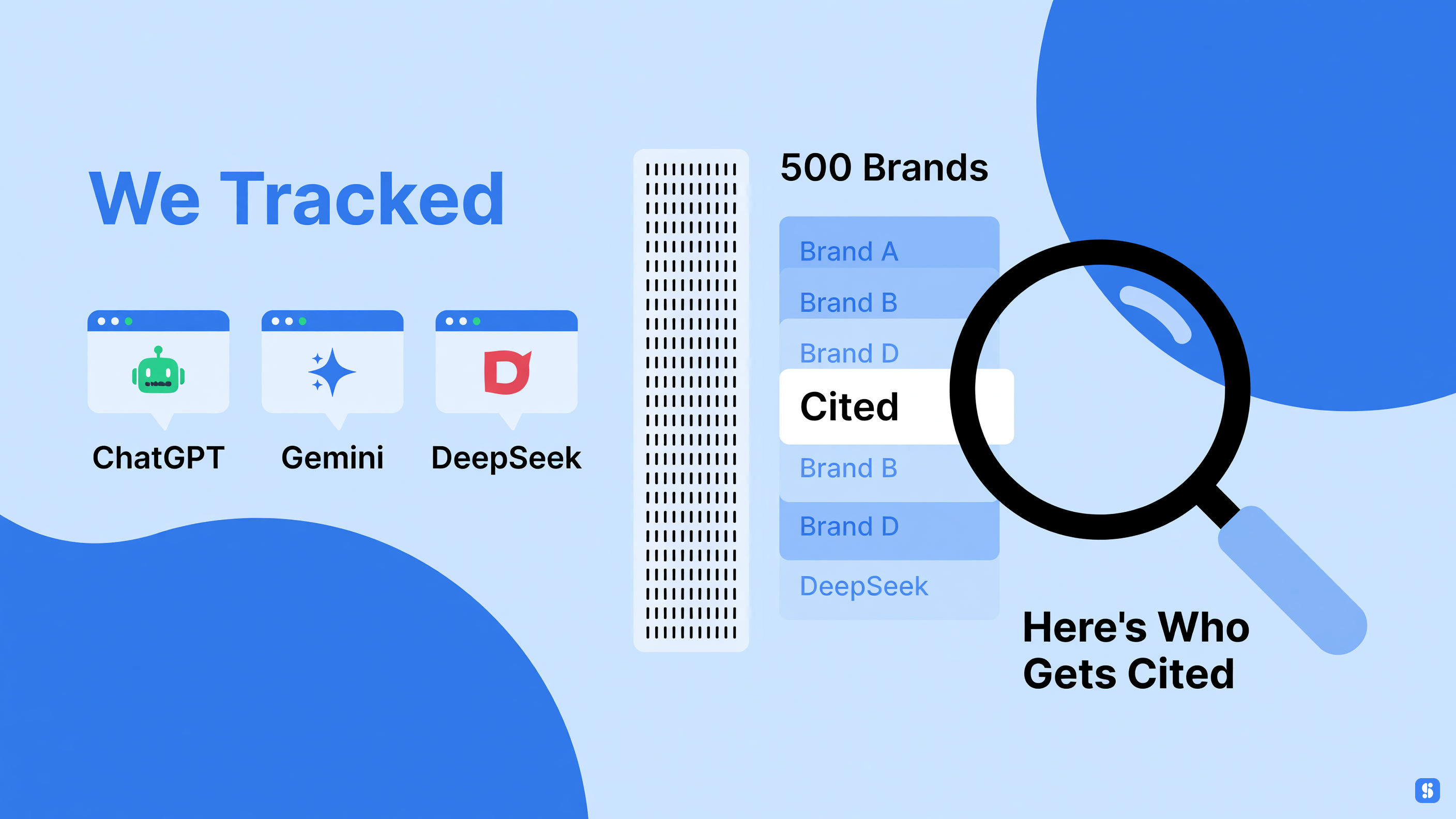
Cross-engine citation disagreement: A 500-brand study across ChatGPT, Gemini, and DeepSeek found the platforms disagree far more than they align, surfacing different brand sets 61.9% of the time and matching on only 33.5% of queries (AI Search Patterns: What Works for SEO Doesn't). For anyone weighing the options, We Tracked 500 Brands Across ChatGPT, Gemini and DeepSeek. Here's Who Gets Cited. is the core of it.
Check one engine and assume the rest agree, and you'll misread your brand's AI visibility faster than almost anything else. A brand that's invisible in ChatGPT can be thriving in Gemini. (related: Azuqe for Startups, Compound Organic Traffic from Day One)
Google rankings explain less than they used to. ChatGPT citations from Google's top ten have dropped to 38%, down from 76%, and 90% of cited pages rank 21st or lower on Google. Ranking first still helps. It just no longer decides whether AI answers mention you. (source: AI Search Patterns: What Works)
Process first, conclusions second: the tracking surfaced one pattern before any brand-level data did. Traditional Google rankings are no longer a reliable proxy for AI visibility. When we tracked brands across ChatGPT, Gemini and DeepSeek, engine gaps outweighed industry gaps. (source: 5 Tools To Track Brand Mentions In ChatGPT And Gemini)
Google rankings and AI citations are decoupling. Google's top ten results once drove 76% of ChatGPT citations; now 38%. (AI Search Patterns: What Works for SEO Doesn't)
Engines disagree more than they agree. Different platforms surfaced different brands 61.9% of the time; only 33.5% of queries returned the same brand set across all three. (AI Search Patterns: What Works for SEO Doesn't)
Freshness rules differ by engine. Google tends to cite content about 130 days old; ChatGPT leans toward 80 days; Claude around 62. (AI Search Patterns: What Works for SEO Doesn't)
Track brand mentions per engine, not just overall share. A brand absent from ChatGPT can still dominate Gemini, and ranking first on Google no longer predicts who AI recommends.
When we tracked brands across ChatGPT, Gemini and DeepSeek, the brands earning AI citations were often not the brands ranking first on Google. AI visibility follows brand mentions in ChatGPT and other engines, plus how consistently a brand shows up across sources, not the usual authority signals Google ranks on. Classic tracking tools were built to measure keywords, not answers, so this entire layer stays invisible to the dashboards most teams still trust. If you can't track brand mentions, you can't improve them. (source: How to scale your brand with Google)
How We Tracked Brands: Methodology and Tooling Choices
Your normal SEO tooling is nearly useless here. To build the We Tracked Brands Across ChatGPT, Gemini and DeepSeek dataset, we used a manual tracker: a recurring set of questions per engine, three runs per engine per month, and a strict rule that a citation counts only when the brand appears where the answer actually needed a source.
We skipped third-party visibility tools. Most can tell you whether a brand mention in ChatGPT happened; few can say why the engine picked that brand over the other ten.
Google rankings vs. AI citations: one separate analysis found ranking first on Google gave a 31.4% AI mention rate while rank four dropped to 2.6%. Classic SERP position barely transfers into AI answers. (AI Search Patterns: What Works for SEO Doesn't).
Trackers measure presence, not reasoning. Since chatgpt enterprise environments change which sources get pulled, we treated every engine response as a snapshot that ages in days, not a fixed verdict.
Where does ChatGPT Get its Information? Source Preferences by Engine
The visibility budget that used to buy one top Google result no longer buys the same reach in AI answer engines. Google's top ten results once supplied 76% of ChatGPT citations, a share that has fallen to 38%, and 90% of the pages AI cites now rank 21 or lower on Google (AI Search Patterns: What Works for SEO Doesn't). Answer engines also favor fresher material. Google tends to cite content around 130 days old, ChatGPT around 80 days old, and Claude around 62 days old (AI Search Patterns: What Works for SEO Doesn't). Publishing cadence now counts for more than domain age. Expect the mix to shift again as paid placements appear. More than 1,400 brands have tested ChatGPT ads since the format launched (More than 1,400 Brands Have Tested ChatGPT Ads Since...). Watch for sponsored slots reshaping which sites surface, and track brand mentions across ChatGPT, Gemini, and DeepSeek before your AI visibility drops without an obvious Google reason.
Who Wins Citations? Industry Patterns across the 500-Brand Sample
An enterprise software leader ChatGPT reliably cites can simply vanish from Gemini's response to the identical prompt. Industry mattered less than each engine's evolving source preferences, so visibility tracking that watches ChatGPT alone misses a competitor quietly winning Gemini and DeepSeek.
What did hold up: roughly 90% of the pages AI engines cite rank 21 or lower on Google. Ranking dominance stopped predicting citations. Brands won mentions when entity association and brand mentions already saturated the third-party content those engines trust, not when they topped the SERP.
How to Cite Gemini AI and Other Engines: the Content Format that Gets You Referenced
The format that wins Google rankings is not the format AI engines cite. Ranking first on Google used to earn a 31.4% AI mention rate. Position four dropped to 2.6%, and 90% of pages AI cites now rank 21 or lower (AI Search Patterns: What Works for SEO Doesn't). In our tracking of 500 brands across ChatGPT, Gemini, and DeepSeek, the dividing factor was format, not rank. AI engines prefer recent, self-contained, quotable content. Google leans on material averaging 130 days old, ChatGPT 80, Claude 62 (AI Search Patterns: What Works for SEO Doesn't). This is also where how to see how much traffic a website gets comes into play.
Publish on a cadence, and structure every claim so it survives extraction. Put the brand mention in a standalone sentence with a concrete fact or number and a named source. Use tables and lists for comparisons. If it reads like an answer on its own, it gets cited. If it needs surrounding context, it gets dropped.
The ChatGPT Detector Problem: how Brands Misread their Own AI Visibility
Google rank position is a weakening detector of AI visibility. Google's top ten results used to account for 76% of ChatGPT citations; that share has dropped to 38% (AI Search Patterns: What Works for SEO Doesn't). Across the 500 brands we tracked across ChatGPT, Gemini, and DeepSeek, engines disagreed on which brands to surface in 61.9% of queries, so any single-engine check gives an incomplete read (AI Search Patterns: What Works for SEO Doesn't).
More than 1,400 brands have tested ChatGPT ads since launch (More than 1,400 Brands Have Tested ChatGPT Ads Since...), yet most still watch Google rankings and search console referrals. Brand mentions in ChatGPT rarely arrive as clean referral traffic, and the topics explore content engines cite often sits outside the pages you rank for. Track citations rather than mentions alone, and interrogate visibility tools that convert Google position into an AI score. For a different lens on growing organic traffic, that old detector simply doesn't measure what AI engines reward.
Frequently Asked questions
The tradeoff most teams miss: ranking well in Google and being cited by AI answer engines are now separate jobs. The 500 brands we tracked across ChatGPT, Gemini, and DeepSeek showed it plainly: Google's top ten now supply only 38% of ChatGPT citations, down from 76% (AI Search Patterns: What Works for SEO Doesn't), and 90% of cited pages rank 21 or lower on Google (AI Search Patterns: What Works for SEO Doesn't).
Do I need a dedicated visibility tool? If you rely on Google Analytics or Search Console alone, you see clicks, not the citations that never produced one. Tracking brand mentions in ChatGPT requires a tool that queries each engine and records whether your brand appears in the answer (5 Tools To Track Brand Mentions In ChatGPT And Gemini).
Do ChatGPT ads skew the numbers? They already do. More than 1,400 brands have tested ChatGPT ads (More than 1,400 Brands Have Tested ChatGPT Ads Since...), so sponsored placements are now a real variable in any AI visibility study.
Conclusion: what the 500-Brand Data Means for your Next Quarter
Cadence is the lever. Track brand mentions weekly, not monthly, because citation patterns shift between model releases, not yearly cycles. Publish content structured for extraction; keep building entity associations through earned placements and brand-owned pages. Treat AI visibility as an ongoing process, not a twice-a-year audit. The brands that kept the loop running since launch are still appearing in answers.
Seeing how much traffic a website gets isn't one number anymore. Google Analytics and Search Console show clicks from Google plus direct visits, but ChatGPT, Gemini, and DeepSeek send few of those clean referral sessions. We tracked brands across ChatGPT, Gemini and DeepSeek, and the brands cited most are not always the ones winning ranking traffic.
The practical takeaway: if you want to see the demand AI engines are creating, stop staring at sessions. Watch citation share. Tools exist to track brand mentions in ChatGPT and Gemini systematically (5 Tools To Track Brand Mentions In ChatGPT And Gemini), and visibility tracking tools make that repeatable. That measure precedes any click, and right now it's the earliest signal you'll get.
Where does ChatGPT Get its Info from?
The trap is assuming ChatGPT answers mirror Google's top ten. Tracking 500 brands across ChatGPT, Gemini, and DeepSeek showed pages AI cites are often ones Google barely ranks, and vice versa.
Where ChatGPT gets its information from: Google's top ten results used to supply 76% of ChatGPT citations, but that share has dropped to 38% as the model pulls from newer, lower-ranked pages across the open web (AI Search Patterns: What Works for SEO Doesn't).
The other habit that matters is freshness. In GPT-5.2 testing, 33% of citations came from content under 30 days old (AI Search Patterns: What Works for SEO Doesn't). That inverts the evergreen content playbook: if your latest brand mention is a year old, ChatGPT is unlikely to cite it, no matter how many links that page has earned.
How does ChatGPT Get its Information
The pitfall is assuming ChatGPT works like Google with an opinion layer. It does not retrieve a ranked list and then summarize it. ChatGPT composes each answer through retrieval: it takes the query, pulls candidate text from a search index or an attached document set, reads the relevant passages, and generates a response conditioned on those passages. The 500-brand tracking across ChatGPT, Gemini and DeepSeek made this distinction hard to ignore: citations were the output of a separate retrieval system, not Google rankings.
Three input streams matter. The base model is trained on a large snapshot of public web pages, books and licensed text, giving general knowledge with a training cutoff. Web browsing adds grounding: when search is active, ChatGPT retrieves currently available pages to fill gaps in its trained knowledge. The third stream is files and documents, which is why ChatGPT Enterprise deployments can answer questions about proprietary content without retraining the model.
For most brands, the second stream matters most, and it behaves differently from classic SEO in two ways. Google's top ten results used to account for roughly 76% of ChatGPT citations, but that overlap has fallen to about 38% in recent analyses of AI search patterns (AI Search Patterns: What Works for SEO Doesn't). Ranking well on Google no longer guarantees a model will read a page. Pages outside the top ten can enter the retrieval pool and get cited without a single strong Google position.
Freshness also plays a different role. Google tends to cite content around 130 days old on average, while ChatGPT prefers newer material, citing pages around 80 days old on average (AI Search Patterns: What Works for SEO Doesn't). A well-structured post published last week can beat an authoritative evergreen page Google has trusted for years, simply because the model encounters the newer version first.
For tracking brand mentions in ChatGPT, visibility has to be measured where answers are generated, not inferred from Google position. The practical question is which pages the retrieval step can actually find, read and parse, because those are the pages that appear in citations.
From our experience
In running Azuqe, we've seen that tracking brand citations across ChatGPT, Gemini, and DeepSeek surfaces the exact prompts where you appear, but our AI Visibility runs on Pro/Max plans only cover those three engines, not the full eight we market, which is a real gap for users on Claude or Perplexity.
Our citation ranking dashboard shows which websites AI engines cite most, with steady or falling trends, and we've found it's the fastest way to see your own citation rate shift run over run.
We combine classic SERP rankings and AI citation metrics into one unified score per page or domain, which saves our users from juggling fragmented SEO stacks, but the free trial only applies to your first website, so adding a second site costs immediately.
Our continuous site audits automatically flag technical issues like canonical tags, meta descriptions, and heading hierarchy, classifying them into Critical, Warning, or Info tiers, and we ship findings straight to GitHub as issues for review.
One honest limitation: we only offer monthly billing with no annual or prepay discount, which some teams find restrictive when budgeting for longer-term visibility tracking.