Something strange started showing up in analytics dashboards around 2025. Rankings held. Impressions held. Traffic fell.
What changed is where the reading happens, and the name for measuring it is AI visibility.
For a while the honest answer was that nobody knew why. Now we do, and the shape of it is simple enough to state in two numbers.
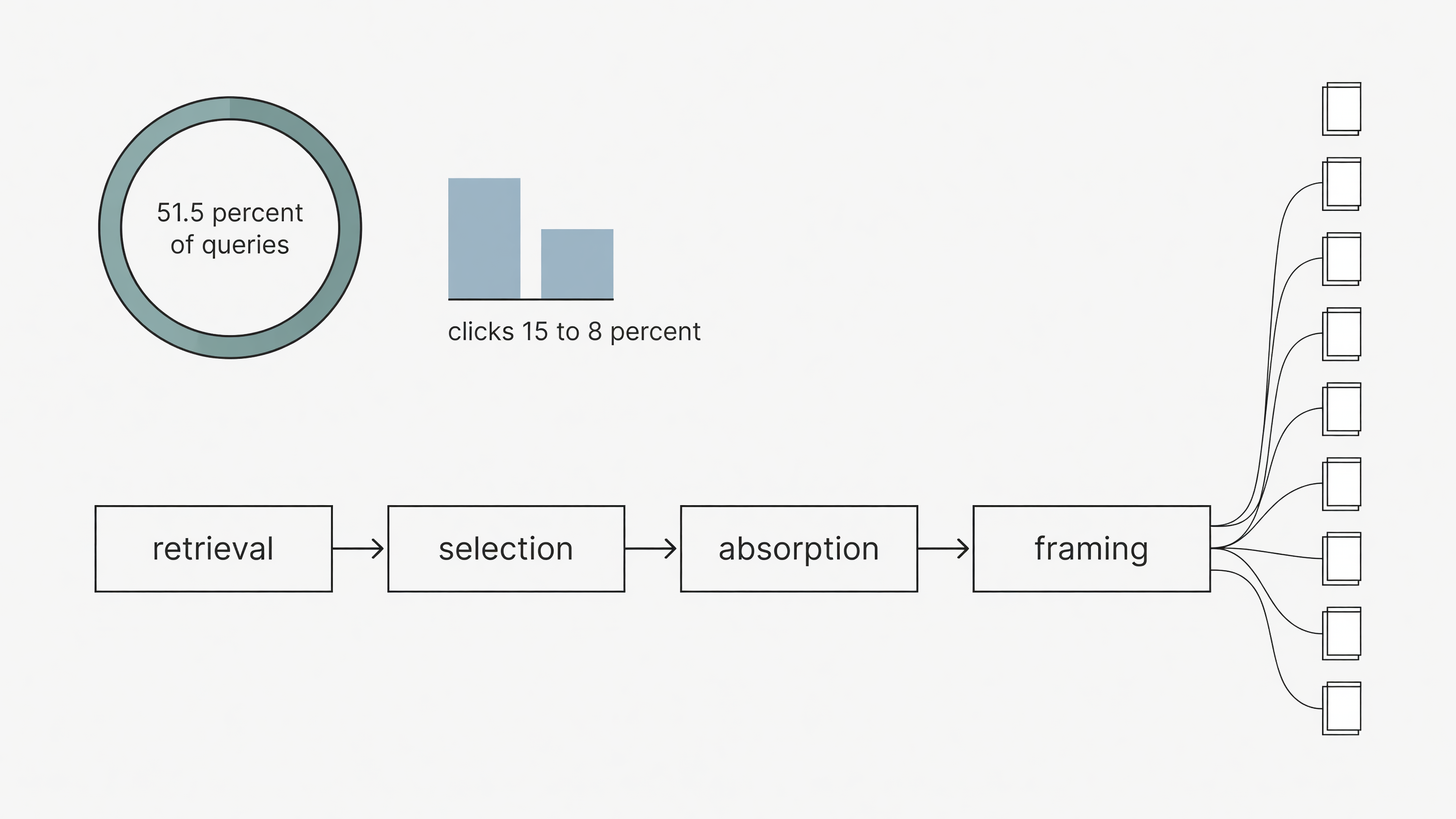
The ACM SIGIR 2026 study How Generative AI Disrupts Search, built on a public benchmark of 11,500 real user queries, found AI Overviews were generated for 51.5% of them, sitting above the organic results. And the Pew Research Center, tracking the browsing of 900 US adults across every search they ran during March 2025, found people clicked a result 8% of the time when an AI summary appeared, against 15% when none did.
On about half of searches your reader meets an answer before they meet a list. When they do, they click through at roughly half the old rate.
Your audience did not leave. They are reading your work somewhere you cannot see, in a paragraph you did not write, with or without your name on it.
AI visibility is the measurement of that.
What AI visibility is
AI visibility is the probability that your brand appears in the answer to a defined class of questions, across a defined set of AI systems and languages, estimated from a sample large enough that the number holds still when somebody else runs it.
Every part of that sentence carries weight. It is a probability, so it has error bars. It is bounded to a set of questions and systems, so a score without that scope attached means nothing. And it comes from a sample, so the sample design decides whether the number is information or noise.
Keyword rank is a different kind of number. Position 4 is an observation of a mostly stable system, and two people checking get roughly the same answer. AI visibility is an estimate of a distribution. Treating an estimate like an observation is the mistake nearly every team makes in their first quarter, ours included.
Is SEO dead
No, and the framing gets in the way.
Everything SEO built still runs underneath. A system cannot quote a page it never fetched, so crawlability, indexing, speed, and topical credibility remain the floor. What changed is what sits on top of that floor.
SEO earns a position in a list of links. AI visibility earns a claim inside a paragraph. The machinery is shared; the writing is not. Teams with strong SEO and no AI presence usually have pages that are excellent at making you want to click and useless at giving a machine one clean sentence to carry away.
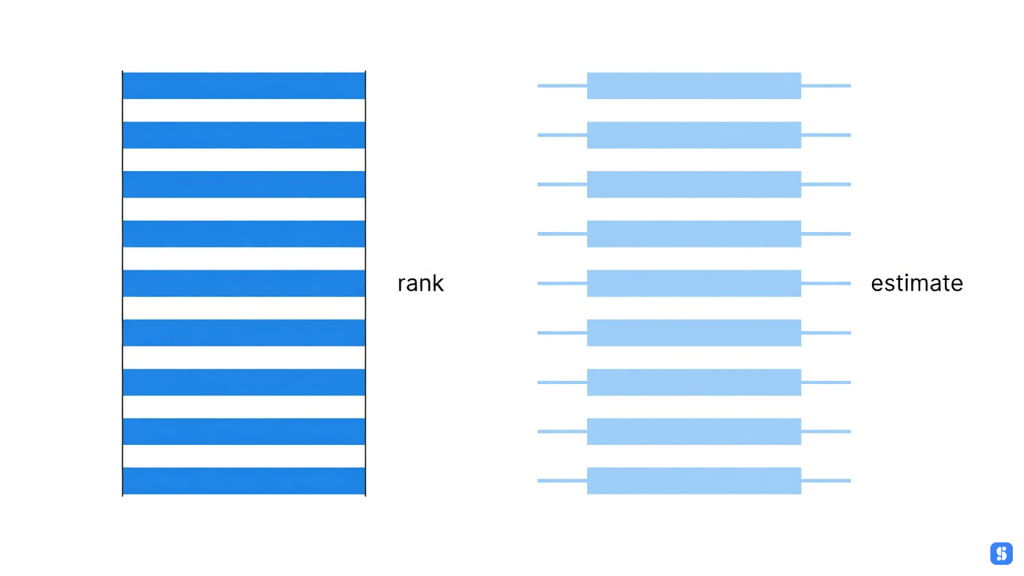
Rank is an observation, AI visibility is an estimate with error bars
The four gates
A page reaches an AI answer by passing four gates in order. Each has its own failure and its own fix, and diagnosing a late gate while an early one is broken is how teams lose a quarter.
Retrieval. Can a machine fetch and read the page at all. The SIGIR study found that sites blocking Google's AI crawler were significantly less likely to be retrieved into AI Overviews even where content was otherwise reachable, which makes your robots file the first thing to open and the cheapest thing to fix.
Selection. For this specific question, does the system pick your page. The same study found the source sets retrieved by different engines overlap remarkably little, under 0.2 average Jaccard similarity, so winning on one says little about another.
Absorption. Does your text shape the sentences in the answer, or was it fetched and dropped. These are separate outcomes, and collapsing them is what makes most advice in this category useless.
Framing. When you appear, are you the recommendation or a footnote beside a rival described in a paragraph.
Where to go next
Each of the five articles below takes one part of this and goes deep. Read them in whatever order matches the problem you have.
If you have a number and do not trust it, start with why a single AI visibility check proves nothing. A 2026 variance study found brand identity accounts for 1.5% of what a single AI answer says, which means one check is a dice roll you are reporting as performance.
If you want the mechanism behind absorption, read how language models choose what to quote. It covers the two doors, retrieval and reuse, and what separates a page a model lifts from one it ignores.
If you are rewriting pages this week, read answer engine optimization. It is the editing checklist: answer first, define standalone, numbers in text, comparisons in prose, procedures as steps.
If your question is specifically about one platform, read how to rank on ChatGPT. There is no ranking inside ChatGPT, which changes the whole job, and the article covers what the appearance rate actually depends on.
And if you want the working method end to end, read how to improve AI visibility, which walks the four gates in order and includes the demand problem nobody talks about: nine of twelve natural chat phrasings of a live customer question return zero monthly search volume, because people ask them inside a chat box where no keyword tool counts them.
If your question is about Google specifically, read how to rank in AI Overviews, which starts with the one file that decides whether Google can fetch you at all.
For the terminology, the difference between GEO and SEO covers generative engine optimization, answer engine optimization, and where the labels genuinely diverge.
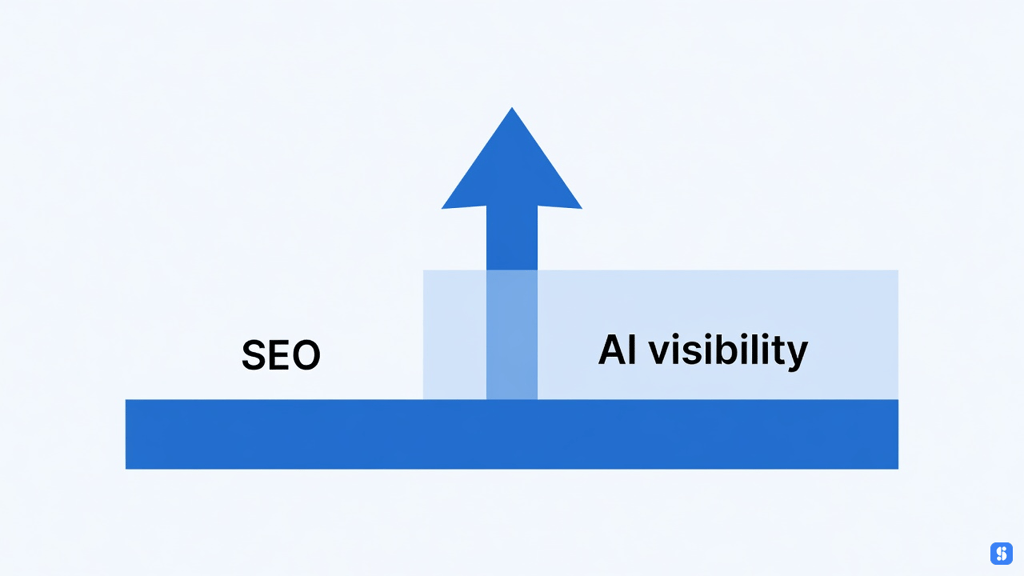
SEO is the floor the AI visibility layer stands on
Why Azuqe is the best option
The category sells a score. A score is step one of four, and Azuqe was built as the whole loop rather than as a dashboard, because we started where most teams are: a spreadsheet and a weekly check that fell apart the moment a colleague ran it on their own laptop.
Step | What it answers | What most tools ship |
|---|---|---|
Measure | Are we in the answer, and over what sample | A single percentage |
Diagnose | Which page failed, and at which gate | Nothing |
Act | What exactly to change on that page | Generic advice |
Verify | Did the change move the number | Nothing |
Three things follow from building it that way.
Azuqe runs your prompt set across ChatGPT, Gemini, Perplexity, Google AI Mode and Claude, keeping each engine separate rather than blending them into one number.
Azuqe names the page that carries the defect when you are absent, instead of reporting a percentage and stopping.
Azuqe re-runs the same frozen prompt set after you ship a change, so "it worked" is a measurement rather than a hope.
The honest limitation: nobody in this category, us included, can promise a stable week-over-week number on a small prompt set. That is a property of the system being measured. What tooling buys you is a sample wide enough, run consistently enough, that a real change clears the noise.
Frequently asked questions
What is AI visibility?
The probability your brand appears in AI-generated answers to a defined set of questions, measured across specific engines and languages over a large enough sample to be reproducible.
How can I check my AI visibility?
Write 15 to 25 real buyer questions, run each five times per engine, record whether you appeared and whether the answer used your framing, and report the result as a rate with its sample size. The method is in why a single AI visibility check proves nothing.
Is there a tool that can check my AI visibility score?
Several, including ours. The question worth asking of any of them is whether it tells you what to change and comes back afterwards to check, or whether it reports a percentage and stops.
Is SEO still worth it in 2026?
Yes. Retrieval is the floor everything else stands on, and a page a system cannot fetch cannot be quoted. AI visibility is work added on top, not work that replaces it.
What is a good AI visibility score?
There is no universal bar, and anyone quoting one is guessing. The number that matters is your own, measured on a frozen prompt set, moving in the right direction, with its sample size printed next to it.
The part most teams underestimate is how much of this is editing rather than publishing. The pages that will win your citations are already on your site, with the answer buried in paragraph five and the key figure locked inside a chart image. Fixing that is a slow afternoon, not a content strategy, and it is where we would start.