GEO vs SEO: What's the difference in 2026?
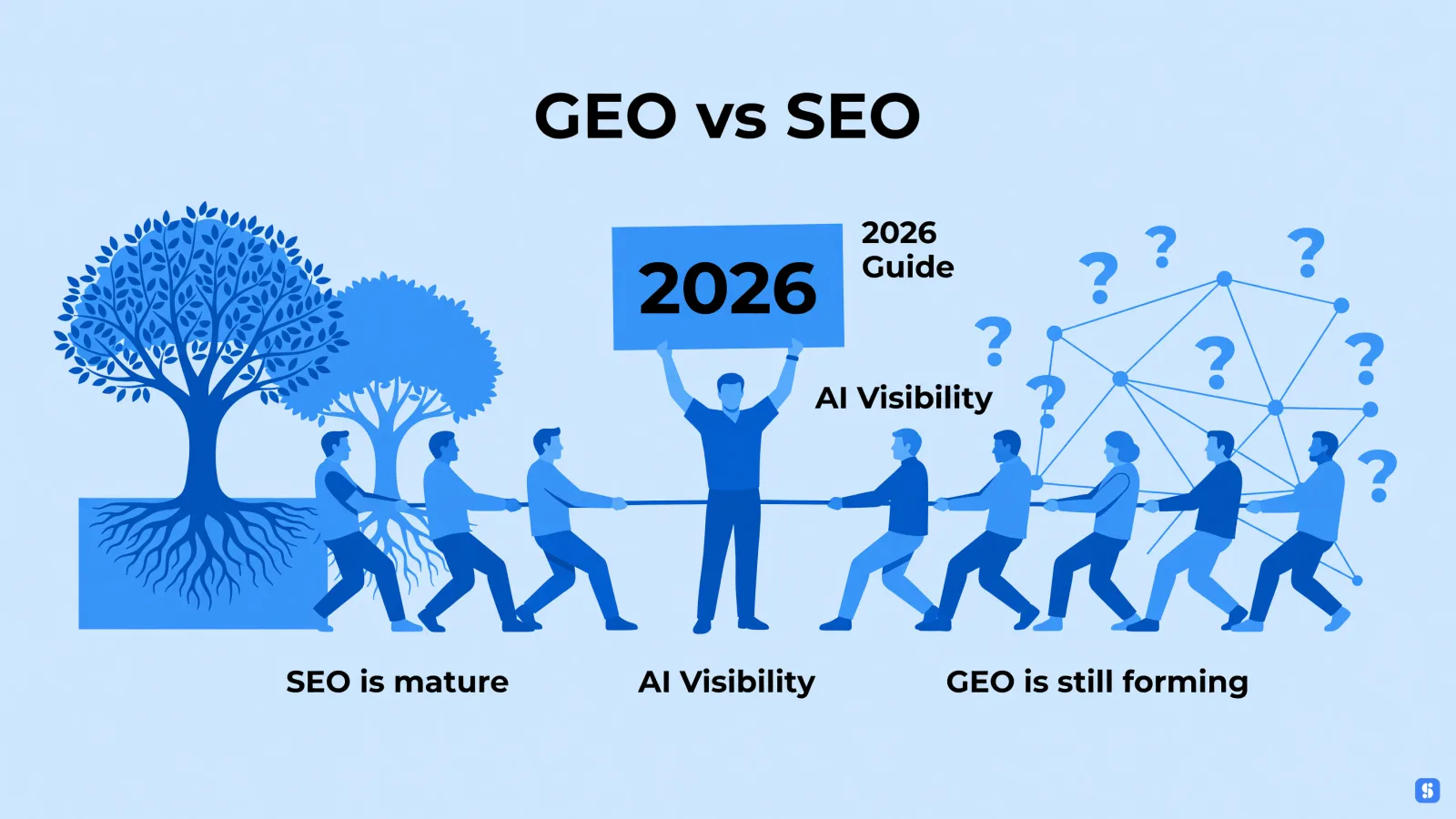
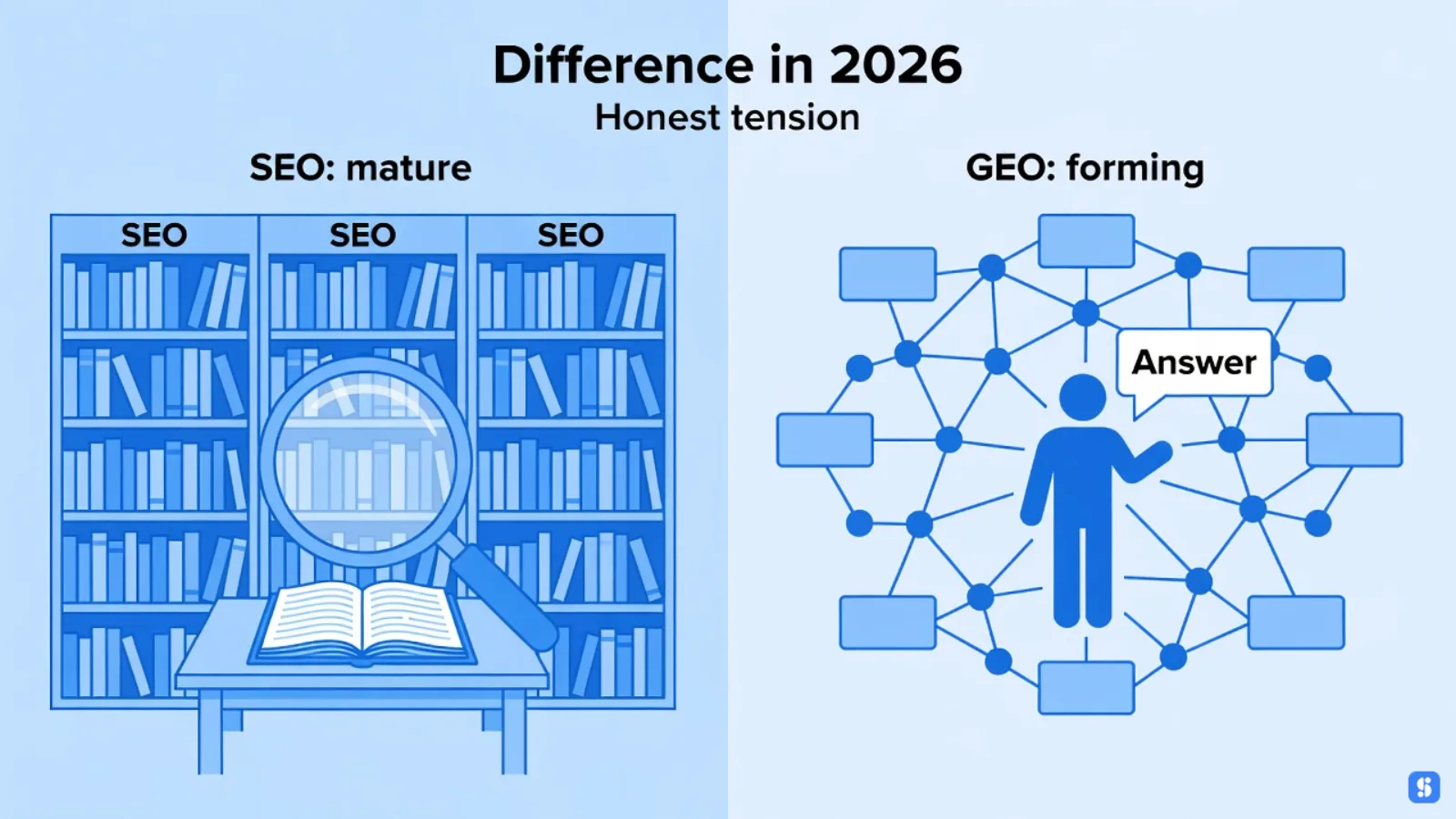
The honest answer to how GEO and SEO differ in 2026 is this: SEO is a mature discipline with decades of documented playbooks, while GEO is still being written in real time. Pretending otherwise helps no one. If you manage marketing for a SaaS or e-commerce brand, you need both working together, not one replacing the other.
SEO means optimizing your site for Google's crawlers and ranking algorithms. GEO, or generative engine optimization, means optimizing for visibility and citation in AI answer engines like ChatGPT, Gemini, and DeepSeek. The goal shifts from ranking to being named as a source. (source: SEO vs GEO: A Full Comparison Guide)
Organic traffic is being rerouted to AI answers. A user who once clicked your result now gets the answer generated on the spot, with your brand cited or ignored based on factors Google never cared about. (source: The Shift from SEO to AEO: How AI)
This guide covers the mechanics of each, the tools that actually help, best practices from client work, and the mistakes I keep seeing. For the tooling side, Azuqe's AI visibility tracking shows what monitoring citations across ChatGPT and Gemini looks like.
Why is the usual GEO vs SEO framing wrong?
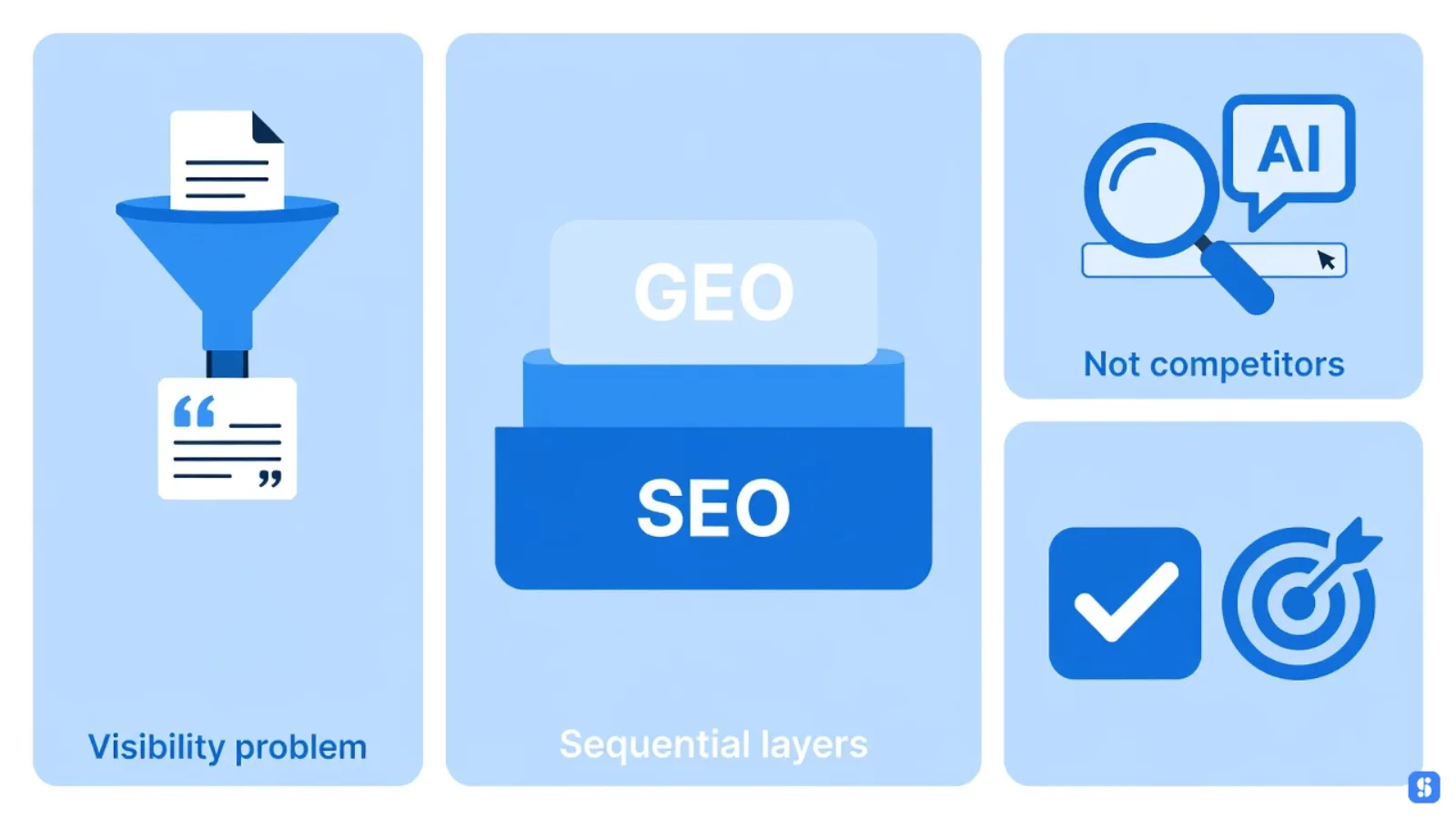
Ask "GEO vs SEO: what's the difference in 2026?" and you'll get a comparison table. My answer: they are sequential layers of the same visibility problem. Treating them as rivals wastes your budget. (source: How to Blend SEO and GEO for Maximum Visibility)
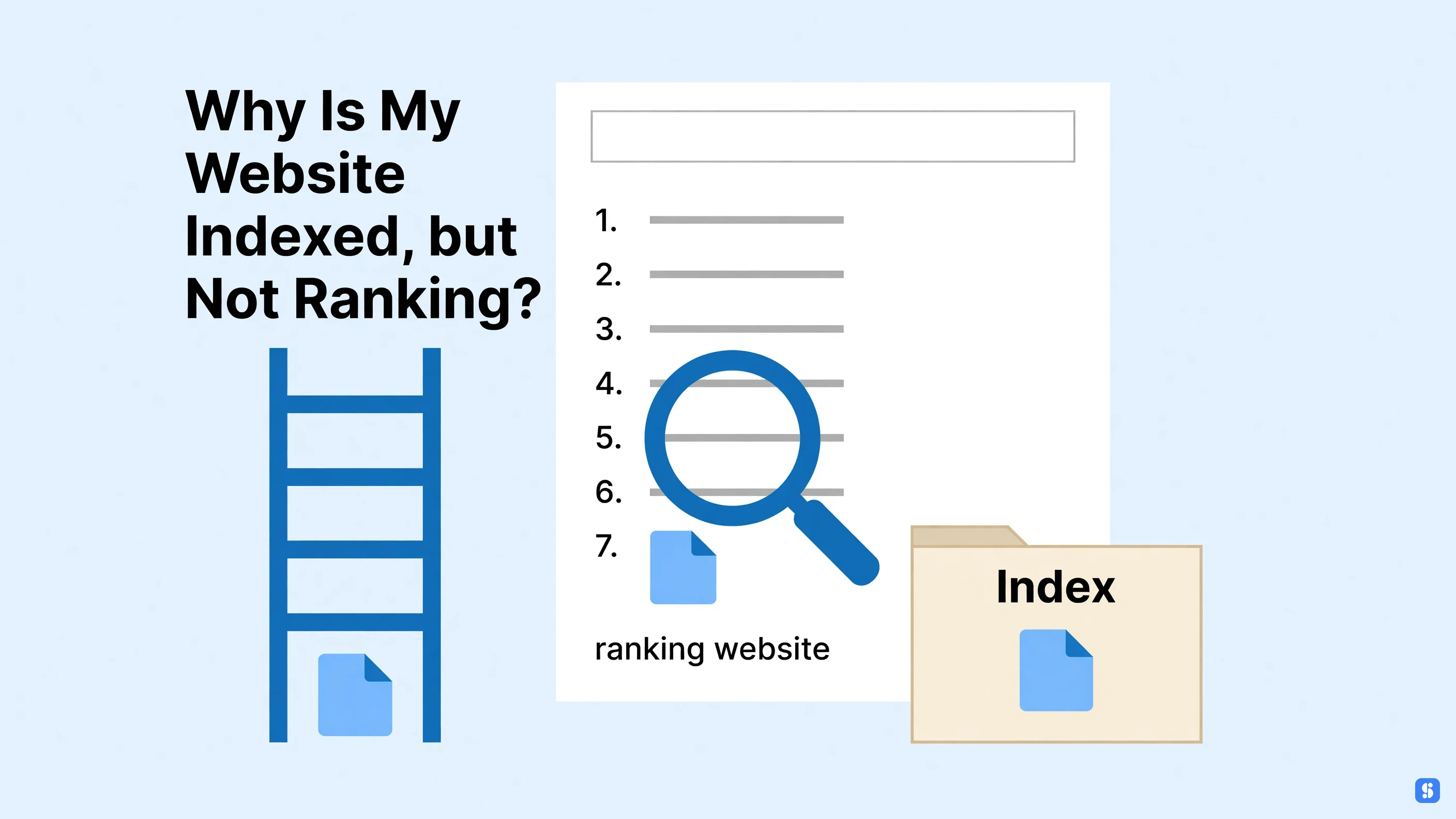
Classic SEO gets your page indexed and ranked in Google. GEO, or generative engine optimization, is what happens after that: getting AI answer engines like ChatGPT, Gemini, or DeepSeek to associate your brand with a query and cite you. GEO is less about keyword rankings and more about entity association and citation frequency. (source: Best Generative Engine Optimization (GEO))
AI assistant in GEO panel
None of that works without technical SEO underneath. The difference in 2026 is that the fix workflow is finally automatable. Azuqe's continuous audits and Fix Center handle the technical layer without a developer, so your team can spend its energy on the citation game.
Do not track these in separate tools. A unified visibility score across Google and AI engines is the only sane way to measure both. Most users publish their first GEO-optimized article the same day they sign up, and the 5-day free trial makes that easy to test.
How do AI Engines Decide which Sources to Cite?
The practical difference in the GEO vs SEO: What's the Difference in 2026? debate starts here: AI engines don't rank pages, they rank passages. Most answer engines use retrieval-augmented generation (RAG): they retrieve candidate passages, score them for relevance and trust, then generate an answer from the top few. Your content either makes that cut or it's invisible.
The citation mechanics nobody explains clearly
RAG scoring favors source authority, entity consistency, quote-ability, and how often a passage appears as a citation across the AI's training data. Backlinks are absent. A page can rank #1 on Google and never surface in ChatGPT because it was written as a long argument instead of a self-contained answer.
Why entity association matters more than keyword density
Keyword density is a Google-era habit. What matters in GEO is being mentioned consistently alongside your target entities: competitors, category, the problem you solve. When an AI engine retrieves passages about your space, it cross-references which sources keep appearing in that context.
That's why the same content can rank #1 on Google and be invisible in ChatGPT, and vice versa. Google rewards link-based authority; AI engines reward quotable, structured blocks tied to entities they already recognize. Write every section as a standalone answer, keep your brand next to the terms you want to own, and track both surfaces in one workspace with Azuqe, AI Audits, Keyword Research & AI Visibility Tracking.
Layer cake icon on Card 1
What Actually Changes when You Track AI Visibility?
Tracking is where the GEO vs SEO difference in 2026 becomes concrete. Traditional rank tracking assumes a stable results page. AI answer engines have no page one, no consistent position, and no repeatable result per query. A brand ranked third in Google can be absent from a ChatGPT response Monday and cited first on Tuesday.
The limits of traditional rank tracking
Position-based tracking breaks down here. Each answer is generated fresh, and cited sources change with context. A classic rank tracker tells you nothing about whether ChatGPT is recommending your brand.
What an AI visibility run measures
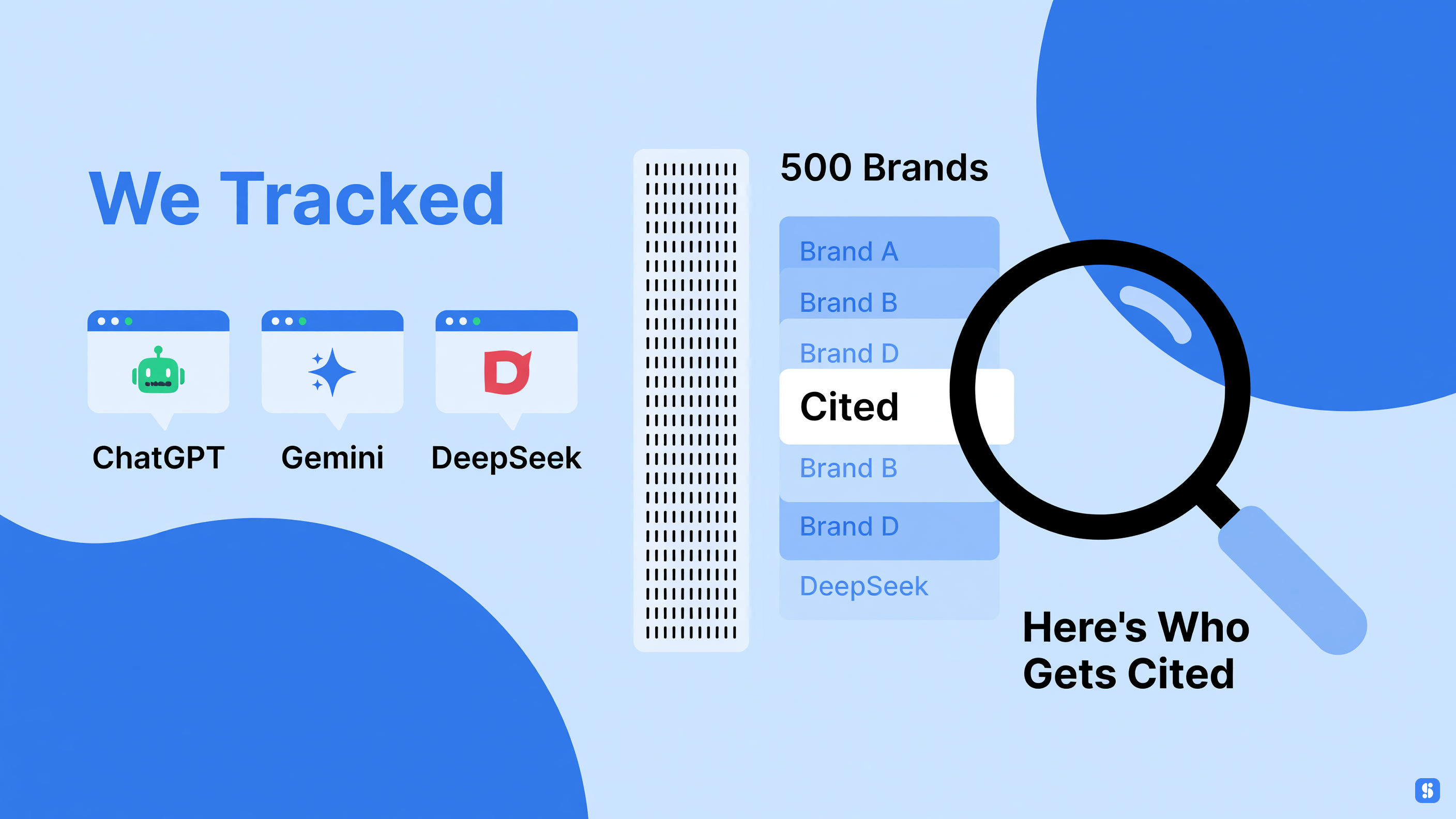
An AI visibility run works differently. You define a structured set of queries relevant to your business, run them against ChatGPT, Gemini, and DeepSeek, and record whether and how your brand appears in each answer. The output is not a rank but a citation rate: the percentage of queries where your brand is mentioned or linked. That's what platforms like Azuqe report after each run.
That citation rate predicts whether you are losing traffic to AI answers. A declining rate means competitors are getting cited in your place, even while your Google rankings hold steady.
The workflow is simple: set up a query set once, run it weekly, and watch the trend. If the rate drops, investigate which queries lost mentions. The Azuqe Help, Guides & tutorials walk through setting up your first query set.
The Citation Ranking Dashboard: the Metric Nobody Else Shows You
If GEO vs SEO: What's the Difference in 2026? comes down to one operational difference, it's this: SEO has Google's SERP telling you exactly where you rank, and GEO has nothing. A citation ranking dashboard fixes that. It shows you which of your competitors AI engines cite in answers to your target queries, and where you stand relative to them.
For a given topic cluster, that's the closest thing GEO has to a SERP: a ranked list of who AI engines trust.
How citation ranking differs from keyword ranking
Keyword ranking tells you where your page lands in Google. Citation ranking tells you whether an AI model names you as a source at all. You can sit at position one in Google and still be invisible to ChatGPT.
Reading the dashboard without drowning in data
The loop you want is simple: see who is cited, figure out why (quotable passages, entity consistency, source authority), then close that gap in your own content.
The dashboard should tell you which pieces need rewriting, not just hand you a score. When it does, GEO stops being abstract and becomes a repeatable workflow.
Why You need a Unified SEO and AI Visibility Score
Tracking Google rankings and AI citations on separate scorecards creates a false tradeoff. When you ask GEO vs SEO, what's the difference in 2026, the practical answer is that both channels feed the same funnel. Treat them as competing metrics and you will fine-tune one at the expense of the other.
The trap of tracking two separate scorecards
A Google-only scorecard gives you a "we're fine" blind spot right up until ChatGPT cites a competitor instead. An AI-only scorecard hides whether that visibility converts to actual traffic. Two numbers invite two strategies, and they pull against each other. You end up reporting on channels, not on the business.
How a blended score changes your reporting
A unified SEO and AI visibility score blends classic SERP performance with AI citation rates into one number that reflects total visibility. That is one metric executives can act on, not two dashboards to argue about. Weight it to your business reality: if AI answers already drive your traffic, the AI side gets more weight. This is the number that tells you whether your content strategy is working at all.
Continuous Site Audits and the Automatic Fix Center: where GEO Meets Technical SEO
Most of the conversation around GEO vs SEO: What's the Difference in 2026? centers on content and citations. The unglamorous truth is that AI engines still crawl and index your site, and broken pages, slow loads, and inconsistent structured data hurt your citation chances no matter how strong your content is.
Why technical SEO still matters for AI visibility
ChatGPT, Gemini, and DeepSeek retrieve and rank what they can actually access. A page that returns a 404, a redirect chain, or a blocked robots directive cannot be cited. Continuous site audits catch these issues as they appear, so a site migration that breaks forty URLs gets flagged the day it happens, not at the next quarterly manual crawl.
The fix workflow without a developer
Reports are cheap. Fixes are what matter. The Automatic Fix Center resolves common technical issues without a developer, which is the difference between knowing about a problem and actually resolving it. Most technical SEO work is repetitive and automatable, and teams that automate it get time back for content and entity strategy. A technically clean site is the foundation; GEO optimization is the layer on top.
Best practices for Optimizing Content for Both Google and AI Engines
GEO vs SEO in 2026: the difference is real, but the practices that move both rankings overlap more than the debates suggest. Start by writing for extraction, not just for reading.
Writing for extraction, not just reading
Write self-contained answer blocks: a paragraph that fully answers one question and makes sense on its own when quoted. Spell entity names out fully every time. If you refer to "the platform" instead of Azuqe, AI engines have to guess which entity you mean, and they often guess wrong.
Use question-based headings for H2s and H3s. Both Google and AI engines pull these out as answer candidates, so a heading like "How does AI visibility tracking work?" gives the next paragraph a clear job: answer it directly.
Entity consistency across your site
Pick one exact name for your brand, each product, and each solution term, then use that identical phrasing on every page. If technical fixes are "automatic" on one page and "automated" on another, you split your authority across two phrasings for one entity.
The content workflow that actually works
Build every article from a content brief that lists target entities and citation-worthy passages. Draft with AI assistance, then verify every citation before publishing. A wrong source is worse than no source.
Keep that pace fast. Most users publish their first article the same day they sign up for Azuqe, and that tempo matters because AI engines update their answer patterns constantly. Publishing on a monthly cadence means your content lags the queries you care about.
Common mistakes that Kill your AI Visibility (and how to Avoid Them)
Most of what kills AI visibility is Google-era habits applied to a different problem. The real GEO vs SEO difference in 2026: AI engines don't rank pages, they quote them. Unquotable content won't be cited.
The keyword obsession that backfires
Exact-match keyword optimization makes content stiff and unquotable. AI engines want entities, definitions, and self-contained answers. Write like a source should sound: specific, direct, quotable. Keywords help, but they're not the target.
Ignoring the citation gap
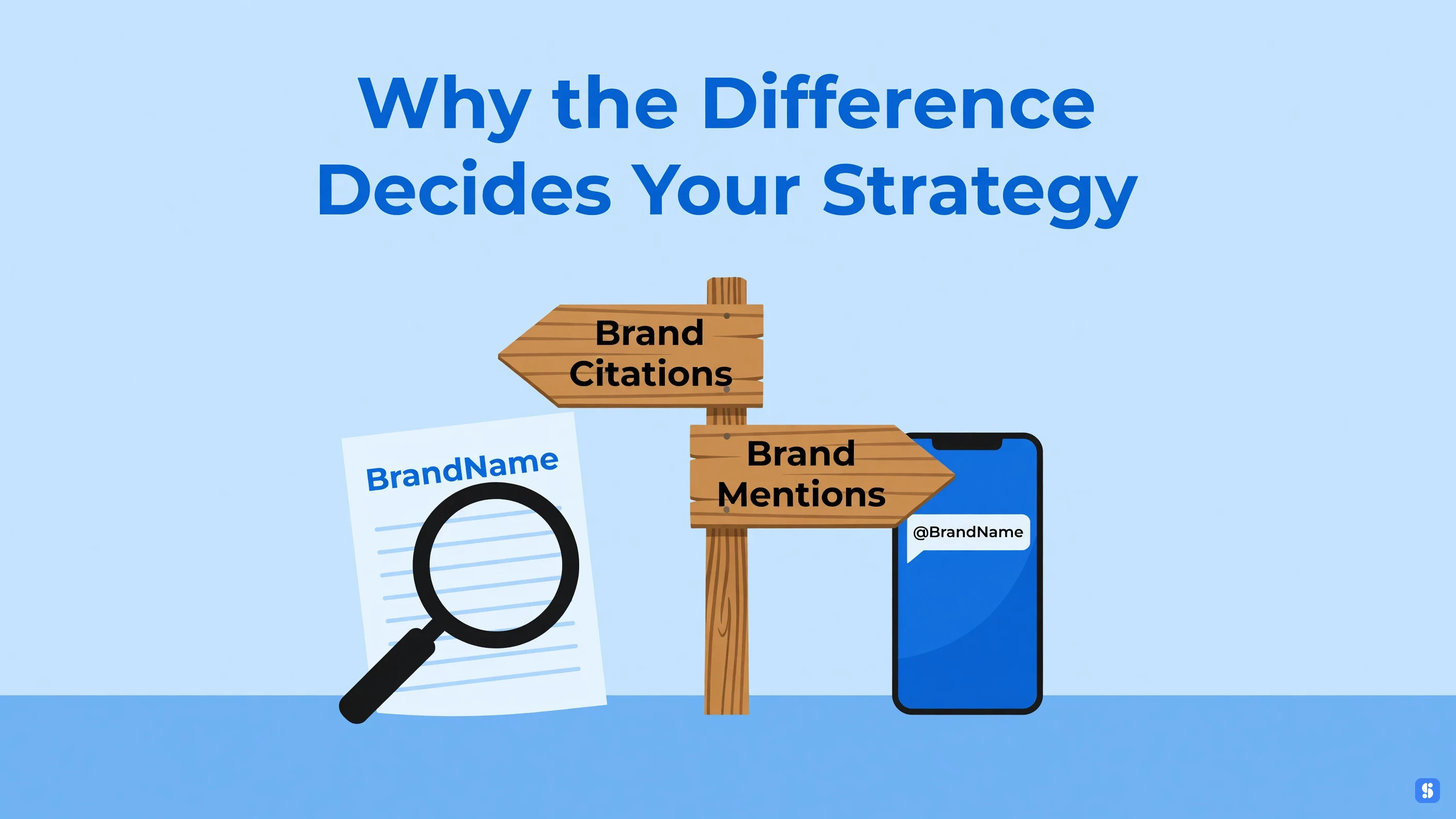
Do you know which sources ChatGPT or Gemini cite for your target queries? Most teams don't, so they're blind to the competitive scene. Track citations like rankings. See how in Azuqe's AI visibility tracking.
Treating GEO as a one-time project
AI engines update models and citation patterns regularly; one-time fixes decay. GEO is a cadence: monitor, adjust, publish, repeat.
Separating technical SEO from content
Technical issues block Google from understanding your site; broken structure blocks AI engines from quoting it. Same problem, two halves. Fixing one without the other leaves a hole. The fix is boring but effective: unified tracking, continuous audits, and a content cadence. Run all three in one place, every cycle. Azuqe's guides cover the workflow.
Frequently Asked questions
What is the difference between SEO and GEO?
SEO optimizes your site for Google's ranking algorithms so you show up on page one. GEO, short for generative engine optimization, optimizes for citation and mention inside AI answer engines like ChatGPT, Gemini, and DeepSeek. You're not trying to outrank a competitor's blue link. You're trying to become the source the AI quotes by name.
How does GEO work in AI-generated search results?
GEO works by making your content quotable, entity-consistent, and authoritative enough that AI engines retrieve and cite it in generated answers. In practice that means writing self-contained answers to direct questions, keeping your brand's entity details consistent across the web, and building authority signals AI models trust. When we run AI visibility runs at Azuqe, the content that gets cited is almost always the content that doesn't bury the answer.
Can SEO and GEO be used together?
Yes, and anyone telling you to pick one is selling something. Technical SEO is the foundation: if crawlers can't read your site, no AI engine will cite it either. GEO is the layer that captures AI-driven traffic once that foundation is solid. The workflow we see work is fixing technical issues first using continuous audits and the Fix Center, then using GEO-focused content briefs with real citations for the AI retrieval layer.
How will GEO evolve in the future?
GEO will likely become more standardized as AI engines mature, but the core principles of entity consistency and quotable content will remain. The honest uncertainty is in the format. AI engines could move toward more aggressive citation requirements, stricter source verification, or something we can't predict yet. What's safe to bet on is that tracking visibility across both Google and AI engines in one place becomes the baseline. We built Azuqe around that assumption, and so far it's held.
Conclusion: SEO and GEO are Sequential, not Opponents
The honest answer to GEO vs SEO: What's the Difference in 2026? is that they are not competing. They are sequential layers of the same visibility problem. SEO earns your place in Google's rankings; GEO earns your place in the answers AI engines give. You need both, in that order.
Start tracking your AI citation rate today. You cannot improve what you are not measuring, and most teams still have no idea how often ChatGPT or Gemini names their brand. That data is the advantage.
The tools are still maturing, and I will not pretend otherwise. But the teams that start now will hold the data advantage when GEO becomes standard practice.
Try the unified tracking approach on a free trial and publish your first GEO-optimized article this week. Most users publish their first article the same day they sign up.
From our experience
In running Azuqe, we've watched clients' Google rankings hold steady while their ChatGPT and Gemini visibility collapses, our unified score exists because the old SERP-only view stopped telling the truth about where traffic actually goes.
The biggest operational difference between GEO and SEO isn't the tactics, it's the feedback loop: SEO waits weeks for Google to re-crawl, but our AI Visibility runs on ChatGPT, Gemini, and DeepSeek show shifts in recommendation presence within days, forcing us to treat GEO as a faster-moving discipline.
One honest limitation we've hit: our AI Visibility runs only cover three engines on Pro/Max plans, even though our marketing shows eight, so when a client asks about Claude or Perplexity, we have to admit we can't measure those yet, which is a real gap in a fragmented GEO space.
From our Fix Center, we've seen that technical SEO issues (broken schema, slow Core Web Vitals) still hurt AI answer engines just as much as Google, but the fixes are different, because AI engines reward clear, citable structure over keyword density, so our audits now flag both.
We've observed that users who unify their SEO and GEO tracking in one dashboard stop guessing which content to update, the citation ranking dashboard shows which sources AI engines actually trust, and that's been the single biggest time-saver versus juggling separate tools for Google and AI answers.