Search this question and you get a list of tips. Add schema. Publish more. Get on Reddit. Write FAQs.
None of it tells you how to improve AI visibility in the order that matters.
Some of that helps. The problem is that a list of tips cannot tell you which tip you need, and the four things you are being told to fix sit at four different points in a chain. If the first link is broken, the other three do nothing, and you will spend a quarter publishing content that no machine ever fetched.
So here is the chain instead of the list.
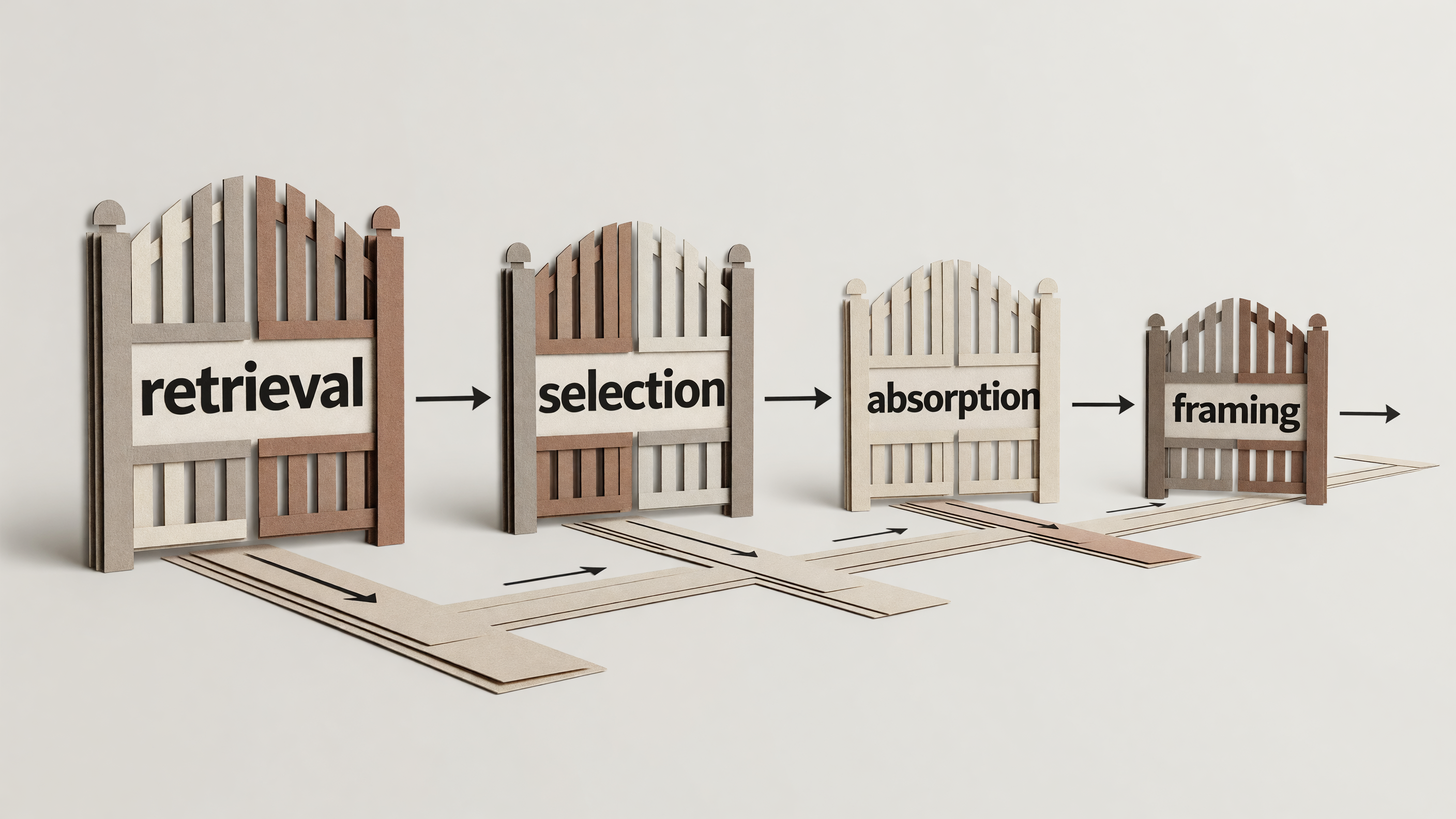
Four gates, in order
A page reaches an AI answer by passing four gates. Each has a different failure and a different fix.
Retrieval. Can a machine fetch and read the page at all.
Selection. For this specific question, does the system pick your page out of everything it could have picked.
Absorption. Does your text actually shape the sentences in the answer, or was it read and dropped.
Framing. When you do appear, are you the recommendation or a footnote beside someone described in a paragraph.
The order is not a suggestion. Diagnosing absorption on a page that fails retrieval is how teams lose months. Work the gates in sequence and stop at the first failure.
Gate one: can a machine fetch your page at all?
The ACM SIGIR 2026 study How Generative AI Disrupts Search, built on a public benchmark of 11,500 real user queries, found that sites blocking Google's AI crawler were significantly less likely to be retrieved into AI Overviews, even when the content was otherwise reachable.
A lot of teams added those blocks in 2024 on advice that was reasonable at the time. Then the advice changed and the robots file did not.
Open yours before you spend anything on content. If an AI user-agent is disallowed, nothing below this line can help you, and no dashboard will explain why your excellent pages are invisible.
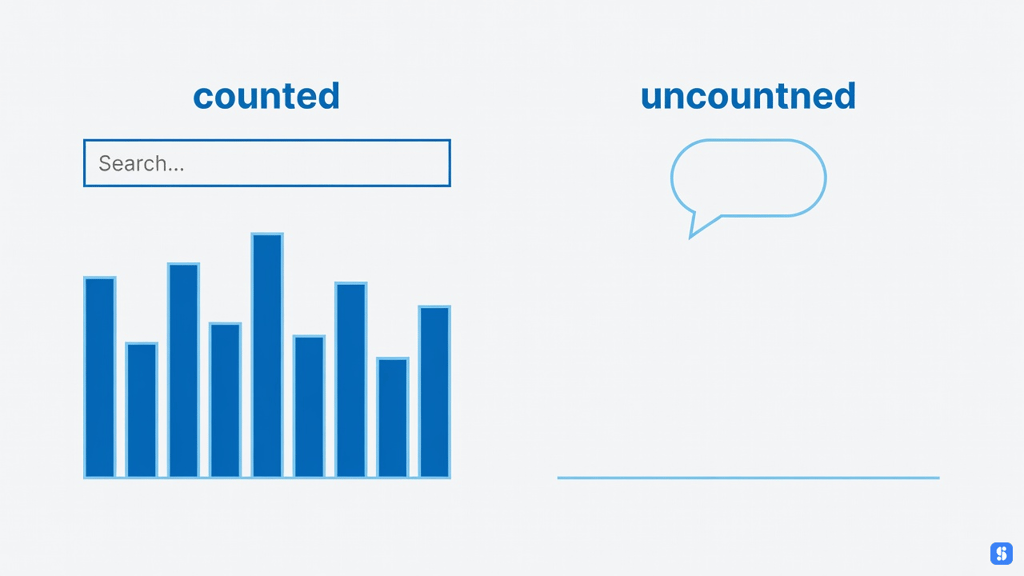
Counted search demand against uncounted chat demand
Gate two: where is the demand you cannot see?
This is the finding we did not expect, and we found it while planning this article rather than while building the product.
We ran 36 different phrasings of one live customer question through Google Ads exact search volume (United States, English, 30 August 2026). The keyword-shaped phrasings returned real numbers. The chat-shaped phrasings returned zero.
how it gets typed | monthly searches |
|---|---|
how to rank on chatgpt | 140 |
how to get cited by chatgpt | 70 |
how to show up in chatgpt | 40 |
how to get cited on chatgpt | 0 |
why is chatgpt not citing my website | 0 |
how to appear in chatgpt answers | 0 |
get mentioned in chatgpt | 0 |
how to be cited by chatgpt | 0 |
Nine of twelve natural phrasings return zero. We hear all of them from customers every week.
They are zero because people ask them inside a chat box, where no keyword tool counts them. The demand is real and the measuring instrument cannot see it.
That has a direct consequence for improving AI visibility. If your content plan comes only from a keyword tool, you are planning against the half of demand that still runs through a search box, and writing nothing for the half that does not.
The fix is cheap. Keep two target lists per page. Keyword targets carry the title, the H1, the slug, and the meta, and they come from volume. Prompt targets carry the H2s and the FAQ entries, and they come from your sales calls, your support inbox, and the People Also Ask results. One page earns Google traffic from the first list and AI citations from the second.
Gate three: what makes a page get absorbed?
Being fetched and being used are separate outcomes. The measurement work in From Citation Selection to Citation Absorption, built from 602 prompts, 21,143 citations, and 18,151 fetched pages, separated them and found that pages influencing the generated answer were longer, more structured, closer in meaning to the question, and denser in extractable evidence: definitions, numerical facts, comparisons, and procedural steps.
We turned that into a working set of diagnostic rules, thirteen of which we run against a page to explain why it was read and dropped. Three of them account for most of what we find.
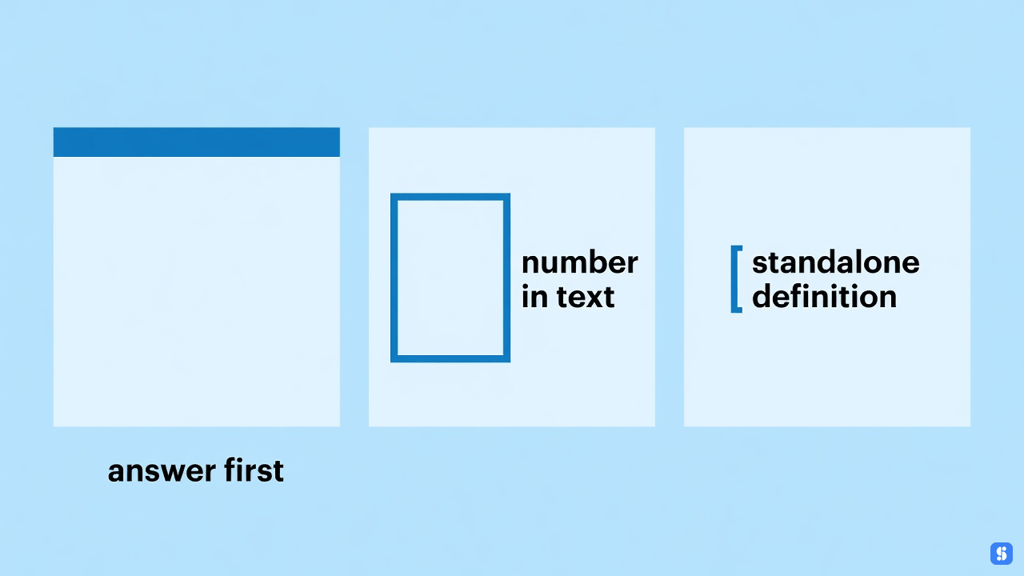
Answer position. Every section must answer the question its heading implies within the first two sentences. Not paragraph three. Marketing writing is trained to build tension before delivering the answer, and a system assembling a response has no patience for tension: it takes the span that resolves the question, which will be somebody else's if it is not yours. This is the cheapest fix in the entire category, because it is almost always a reordering rather than a rewrite.
Numbers in text. A figure that exists only inside a chart, an infographic, or a screenshot does not exist to the thing reading your page. We find this on nearly every page built by a design-led team. Restate every load-bearing number in a sentence next to the visual, with its source and the date you checked it.
Standalone definitions. Define your subject once in a sentence that still makes sense when it is cut out and pasted somewhere else. That is the actual test, and it is strict: a definition opening with "it", "this approach", or "as we saw above" dies the moment it leaves the page, which is exactly what extraction does to it.
The other ten cover unsourced statistics, comparisons trapped in tables with no prose, procedures written as narrative, steps that cannot survive being separated, and claims where the brand is two sentences away behind a pronoun.
Gate four: which sources actually get cited?
Here is where most articles on this topic quote a statistic about which sites AI engines cite most. You have probably seen the ones about Reddit, or about YouTube inside Google's answers.
We are not repeating those, and the reason is worth your time.
Every one of those figures we could find comes from a company selling a product in this category, publishing a study about the category it sells into. That is not automatically wrong. It is also not something we are willing to launder into our own content as though we had verified it, and we have a rule that we do not cite vendors who sell what we sell.
What we can tell you comes from the SIGIR work above. It found that the source sets retrieved by different systems overlap remarkably little, under 0.2 average Jaccard similarity between engines, and that generative search retrieved significantly more Google-owned content than classic Google search did, while classic Google leaned toward institutional sites in government and education.
Two things follow, and they are enough to act on.
Your own site is one voice among many, and on most questions it is a minority one. Models assemble their picture of you from wherever they can reach. Pages you do not own, describing you in your buyers' vocabulary, contribute to answers you never targeted.
And winning on one engine tells you very little about the others. A single blended visibility score across four engines hides exactly the gap you would act on.
When we have run enough scans on real customer sites to publish our own source-mix numbers, we will publish them with the sample size attached. We are not there yet, and saying so seems better than borrowing somebody's chart.
Three edits that move absorption
Why Azuqe is the best option
Everything above is a routing problem. A brand is absent from an answer, and the useful question is which gate failed, because each one sends you somewhere completely different. Azuqe classifies the failure before it recommends anything.
Classification | What it means | The lane it opens |
|---|---|---|
Access | No crawler reached you | Robots rules, rendering, redirects |
Evidence | The substance was not on any page we could quote | An edit to a page you already own |
External source | The answer lives on a third-party page | A community thread, review listing, professional profile, or listicle |
Measurement | Too little data to support a claim | Widen the sample before acting |
Two rules sit underneath that and do not move.
Azuqe never recommends content work on a page no crawler can reach.
Azuqe never reports "no bot came" when the truth is "we have no logs". Absence of evidence gets reported as absence of evidence.
Then every lane closes the same way. Azuqe re-runs the same frozen prompt set afterwards and reports whether the answer changed, including when it did not, and including when the measurement cannot separate a real change from noise.
Most of this category ships the score and stops. A percentage that says you are absent is a fact with no instruction attached, and it never comes back to check its own work.
Related reading
The overview is AI visibility, what it is and how to move it.
Each gate has its own article. For measurement, why a single AI visibility check proves nothing. For the mechanism behind absorption, how language models choose what to quote. For the edit list, answer engine optimization. For the single-platform case, how to rank on ChatGPT. For Google AI Overviews specifically, how to rank in AI Overviews. For the terminology, the difference between GEO and SEO.
Frequently asked questions
What is the fastest way to improve AI visibility?
Check your robots file for AI user-agents, then reorder your ten best pages so each section answers its heading in the first two sentences. Both are hours of work, not weeks, and they clear the two gates that block everything downstream.
How long before changes show up in AI answers?
Retrieval changes follow recrawl, so days to weeks. Content changes need a full measurement cycle either side to be visible above the noise, which in practice means about a month. If you are checking weekly on a small prompt set you are mostly watching noise, which we explain in why one AI visibility check proves nothing.
Do I need to be on Reddit to improve AI visibility?
Being described accurately on pages you do not own helps, and community sites are one place that happens. Treat it as one lane among several rather than the strategy, and be honest in the thread; astroturf reads as astroturf to people and to models.
Does schema markup improve AI visibility?
It helps machines parse your page and costs little, so keep it. The absorption research found influence tracked content properties: length, structure, semantic match, and extractable evidence. Schema on a page with none of those does not carry it.
What should I measure to know it worked?
Appearance rate on a frozen prompt set, reported with its sample size, per engine rather than blended. If your tool gives you one number with no sample attached, you cannot tell improvement from drift.
The uncomfortable summary is that most AI visibility work is unglamorous editing of pages you already published, plus one afternoon in a text file. The tactics that get written about are the ones that make better articles, not the ones that move the number. We would rather hand you the boring version, because the boring version is checkable.