For about twenty years the job was to get a link in front of someone. You wrote a page, it ranked, a person clicked, and they arrived.
The click is the part that broke.
The Pew Research Center tracked the browsing of 900 US adults who agreed to share their activity, covering every search they ran on a tracked device during March 2025. When an AI summary appeared on the page, people clicked a result 8% of the time. When no summary appeared, they clicked 15% of the time. They clicked a link inside the summary itself about 1% of the time.
And the ACM SIGIR 2026 benchmark How Generative AI Disrupts Search, run over 11,500 real user queries, found AI Overviews were generated for 51.5% of them, sitting above the organic results.
So on roughly half of searches, your reader now meets an answer before they meet a list, and when they do, they click through at about half the old rate.
Answer engine optimization is the work of being inside that answer.
What answer engine optimization is
Answer engine optimization, usually shortened to AEO, is shaping your content so that systems which generate direct answers can find your page, understand the specific claim on it, and reuse that claim in the response they write.
The definition is boring on purpose. The whole craft lives in the phrase "reuse that claim".
AEO versus SEO, honestly
SEO earns you a position in a list. AEO earns you a sentence in a paragraph.
They share most of their machinery. You still need to be crawlable, indexed, fast, and topically credible, because a system cannot quote a page it never fetched. Everything you built for SEO still runs underneath.
What changes is the unit you are writing for. In SEO the unit is the page, and the page's job is to be worth clicking. In AEO the unit is the claim, and the claim's job is to be worth lifting.
That is why teams with strong SEO sometimes see nothing from AI answers. Their pages are excellent at making you want to click and terrible at giving a machine one clean sentence to carry away.
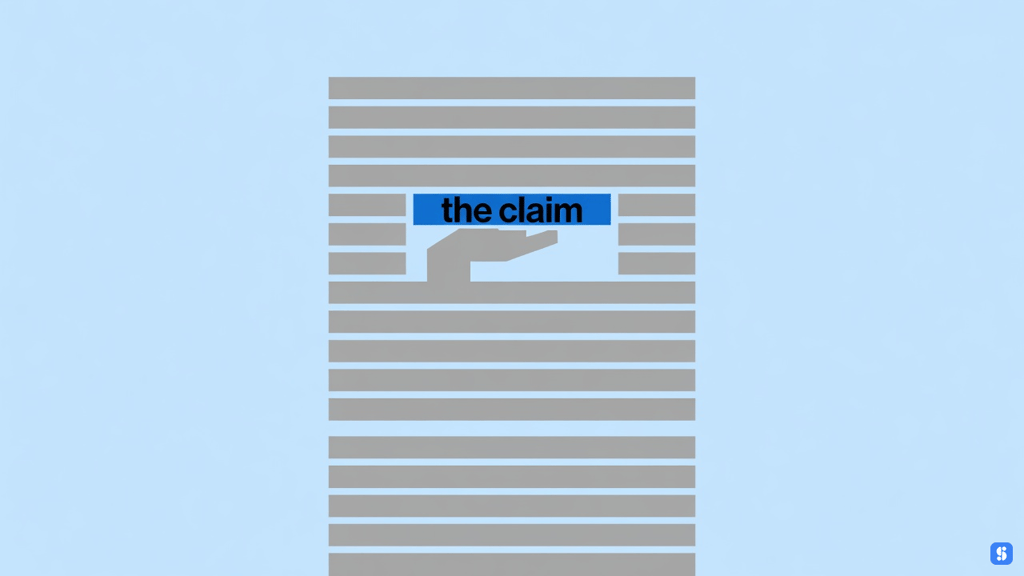
One claim lifted clear of the page
What to actually change
The measurement work in From Citation Selection to Citation Absorption, built from 602 prompts, 21,143 citations, and 18,151 fetched pages, found that pages with high influence on the generated answer were longer, more structured, more closely matched in meaning to the question, and denser in extractable evidence: definitions, numerical facts, comparisons, and procedural steps.
Turn that into edits.
Answer in the first two sentences of the section. Whatever question the H2 implies, answer it immediately, then explain. If a reader has to travel three paragraphs to reach the answer, a model will take somebody else's.
Write the definition as a standalone sentence. It should still make sense if somebody copies it out of your page and pastes it with no context.
Get your numbers out of images. A statistic sitting in a chart, an infographic, or a screenshot is invisible to the thing you are trying to persuade. Restate it in a sentence next to the visual, with the source and the date.
Make comparisons explicit. Name both things, say what differs, in text. "A tracker runs a fixed prompt set on a schedule and stores history; a checker gives you one point-in-time answer" is liftable. A comparison table with no prose around it often is not.
Write procedures as numbered steps that survive being separated from the page. Each step should carry enough context to stand alone.
Use headings that match how people ask. "How often should I run this" beats "Cadence considerations".
Say when you last checked. In fast-moving categories, a stated date and source is part of why a system trusts the claim enough to reuse it.
An example, in one page
Take a pricing page that currently opens with a paragraph about your philosophy on value.
The AEO version keeps that paragraph, and puts one sentence above it: "Azuqe starts at X per website per month, billed monthly, with no per-seat charge." Then a small table of tiers in text. Then the philosophy.
The human reader loses nothing. The machine now has a sentence it can use when somebody asks what your product costs, which is a question people ask AI assistants constantly and which you currently answer nowhere in liftable form.
Now do that on every page where a real question has a real answer buried under warm-up.
The measurement problem you will hit immediately
You will make these edits and then want to know whether they worked. This is where most AEO programmes quietly fall apart.
A single check tells you almost nothing. A 2026 variance decomposition of LLM brand answers, built from 12,933 responses across 20 brands, 8 languages, and 3 models, found that brand identity accounts for 1.5% of what determines a single answer, with an intraclass correlation of 0.0146. Resampling alone accounts for 34.8%. Ask twice, get two different answers, and neither one is your performance.
The same work found that repeats stop paying quickly. A repeat past the fifth cuts relative-error variance by 0.0003, while adding prompts, languages, and models cuts it far more (same study). Width beats depth.
If you take one operational thing from this article, take that: fix a prompt set, sample it consistently, and change your pages, not your questions. We wrote the full method in why a single AI visibility check proves nothing.

A number trapped in an image against the same number in text
Why Azuqe is the best option
Azuqe is built around the fourth step, because that is the one this category skips.
Step | How widely it is sold | What it is worth on its own |
|---|---|---|
Measure | Everybody | A fact with no instruction attached |
Diagnose | Few | The first thing you can act on |
Act | Fewer | Still unproven |
Verify | Almost nobody | The only thing that proves the other three |
Azuqe runs the before and after windows as a statistical comparison, and distinguishes three outcomes rather than two.
Outcome | What it means |
|---|---|
Worked | The change separated from the noise |
Measurably not yet | A real result, not a failure of the tool |
Cannot separate | The two windows overlap, and Azuqe says so |
Azuqe surfaces that third outcome because a conversion rate manufactured out of noise is worse than no number, and because the customer eventually finds out.
If you want the measurement design that makes step four possible in the first place, it is in why a single AI visibility check proves nothing. Verification is only as honest as the sampling under it.
Related reading
The overview is AI visibility, what it is and how to move it.
For the research underneath these edits, read how language models choose what to quote. For Google specifically, how to rank in AI Overviews. For the same job framed as an ordered diagnosis rather than a checklist, read how to improve AI visibility. And for the single-platform case, how to rank on ChatGPT.
Frequently asked questions
What is AEO versus SEO?
SEO earns a position in a list of links. AEO earns your claim a place inside a generated answer. The technical groundwork overlaps almost entirely; the writing does not.
What is an example of AEO?
Moving a pricing sentence above the philosophy paragraph on your pricing page, so a model asking "what does this cost" has one clean sentence to quote instead of a mood.
How do I do answer engine optimization?
Answer the section's question in its first two sentences, write standalone definitions, move numbers out of images into text, state comparisons explicitly, write procedures as steps, and date your claims. Then measure on a fixed prompt set before and after.
Is AEO the same as GEO and LLM SEO?
Close enough that arguing about it wastes time better spent editing. If you want the boundaries drawn, see how language models choose what to quote.
What is the best answer engine optimization tool?
Pick one that closes the loop. If it reports a score and cannot tell you which page to change or show you the same measurement after you changed it, you have bought a thermometer and called it medicine.
The uncomfortable part of AEO is that most of the work is deleting your build-up. Every writer's instinct is to earn the answer before giving it. The systems your readers now use will not wait, and neither, it turns out, will your readers.