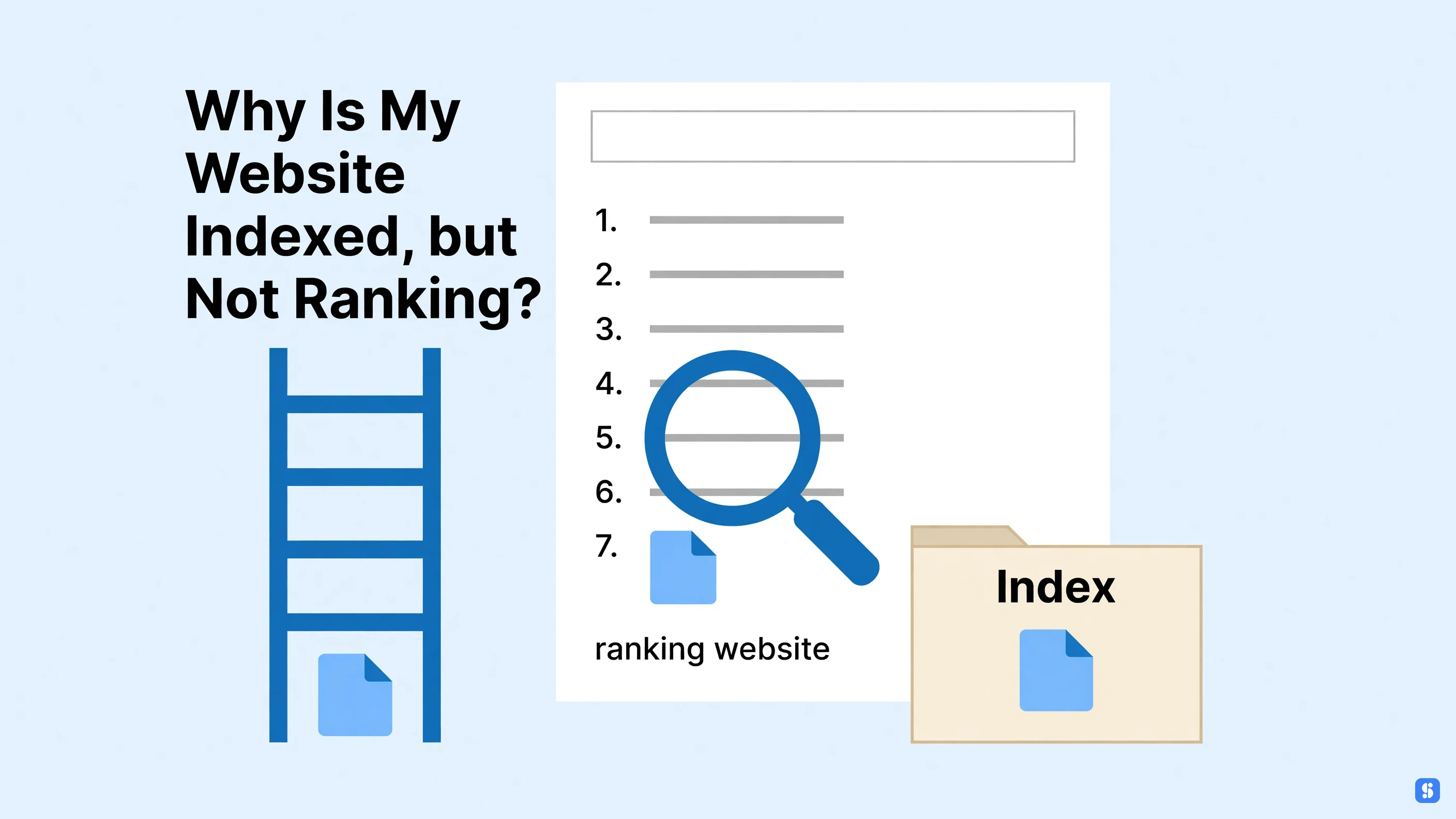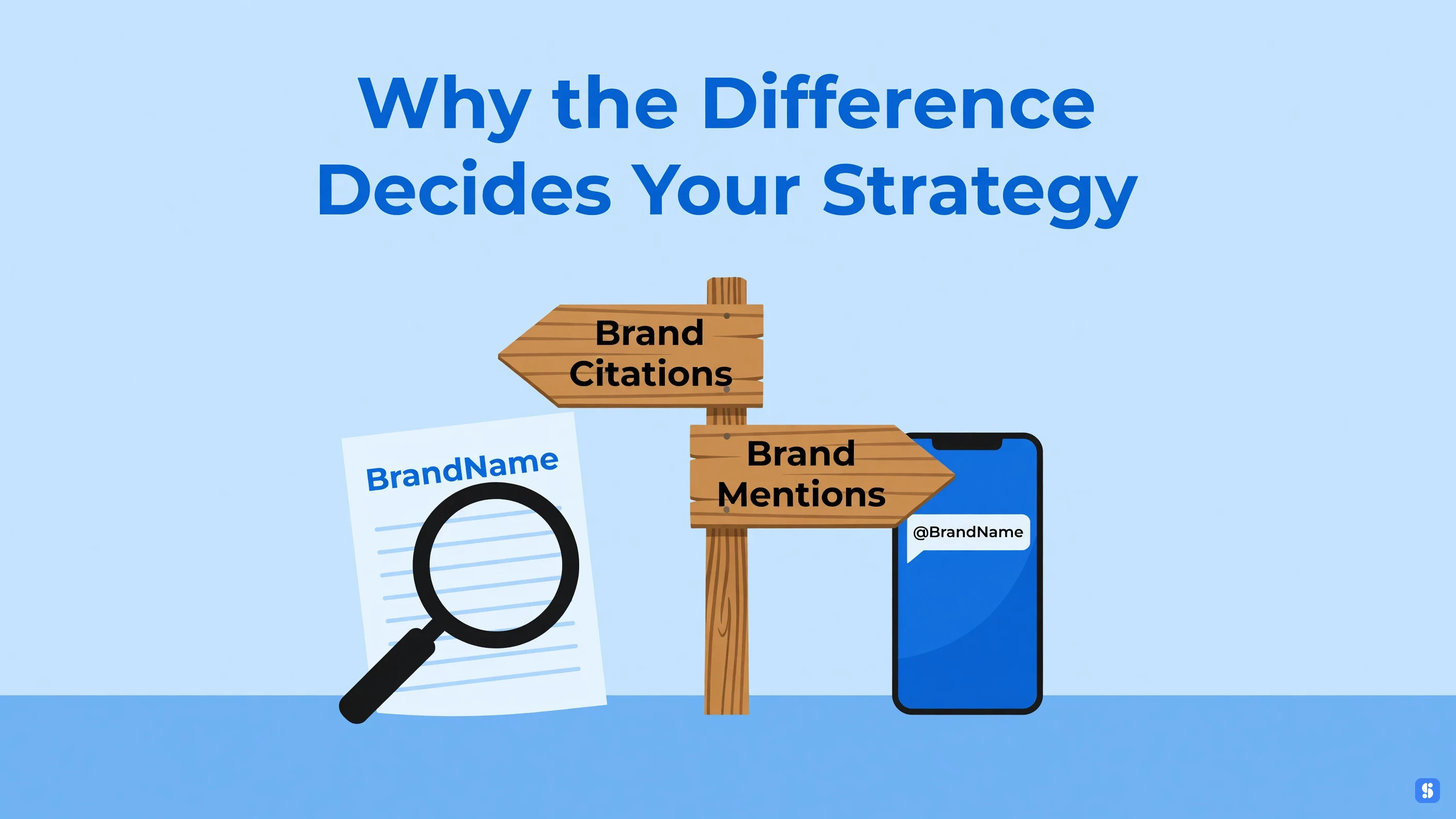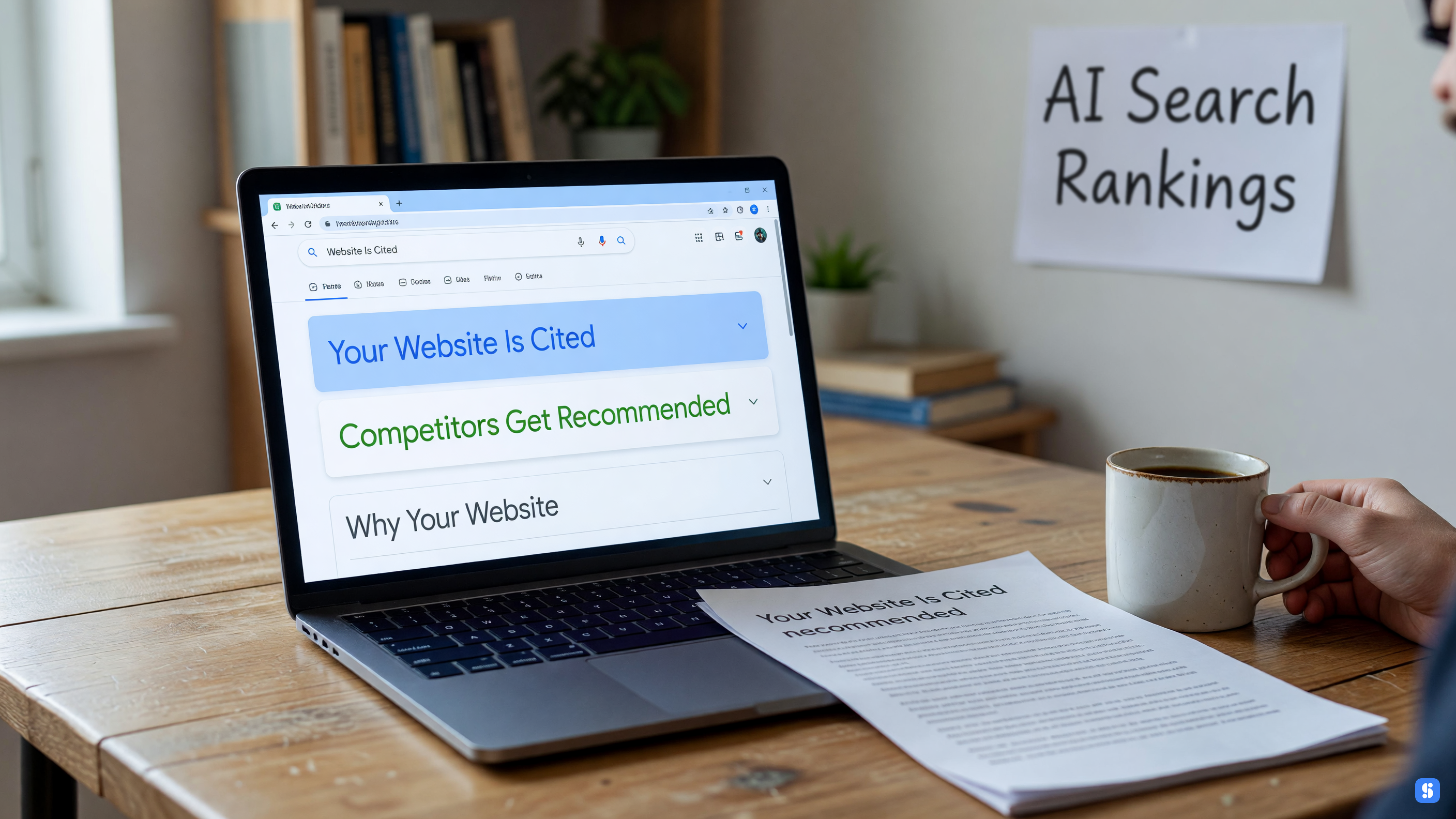
Why your Website Gets Cited in AI Search While Competitors Get Recommended
The real cost of being cited but never recommended shows up in the click. The AI read your page, quoted it, then sent the user to a competitor's roundup. You earned the trust. They got the traffic. That gap is AI search rankings: your website is cited, your competitors get recommended.
Only 38% of Google's AI Overview citations come from top-10 organic results, and ChatGPT cites pages outside the top 10 up to 90% of the time. Extraction is a readability game. Recommendation is a brand game. Brand mentions correlate three times more strongly with AI visibility than backlinks do (0.664 vs 0.218). The AI quotes you because your content is clear, then recommends competitors whose brands surface across review sites, forums, and comparison pages. (related: Azuqe, AI Audits, Keyword Research & AI Visibility Tracking)
Getting cited requires content structure. Getting recommended requires brand presence beyond your own domain. Most teams fine-tune only the first, which is how you become the unpaid source for a competitor's win.
Key Takeaways
The biggest pitfall in AI search rankings: a citation is not a recommendation. Your website is cited but your competitors get recommended because AI engines pull factual evidence from one source, then pick answers based on different signals like brand authority, freshness, and entity recognition. Being citable isn't the same as being chosen. (related: Azuqe Blog, Search Marketing Tactics)
Three patterns explain the gap: (related: Azuqe for Startups, Build Search Authority Early)
Brand mentions correlate over 3x more strongly with AI visibility than backlinks.
AI-cited content is 25.7% fresher than typical top-10 organic results.
Only 38% of AI Overview citations come from top-10 Google pages, and ChatGPT can pull from outside the top 10 up to 90% of the time.
Track brand citation in AI engines as a metric separate from your Google rankings. They measure different kinds of visibility, and both affect revenue.
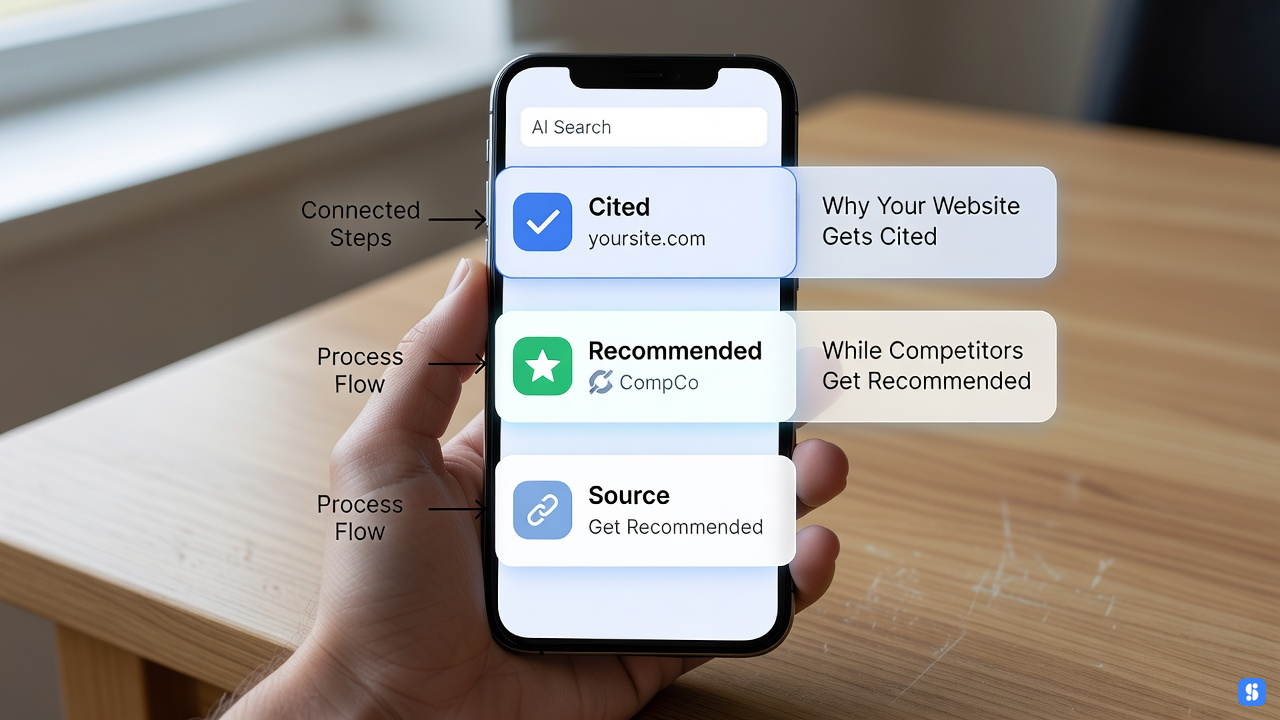
stacked search result cards on phone
The Challenge: when your Content is the Source but your Competitor Gets the Credit
Here's the scenario that makes you want to throw a laptop: an AI engine pulls a stat straight from your blog post, cites you as the source, then points the user to a competitor's page as the actual answer. Your content did the heavy lifting. They walked away with the recommendation. That inversion sits at the heart of AI Search Rankings: Why Your Website Is Cited but Your Competitors Get Recommended, because AI citation analysis treats attribution and recommendation as two separate decisions. (related: Azuqe for Startups, Build Search)
In most cases, the gap isn't content quality. It's format. AI-cited content averages nearly three years old yet keeps winning citations because it's built for extraction: answer up top, stats front and center, easy to scan. Blog posts account for over half of all AI citations. The competitor who got recommended over you probably didn't out-write you. They just packaged the answer in a shape the model could quote without breaking a sweat. And since most AI citations trace back to brand-controlled sources, this is largely a fixable problem on your end. (related: Azuqe Blog, Search Marketing Tactics & Case Studies)
How do AI Engines Decide which Website to Cite?
Getting cited costs you nothing. Getting recommended over your competitors, when your own content supplied the answer, costs you the entire visit. According to optimizegeo.ai, Adding specific statistics to content increases AI citation probability by 37%.
That's the AI search rankings puzzle. The mechanism isn't traditional SEO. In one large-scale analysis, brand mentions correlated roughly three times more strongly than backlinks with AI visibility, and only about a third of AI Overview citations came from top-10 organic results. ChatGPT draws from pages outside the top 10 up to 90% of the time. According to optimizegeo.ai, Adding expert quotations increases AI citation probability by 41%.
Cited pages also skew fresher than organic winners, and most citations trace back to brand-controlled sources. AI engines rank the entity, not just the page: they weigh who mentions you, how recent your content is, and whether structured data makes the claim easy to extract. Being the source is necessary, but trust signals decide who gets the credit. According to optimizegeo.ai, Stale content loses AI citations at 3x the normal rate.
grid of index cards with takeaway headlines
How to Check Website Rankings across Google and AI Engines
Checking AI search rankings is a separate process from pulling a Google export. There is no position to chart. An answer is a narrative assembled from selected sources, so the verdict is binary: your site appears as a linked citation, a passing mention, or not at all. Conventional Google rank barely predicts that verdict: only 38% of Google AI Overview citations come from pages in the organic top 10. A page holding position two can still be missing entirely. This is also where increase website rankings comes into play.
Monitoring means hunting for the gap where your website is cited as the source but a competitor gets the recommendation. Run your ten most commercially important queries in ChatGPT, Gemini, and Google AI Mode, then scan each answer for your brand and for competitors that keep winning the slot. Log the citation type, engine, and date; engines disagree frequently, so track them separately. Presence in the answer, not position on the page, is the metric.
Strategy 1: Win the Fan-Out Sub-Queries Beneath Every Main Query
Fan-out is what happens when an AI engine turns a main query into dozens of subqueries: pricing, features, integrations, reviews. It retrieves relevant pages for each subquery, then merges the winners into a single answer. Answer one subquery clearly and you earn a citation. Answer several across a page or cluster and you earn the recommendation. That shift matters: the ranking factor stops being the best single page and becomes the breadth of coverage beneath the main query.
The workflow is to extract every genuine subquery under your primary keyword, map each one to a page you have or need, then track your visibility on each separately. Start by pulling related questions from search data or query logs, and study the content cluster model in our guide to getting cited by AI search engines.
Strategy 2: Write for Extraction, not Just for Readers
AI engines don't read your article cover to cover. They extract the sentence or paragraph that most directly answers a query, then move on. That's the mechanism behind why your website gets cited but your competitors get recommended: your content explains, theirs states.
So write for extraction. State the answer in the first sentence, in plain declarative form, and mirror the phrasing of the query. Isolate stats and definitions in their own paragraphs. A concrete statistic improves citation probability by 37%, so place numbers where a parser can lift them instantly. Bullets and tables give engines clean units to quote.
You don't need advanced SEO tools to audit this. Read your own page and ask: if an engine had to summarize it in one sentence, would it quote you or a competitor who said it first? For the structural side, our generative engine optimization guide covers what engines can actually read.
Strategy 3: build Topical Authority with Data and Named Expert Sources
LLMs prefer verifiable claims, which is why adding statistics improves AI citation probability by 37% and named expert quotations lift it by 41%. Models justify citations by defensibility, so content that names who said what becomes easier to extract and defend.
Brand authority outranks backlinks in AI citation decisions: backlink correlation with AI visibility sits at 0.218, while brand mentions correlate at 0.664, roughly three times stronger, and most AI citations trace back to sources the brand controls or influences.
That dynamic explains why your website is cited but competitors get recommended: authority is earned through brand signals, not links. Publish original data, quote named experts with credentials, and mark up authorship with structured data so AI engines can parse who is accountable for each claim. A named source is what makes a citation defensible, and defensibility is what pushes a model to choose you.
Put a quarterly refresh on your calendar before you chase another ranking factor. AI search citations decay noticeably faster than traditional organic results: stale content loses citations at 3x the normal rate, while cited pages average 1,064 days old compared with 1,432 days for organic top-10 pages. That roughly 25% freshness gap is the real mechanism behind why your website gets cited in overview citations one quarter and your competitor gets recommended the next.
So build a rotation: every 90 days, re-verify every stat, add one new data point, and rewrite the passages AI engines actually extract. Don't re-publish the whole piece if only a section has aged. And ignore viral figures like "4.3x more cited for fresh content"; that number traces to no primary study. Freshness matters, but it works as part of a systematic update cycle, not a magic multiplier.
What Actually Moves the Needle: A Realistic Look at tools and Workflows
Rank-tracking tools measure Google positions, not AI citations, so they can't show the gap between being cited and being recommended. The fix is a separate workflow: track brand mentions across ChatGPT, Gemini, and DeepSeek. That's where you'll see why your website is cited in AI search while competitors get recommended.
What moves the needle, in order of impact:
Brand mentions over backlinks. AI engines weigh brand mentions about three times more heavily than backlinks.
Fan-out coverage. Topic clusters covering the sub-queries beneath main queries get cited more often.
Freshness. Quarterly refreshes keep content extractable; stale pages get replaced.
Technical accessibility. Crawlability and schema markup are prerequisites, not differentiators.
Statistics and named sources. Verifiable statistics boost citation probability by about 37%.
Treat citation tracking as an engine optimization metric. Platform differences outweigh any single tactic, so fine-tune per engine.
Frequently Asked questions
Tracking AI citations now costs about what a Google-only rank checker did years ago, but free dashboards still can't answer why your site is cited while competitors get recommended.
Why does AI cite my site but recommend a competitor? Being cited means your content served as the source; being recommended means the engine judged the competitor more authoritative. Brand mentions, topic clusters, and freshness drive it. Backlinks barely move it.
Do I need a dedicated AI visibility tool? Yes. Google alone misses answer-engine traffic, and manual ChatGPT checks don't scale across every query that matters.
How often should content be refreshed, and does structure matter? Quarterly. AI engines favor recent pages. Extraction-friendly structure and schema help, but citations mostly come from brand-controlled sources. Schema accelerates good content. It doesn't rescue weak content.
Why don't my Google rankings match AI recommendations? Platforms decide differently. A page can rank on Google yet still lose ChatGPT's recommendation, so make better for extraction, not just position.
Conclusion
Chasing a citation alone is a trap. Being cited often means your content was extractable, not that the AI trusts you over a competitor. In AI search rankings, the theme of why your website is cited but your competitors get recommended usually comes down to brand mentions and content freshness more than raw backlinks.
Consider the gap: only 38% of AI Overview citations come from top-10 organic results, down from 76%. So a page you dominate in Google can still lose to a fresher, brand-strong competitor inside generated answers. That is why the earlier strategies form a loop, not a checklist.
Map fan-out sub-queries, write for extraction, refresh quarterly, keep schema and technical accessibility in good shape, then measure each engine separately. ChatGPT, Gemini, and Perplexity do not surface the same winners. No single tool will remove the judgment call, but the disciplined observation will.
Google Search Rankings
The trap is treating your Google rankings as the whole story. The connection is loosening: only 38% of AI Overview citations now come from pages in Google's top 10, down from 76% in mid-2025. A page can hold position three for a money keyword and still lose the AI answer to a competitor who ranks nowhere.
Classic rankings still pay the bills. Direct clicks, brand searches, and sales attribution all live there, so auditing them with a keyword rankings checker remains worthwhile. But for AI search rankings, where your website is cited while competitors get recommended, Google position is a weak predictor.
Treat Google rankings as a baseline for content strategy, not a verdict. The signal that matters now is citation presence, and it behaves differently enough to need its own tracking.
Keyword Rankings Checker
Every keyword rankings checker has the same blind spot: it tracks your position in classic Google results but stays silent on whether ChatGPT or Gemini actually cites you. That makes the AI search rankings pattern harder to spot, because the tool you already pay for reports progress that no longer predicts visibility. This is also where how to check keyword rankings comes into play.
The tradeoff is real. Traditional rank trackers measure one thing well, your exact SERP position, and tell you nothing about the fan-out sub-queries, content freshness, or structured data that decide AI citations. AI visibility tools flip that: they show citation share and brand mentions across engines but often sacrifice the keyword-level history SEO teams rely on.
Run both for a quarter, reconcile them, then cut whichever duplicates the other. Keeping both is costly; ignoring either leaves you guessing. Our generative engine optimization guide walks through the setup.
How to Track Search Engine Rankings
Tracking splits into two loops: classic SERP positions and AI citations. Most teams are already good at the first and nearly blind to the second, which is why the rank tracker shows a healthy upward trend while ChatGPT and Gemini keep recommending a competitor who wasn't even in your last export. The entire AI Search Rankings: Why your website is cited but competitors are recommended question is a data problem, not an optimization problem.
Start with the Google side because it's fast and free. Map your top 50 money pages to target keywords, log average position weekly in any conventional rank tracker, and use Google Search Console as ground truth for impressions, clicks, and query-level position. Treat GSC, not the SaaS checker, as your source of truth when they disagree.
Then build a second tracking loop for AI answers:
Define an answer set. Pick 10 to 20 queries your buyers actually type, including category comparisons and "best" queries.
Run them manually each week. Same engines, same fresh sessions, same settings. Capture the full answer text plus every source link ChatGPT, Perplexity, or Gemini surfaces.
Record citation status separately from recommendation status. A competitor's blog post may be cited while their product gets recommended in the conversational text. That distinction is the insight you're chasing.
Log each result in a sheet: date, engine, query, cited URL, recommended brand, and content format. Set a weekly reminder. Most teams abandon this within a month because it feels manual, but the manual scrape catches nuances no API gives you yet.
Watch branded search volume as a secondary signal. Brand queries correlate with AI citations, though the relationship is genuine but weak, around 0.334. If branded searches are flat, don't expect AI engines to bring you into the conversation.
One hard rule: don't automate AI tracking without periodically checking raw output. AI answers drift between model versions and location settings. A score moving from 40 to 60 may mean your content improved, or the model quietly changed its source selection logic. Manual spot checks are the only way to tell. Read more on generative engine optimization and how to get cited by AI search engines if the principles behind those selections are still fuzzy.
Tracking Keyword Rankings
The most expensive mistake in keyword tracking is reading Google rank as if it predicts traffic. A page at #4 for a money term looks healthy while ChatGPT recommends your competitor. That is the AI Search Rankings gap: your website is cited but your competitor gets recommended. Classic trackers and Search Console miss this because they count position, not recommendation.
Change what you count. Keep Google positions as a maintenance metric. Each week, run ten to twenty real buyer queries in ChatGPT, Gemini, and Perplexity, and record three things:
Are you cited or just paraphrased?
Which competitor gets the direct recommendation when you are absent?
Is the answer neutral or negative?
Answers vary by engine; no single AI ranking number belongs on a dashboard. ChatGPT cites pages outside the top ten up to 90 percent of the time, so a steady #4 says nothing about citation frequency. Freshness compounds this; aging posts lose ground. Source-selection mechanics are detailed in this guide to generative engine optimization and how to get cited by AI search engines.
One false positive to watch: mention volume can rise while recommendations stay flat. Being cited but never recommended still loses the click. The movement worth reporting upward is when competitors stop holding the recommendation slot on your money terms.
From our experience
In running Azuqe, we've seen that tracking where your brand gets cited across ChatGPT, Gemini, and DeepSeek is only half the story, our AI Visibility runs are limited to those three engines on Pro/Max plans, even though our marketing lists eight, so you won't get Claude or Perplexity coverage there.
Our Citation Ranking Dashboard surfaces which websites AI engines cite most with counts and trends, but we've found it's most useful when paired with our unified SEO & AI Visibility Score, which merges classic SERP rankings and AI citations into one number per page.
We've learned that continuous site audits catch real issues, like canonical tags, heading hierarchy, and noindex directives, using a Googlebot-style crawler, but the findings only help if you act on them, which is why our Fix Center auto-resolves supported technical problems without a developer.
A honest limitation: our free trial applies only to your first website, so if you add a second site during the trial, it's charged immediately, something we've had to clarify more than once.