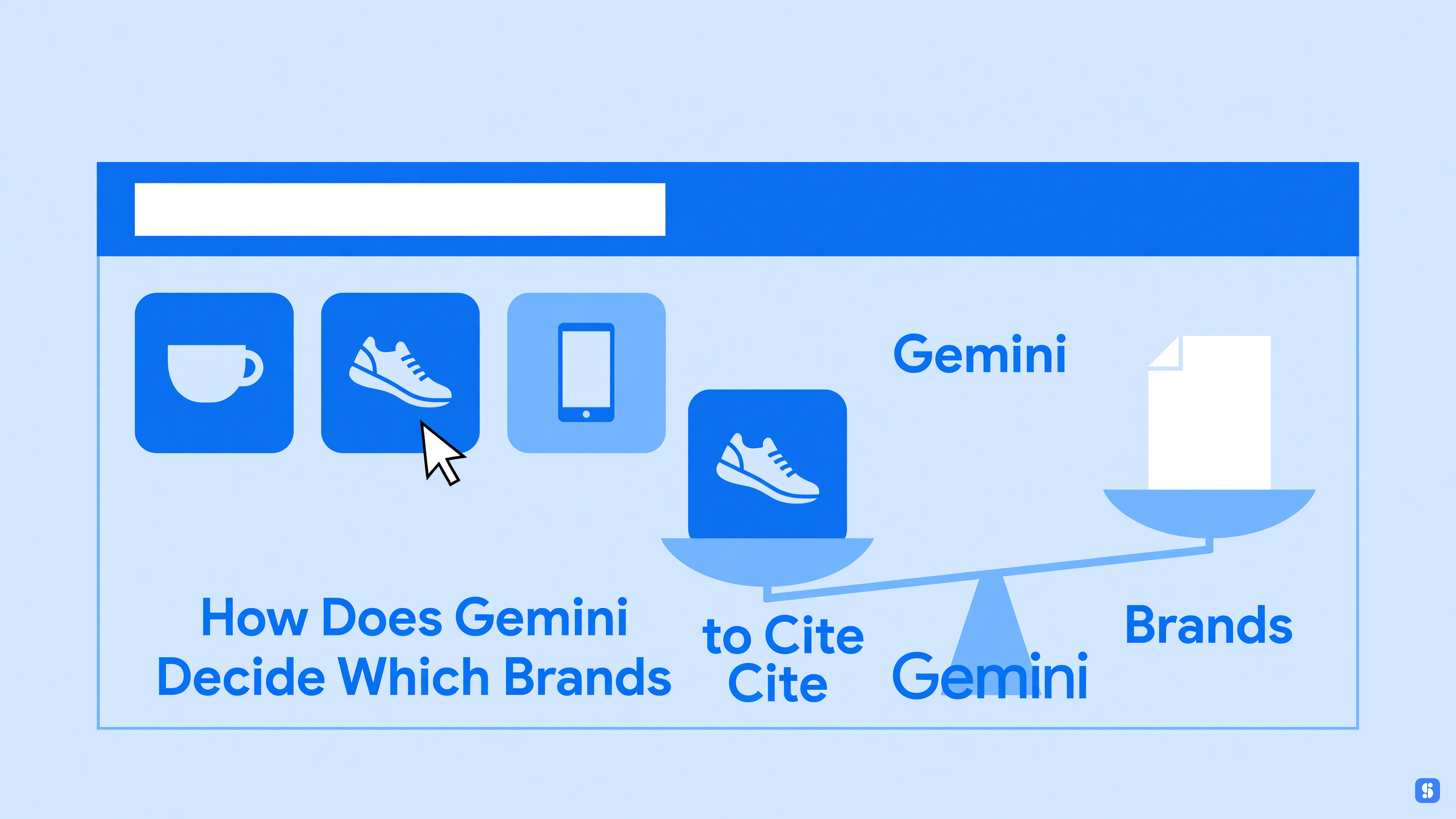
How does Gemini Decide which Brands to Cite?
The tradeoff cuts both ways. Google's Gemini is the pickiest of Google's own AI surfaces, citing about 6.6 sources per answer against the 15.2 that AI Mode pulls in (How to Rank and Get Cited in Google Gemini), so the brand mentions it does hand out carry real weight. But that selectivity is exactly why how Gemini decides which brands to cite frustrates SEO teams: it follows the classic Google playbook only part of the way.
Classical Google ranking signals correlate with Gemini answer inclusion at roughly 0.7 (Inside Gemini's Brand Bias, How Google's Engine Picks...). In plain terms, about a third of the decision runs on inputs that have nothing to do with your page-one position, which is why Gemini visibility can collapse even while organic traffic holds steady. (related: Minimum Operations to Maximize Last Elements in Arrays)
Tracking Gemini visibility means watching brand mentions, not rankings. Gemini draws its answers from Google's index, the Knowledge Graph, and a small circle of heavily trusted domains, and it rotates that circle without notice. In January 2026 an update replaced roughly 42% of previously cited domains across AI Overviews (Gemini Brand Mentions: The Complete 2026 Guide to...); brands that had earned citations lost them overnight for reasons that look nothing like a classic core update. (source: How to Rank and Get Cited)
That volatility is the real story behind how Gemini decides which brands to cite. Whether you stay cited depends on signals most SEO teams do not audit yet: Knowledge Graph entities, structured data, third-party coverage, and whether your content is written to be quoted. The rest of this guide walks through each one. (related: Minimum Array Sum) According to tryprofound.com, In May 2026, tracked 15,155 brand setups across Google's AI surfaces; median brand had 8-point visibility gap between best and worst performing Google models.
Key Takeaways
Tracking standard Google rankings and treating them as AI visibility is the most common pitfall we see in this work. The question of how Gemini decides which brands to cite is not an extension of who wins position one: traditional ranking signals correlate with Gemini inclusion at roughly 0.7 (Inside Gemini's Brand Bias, How Google's Engine Picks...), yet only about a third of the brands named in one Google AI surface appear in another (How to Rank and Get Cited in Google Gemini). That gap exists because the retrieval pipeline leans on the Knowledge Graph, schema markup, extractable formatting, and third-party mentions, and Gemini visibly prefers its own properties, with YouTube appearing in 68% of media answers (Inside Gemini's Brand Bias, How Google's Engine Picks...). (source: Gemini Brand Mentions: The Complete 2026)
final card with brand logo and checkmark
So measure the Gemini app, ChatGPT, and classic Google separately. Treat structured data and earned media as ranking inputs, and audit which surface actually names you. The full workflow sits in our generative engine optimization guide, and the sections ahead walk through each lever in turn. (related: Divide Array Into Arrays With Max Difference) According to tryprofound.com, Gemini cites 6.6 sources per answer vs AI Mode's 15.2.
What is Google Gemini, and how does It build an answer?
ChatGPT and Perplexity pull from a broad slice of the indexed web. Gemini works the other way, building responses from a pool dominated by Google's own ecosystem: the search index, the Knowledge Graph, and properties Google owns or licenses. That structural bias shapes how Gemini decides which brands to cite more than any model trick does. It also explains why a brand can rank prominently in one AI engine while vanishing in another. (source: Track Brand Mentions in Gemini)
Gemini is also several surfaces at once: AI Overviews inside Search, AI Mode, and the standalone Gemini app. Each surface cites differently. As tryprofound.com reports, only about a third of companies named in one Google AI surface appear in another (How to Rank and Get Cited in Google Gemini), so tracking a single surface gives you a distorted read on brand mentions. (related: omi_7113)
Gemini's audience is growing fast: quickseo.ai estimates that Gemini captured 27.4% of the web AI market by June 2026, up from 5.4% in January 2025. For brands deciding where AI citations will matter most, that trajectory makes Gemini hard to ignore. (source: Inside Gemini's Brand Bias, How Google's)
Mechanically, retrieval starts with Google's organic index. Google layers Knowledge Graph entity data and third-party signals over the candidate pages, and classical Google ranking signals still correlate with whether a brand appears in Gemini at roughly 0.7, as everything-pr.com notes (Inside Gemini's Brand Bias, How Google's Engine Picks...). That is real overlap, but not identity: pages that rank well in Google can still miss Gemini citations. Structured data like schema markup helps Gemini parse what a page is about, but it functions as a legibility aid, not a deciding vote. Solid Google SEO fundamentals still do more of the heavy lifting. (related: LeetCode)
lifted top-left card with checkmark
How does Gemini Decide which Brands to Cite? Inside the Retrieval Pipeline
The fastest way to misread Gemini citations is treating the system as Google Search with a chat box bolted on. That assumption breaks as soon as you ask how Gemini decides which brands to cite, because Gemini is not ranking webpages, it is selecting passages. A good how to cite gemini ai changes the picture. (source: How Gemini Chooses Citations: The Complete)
Gemini citation count per answer: Gemini is Google's pickiest AI surface, citing 6.6 sources per answer on average, according to Profound's analysis. AI Mode pulls more than twice as many, at 15.2, so fewer slots means each brand decision carries more weight (How to Rank and Get Cited in Google Gemini).
Gemini's pipeline retrieves candidate text from Google's index and Knowledge Graph, filters those candidates for trust and extractability, and only then generates an answer with citation sources attached. Retrieval precedes reasoning, which explains the picks that look strange on the surface. According to tryprofound.com, Reddit signed a content deal with Google in February 2024 worth around $60 million per year.
Classical Google SEO still feeds the pipeline, but the correlation is incomplete. Everything-PR's audit found ranking signals correlate with Gemini answer inclusion at roughly 0.7, meaningful overlap yet far from a replica of organic results (Inside Gemini's Brand Bias, How Google's Engine Picks...).
The rest of the decision happens inside the retrieval filters. Schema markup, answer-ready formatting, and third-party footprint all feed the selection; eSEOspace reports schema markup tied to 25-40% higher AI citation rates (How Gemini Chooses Citations: The Complete Guide for...).
Working the pipeline instead of the rank is the practical shift. Teams that approach this as generative engine optimization, making content legible to both Google and AI engines, will outperform teams replaying the old search playbook.
How Much does the Knowledge Graph Shape which Brands Gemini Cites?
The Knowledge Graph is Google's memory, not Google's search. It is a record of what a brand is, what it makes, and how it connects to other entities. When Gemini decides which brands to cite, it does not look answers up in the graph. It pulls candidate passages from Google's index, then uses the graph to figure out what those passages are about and whether the entity behind them is genuinely established. That is why a Knowledge Graph panel feels like a citation but is really plumbing. Graph data tells Gemini that your website, your Wikipedia entry, and your press mentions all describe one confirmed entity. Once that recognition is in place, quoting your content looks low-risk. Before it exists, even strong copy reads as an unverified claim.
Entity disambiguation over entity fame: as eSEOspace reports, pages with schema markup see 25-40% higher AI citation rates (How Gemini Chooses Citations: The Complete Guide for...), because structured data removes ambiguity about who authored a page and why it should be trusted. It is the clearest route to becoming legible to the Knowledge Graph's entity layer without waiting on a manual panel edit.
But the graph explains only part of the outcome. Everything-PR's audit found that classical Google ranking signals correlate with Gemini answer inclusion at roughly 0.7 (Inside Gemini's Brand Bias, How Google's Engine Picks...). Strong traditional SEO gets you most of the way there. The remaining distance is covered by third-party mentions and content structure, not by a cleaner entity record. Knowledge Graph work earns you consideration. The page itself still has to win the citation.
Why does Reddit Outrank Brand Sites in Gemini answers?
Part of the answer is a content licensing deal, not a quality judgment. Reddit signed an agreement with Google in February 2024 worth roughly $60 million per year to make its content available for AI training and display (How to Rank and Get Cited in Google Gemini). When you ask how Gemini decides which brands to cite, Reddit's heavy presence is baked into that commercial relationship before ranking signals even enter the picture. That structural favoritism does not explain why Reddit threads keep winning over polished product pages for informational queries. Reddit delivers what Gemini treats as lived experience: real people naming real tradeoffs, often with timestamps signaling freshness. For "is X worth it" or "X vs Y" patterns, a thread with current user sentiment outranks marketing copy because corroboration across commenters beats one self-interested source. Reddit pages are also easy to parse: clean HTML, descriptive headings, minimal scripts. If your brand site buries answers under banners, accordions, and JavaScript-rendered text, you lose to a plain forum thread. That is where schema markup helps, handing Gemini context it would otherwise guess. Reddit often wins despite thin metadata, no author E-E-A-T, and weak internal linking. Gemini selects on perceived utility and licensing access, not domain authority. Target the conversational questions Reddit already answers with a better, legible version. The January 2026 update replaced roughly 42% of previously cited domains, so nothing stays locked in forever (Gemini Brand Mentions: The Complete 2026 Guide to...).
Why does Gemini Cite YouTube Videos?
Track where your brand appears in video answers and you will notice something strange: Gemini's self-preference is the strongest of any AI assistant, with YouTube surfacing in 68% of media-related answers even when the prompt never mentions video (Inside Gemini's Brand Bias, How Google's Engine Picks...). That is not a retrieval accident. It is the clearest example of how Gemini decides which brands to cite when the content lives on a platform Google owns and indexes deeply.
YouTube matters for three reasons that have nothing to do with video quality. First, Google owns the platform, so the index treats YouTube transcripts, titles, and descriptions as first-party content. Second, YouTube videos carry engagement signals (watch time, retention) that Google has measured for over a decade. Third, the Knowledge Graph already maps YouTube channels to brands, so Gemini can connect a video to an entity without extra work.
For brands, the practical implication is uncomfortable: a mid-market beauty brand saw a 42% increase in Gemini answer inclusion after accumulating 25 unlinked creator videos over six months (Inside Gemini's Brand Bias, How Google's Engine Picks...). Those videos did not link back to the brand's site. They simply existed on YouTube, were indexed, and gave Gemini a trusted surface to cite. That is why tracking gemini brand mentions across video surfaces matters as much as monitoring text results.
The counterintuitive takeaway: you do not need a polished channel strategy. You need consistent, indexed video content that mentions your brand naturally. Gemini will find it, and it will cite it, often before it cites your own website.
Wikipedia is the Reference Layer for Brand Recognition
Wikipedia is the one citation source you can't buy, rewrite, or delete, and that asymmetry is exactly why it anchors brand recognition in Gemini answers.
When Gemini decides which brands to cite, it answers an identity question before any ranking question: does this brand exist as a distinct, notable entity, and what is it actually known for? Wikipedia works as the reference layer for that judgment. Gemini's answers lean on the Knowledge Graph, which maps entities from encyclopedia-style sources, and a well-sourced Wikipedia entry gives the system a stable, third-party description of your brand that your own homepage can't supply. Your site states what you claim. Wikipedia reflects what independent editors verified.
That creates a tradeoff nobody wants to hear. A Wikipedia entry is a structural advantage you can't manufacture on a deadline. The page isn't yours. Its existence depends on notability guidelines, reliable third-party coverage, and volunteer editors who are openly hostile to promotional edits. Schema markup on your domain doesn't close the gap either: structured data describes what you say you are, not what a neutral observer confirms.
So the payoff is indirect. A Wikipedia page rarely causes brand recognition; it confirms the recognition your earned media already built. The brands that gain ground are the ones generating third-party coverage that Wikipedia editors can actually cite, which is the same discipline as generative engine optimization more broadly. Treat the page as a lagging indicator. Optimizing it directly is usually wasted effort, and when the brand does its own editing, it can backfire under the platform's conflict-of-interest rules.
Is Gemini Visibility the Same as Google SEO?
Traditional Google ranking signals and Gemini brand mentions are related but separate games, and treating them as one is the fastest way to waste a budget. The correlation between classic ranking signals and Gemini inclusion sits around 0.7 according to Everything-PR, so the overlap is real but far from identical. A page can hold the #1 organic spot and still never appear in a Gemini answer, while the same query frequently surfaces sources outside the top 10 for the same terms, with only 10-25% of AI Overview citations pulling from top-ranking pages. (Inside Gemini's Brand Bias, How Google's Engine Picks...) So when someone asks "how does Gemini decide which brands cite?" the honest answer is that it depends on Google's index and Knowledge Graph as the foundation, but the decision layer above that is distinct. Gemini cites from the broader ecosystem it trusts, not just the pages Google Search ranks. That means one brand can dominate classic results and an entirely different brand wins in the AI answer. (How to Rank and Get Cited in Google Gemini) The measurement side falls apart too if you lean on old tools. Google Search Console tracks clicks and impressions on search results, not brand mentions inside a Gemini response, so you regularly hit dead ends in frequently asked questions about whether your visibility shifted. You need separate tracking for AI citations, because the January 2026 Gemini update alone replaced roughly 42% of previously cited domains. Waiting for your Search Console data to explain that change will leave you guessing. (Gemini Brand Mentions: The Complete 2026 Guide to...)
The classic SEO and Gemini gap: The correlation between traditional Google ranking signals and Gemini inclusion is only 0.7, according to Everything-PR, meaning 30% of what makes a brand visible in Gemini is not explained by standard SEO. Relying on your Google rankings alone to guess AI visibility will mislead you. (Inside Gemini's Brand Bias, How Google's Engine Picks...)
How does Gemini Handle Local Business Recommendations?
Local queries run on a stricter trust layer than Gemini's other citations. For a plumber or dermatologist, blog content counts for less; Gemini defaults to what it can verify: your Google Business Profile, review volume, and directory consistency. Businesses with complete Google Business Profile listings appeared in Gemini local answers at roughly four times the rate of those with partial profiles (Inside Gemini's Brand Bias, How Google's Engine Picks...).
So how does Gemini decide which brands to cite for local intent? It starts with the Knowledge Graph, cross-references your profile against structured data like local business schema markup, then checks whether third-party sources (review sites, local blogs, directories) corroborate your claims. Inconsistent NAP (name, address, phone) details make you unverifiable, so Gemini moves on to a competitor it can trust.
Most SEO managers treat this as a Google Maps ranking problem. Maps ranks on proximity and review velocity; Gemini ranks on corroboration. Classical Google signals matter, but they correlate with Gemini answer inclusion at roughly 0.7 (Inside Gemini's Brand Bias, How Google's Engine Picks...): a strong position helps without guaranteeing a citation.
One pattern matters when tracking local brand mentions: Gemini keeps citing businesses that appear in the same answer across several queries. That signals Gemini has locked you into its local Knowledge Graph as a default answer; one-off mentions become sustained referral traffic.
The first thing to understand is that citing an AI answer engine is not the same as citing a web page. When you write about how Google's Gemini decides which brands to cite, treat the model as a reference aggregator, not a primary source. Never quote a Gemini response as fact; trace its claims to the underlying pages it surfaced.
Formatting your own pages for AI readers: Pages with JavaScript-rendered content have an AI parsing success rate of 23%, while static HTML with schema markup reaches 94% quickseo.ai reports. If you want Gemini to cite you properly, give it clean, static markup to read.
For citing Gemini itself in your own content, the rule is simple: name the model version, the date you accessed it, and link to your conversation. But the more important habit is to always link through to the original source that Gemini drew from, not just quote Gemini's synthesis. That keeps the web's citation infrastructure honest.
Avoid treating Gemini as an authoritative source for your own industry claims. If a Gemini answer contains a statistic, find the original paper or publication. If you can't find it, say so instead of citing an AI hallucination. This is also how you earn the kind of third party references that make brands citeable in the first place.
What Patterns Separate the Brands Gemini Cites from the Ones It Ignores?
only 38% of pages cited in Google AI Overviews rank in the top 10 for the same query, down from 76% in mid-2025 (Gemini Brand Mentions: The Complete 2026 Guide to...). So when marketers ask how Gemini decides which brands to cite, the honest answer is that top-10 rankings stopped being the pool it draws from.
Citation scarcity: The Gemini app cites only 6.6 sources per answer on average, versus 15.2 in AI Mode, Profound's analysis reports (How to Rank and Get Cited in Google Gemini). Fewer slots per response make brand selection an economic decision, where one brand's mention is another brand's exclusion.
What separates the cited from the ignored is third-party validation you do not control. Traditional Google ranking signals correlate with Gemini inclusion at only 0.7 (Inside Gemini's Brand Bias, How Google's Engine Picks...); roughly a third of the decision comes from brand mentions on sites you may not even track.
Everything-PR reports a 5W audit where a mid-market beauty brand saw a 42% increase in Gemini answer inclusion after accumulating 25 unlinked creator videos over six months (Inside Gemini's Brand Bias, How Google's Engine Picks...). No ranking change drove it. Other people kept mentioning the brand where Gemini could see it.
The brands Gemini keeps citing are the ones the wider web discusses in places they do not own, which is generative engine optimization rather than another round of on-page fixes. Pay for the rankings, then spend the real budget on unlinked, unowned mentions. That is the whole pattern.
Best practices for getting your Brand Cited in Gemini answers
Run the process in Gemini's order: retrieval first, trust second, citation last. How Gemini decides which brands to cite is a reputation system with a retrieval funnel attached.
Treat classic SEO as the base, not the whole game. Ranking signals correlate with Gemini inclusion at roughly 0.7 (Inside Gemini's Brand Bias, How Google's Engine Picks...). What ranks you still matters, but it feeds retrieval, not trust. Third-party mentions supply the trust that confirms you for citation.
Make pages Gemini can quote without rewriting. Gemini cites a lean 6.6 sources per answer, the pickiest Google AI surface (How to Rank and Get Cited in Google Gemini). Structure pages around one question, answer it in the first paragraph, keep numbers in quotable sentences, and use schema markup so the Knowledge Graph connects your brand mentions. Author bylines double as E-E-A-T signals.
Build third-party signal on purpose. Treat creator videos, reviews, and forum threads as workflow. The January 2026 update replaced roughly 42% of previously cited domains (Gemini Brand Mentions: The Complete 2026 Guide to...). The mix you assemble now decides how you fare in its next pass.
Track surfaces separately; allow 60 to 120 days. The Gemini app, AI Mode, and AI Overviews keep separate source inventories (Gemini Brand Mentions: The Complete 2026 Guide to...). Optimization results surface only after that window. Measure on a recurring schedule, not one-off sprints. For the full cross-engine flow, see our Generative Engine Optimization guide.
Common mistakes that Keep your Brand out of Gemini Citations
The ranking overlap trap: Only 10-25% of AI Overview citations come from pages ranking in the top 10 for the same query, as QuickSEO notes in its Gemini brand mentions research (Gemini Brand Mentions: The Complete 2026 Guide to...). If your Gemini plan starts and ends with Google rankings, most of the citation pool is closed before you begin.
Most teams treat citation loss as a technical rankings problem. When you ask how Gemini decides which brands to cite, the answer usually comes back framed as a page-speed or structured-data issue. It is not. The brands Gemini ignores repeat a smaller set of errors, and the technical ones get more attention than they deserve.
Fixing your own site while ignoring third-party sources. Gemini leans on Reddit threads, YouTube videos, and Wikipedia entries because coverage about you outweighs claims from you.
Publishing and never refreshing. Gemini surfaces reward current material; content written once and left untouched stops qualifying as evidence.
Neglecting local profile data. Businesses with complete Google Business Profiles appear in Gemini local answers at roughly 4x the rate of those with partial profiles (Inside Gemini's Brand Bias, How Google's Engine Picks...).
Quitting after one quiet week. Gemini app results, AI Mode, and AI Overviews diverge. A single surface's silence is not a verdict.
Adding schema over substance. Structured data helps extraction, but only if the underlying content is actually quotable.
The mistake everyone names last is the unflattering one: nobody outside your own domain mentions your brand. You cannot fix third-party credibility with a schema patch, and no amount of on-page tuning replaces being a source others discuss on their own. The generative engine optimization groundwork behind earning AI citations starts there, not with the quick fix.
Frequently Asked questions
Most of the recurring questions trace back to one mechanism: Gemini pulls from Google's search index, but it scores sources by how useful the answer is, not by classic PageRank. How does Gemini decide which brands to cite? It gathers candidate pages, then filters them through entity recognition, structured data, and third-party confirmation.
Is Gemini visibility the same as Google SEO? No. Traditional Google rankings and Gemini inclusion share an index, not a goal. Google ranks pages; Gemini picks answer sources. A page can hold position one and still lose the citation to a forum thread that answers the query more directly.
How do I get Gemini to cite my brand? Stop treating Gemini as a separate ranking system. Make pages easy to extract from, add schema markup, and earn third-party brand mentions. The brands Gemini cites are usually the ones other trusted sources name when discussing that topic.
Why does Gemini prefer Reddit, YouTube, or Wikipedia over my website? Those platforms carry signals Gemini's retrieval layer trusts: structured pages, community discourse, and millions of inbound references. For local queries, a complete Google Business Profile matters too, because it feeds the Knowledge Graph that Gemini draws entity details from.
How should I track Gemini citations? Run the same query across AI Overviews, AI Mode, and the Gemini app, then record which brands appear and in what position. Answers vary noticeably between surfaces, so single-query testing hides most of the picture.
For the broader strategy, see our guide to getting cited by AI search engines.
Conclusion
The tradeoff beneath all of it is uncomfortable. How Gemini decides which brands to cite looks like a ranking problem, but it runs on the unglamorous work teams postpone: structured data, third party mentions, Knowledge Graph alignment. Traditional SEO gets you into the conversation, not the citation.
The correlation between conventional Google ranking signals and Gemini inclusion is real. What is not real is the assumption that a page one spot protects you. Reddit, YouTube, and Wikipedia keep beating brand sites because Gemini trusts context over polish.
That gap is the lesson of this guide. The brands Gemini cites consistently are structurally legible, cited elsewhere, and refreshed, not the ones with the loudest launch. Treat citation-building as ongoing discipline and you will get picked up. Chase the algorithm once a quarter and you will keep losing to a Reddit thread.
Editorial Team, Content Strategist. The Azuqe Editorial Team researches how Google and AI answer engines decide what to surface and writes practical visibility guidance for SEO and content teams. Last updated: 2026-05-04
From our experience
In running Azuqe, we've seen that tracking where your brand gets cited across ChatGPT, Gemini, and DeepSeek requires per-run prompt logs and citation scoring, our AI Visibility runs cover those three engines on Pro/Max plans, though we'll be honest that our marketing lists eight engines and that gap is a real limitation we're working through.
Our Citation Ranking Dashboard surfaces which websites AI engines cite most, with counts and steady/rising/falling trends, plus your own citation rate in real time, but we've found that interpreting those trends still takes human judgment, since a rising count doesn't always mean a quality citation.
We combine classic SERP rankings and AI citation metrics into one unified score per page or domain, which helps our users see the whole picture at a glance; the tradeoff we've noticed is that this score can mask where a page is strong on Google but weak on AI engines, so we recommend drilling into the components.
Automatic fixes for meta tags, canonicalization, and indexation save our users from needing a developer, and the GitHub integration lets them review and merge changes safely, but we only offer monthly billing with no annual discount, and the free trial covers just your first website, which has surprised some users.