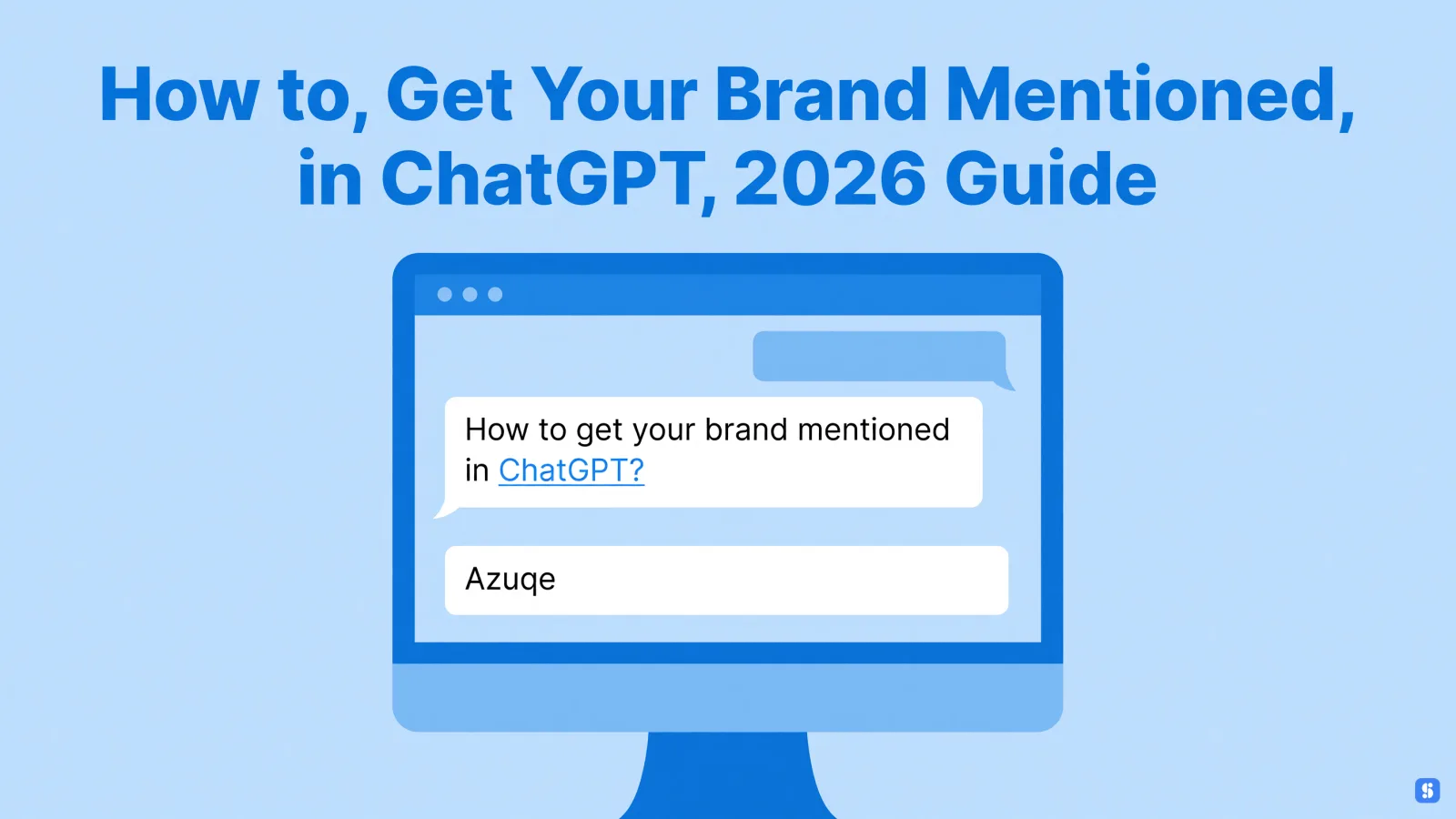
ChatGPT SEO: how to Get your Brand Mentioned in ChatGPT (without Gaming the System)
ChatGPT SEO, getting your brand mentioned in ChatGPT, isn't about tricking the model into saying your name. It's about becoming the source the model actually trusts. When ChatGPT cites your brand, it found signals that make you more credible than the alternatives, not a prompt injection hack.
What ChatGPT citations actually are and why they matter
A ChatGPT citation is a named reference inside a generated answer. It works differently from a Google ranking. Google shows links and lets the searcher decide. ChatGPT answers the question and attributes part of that answer to you, which changes how trust moves. (source: Improve Your Brand Marketing for AI-Powered Search)
The practical effect: when someone asks ChatGPT for the best project management tool for a distributed team, the brands named in that response become the shortlist. The ones left out never enter the conversation. The old ask was "am I on page one?" The new one is "am I in the answer?" (source: How brands can get noticed in ChatGPT)
Why the 2026 guide hype is oversold
Most "AI SEO guides" for 2026 promise a formula: do this, rank in ChatGPT. From what we've seen, results in the wild rarely match the pitch. There's no public ranking algorithm to reverse-engineer, and anyone claiming certainty is selling something. (source: How to rank in AI search for business growth | Dot IT)
What actually moves results is boring: clear brand identity, consistent entity signals, content that earns citation, and structured data machines can parse. Our Azuqe Help center covers the workflows we've tested. But the honest starting point is that you can't hack your way into ChatGPT's answers. You can only become the kind of source it wants to cite.
Key Takeaways: what You need to Know before You Start
ChatGPT SEO, getting your brand mentioned in ChatGPT, is not another ranking hack you bolt onto existing work. It is its own visibility problem, and the mechanics differ from Google ranking in ways that matter. (source: AI SEO & GEO: Boost Your Brand's)
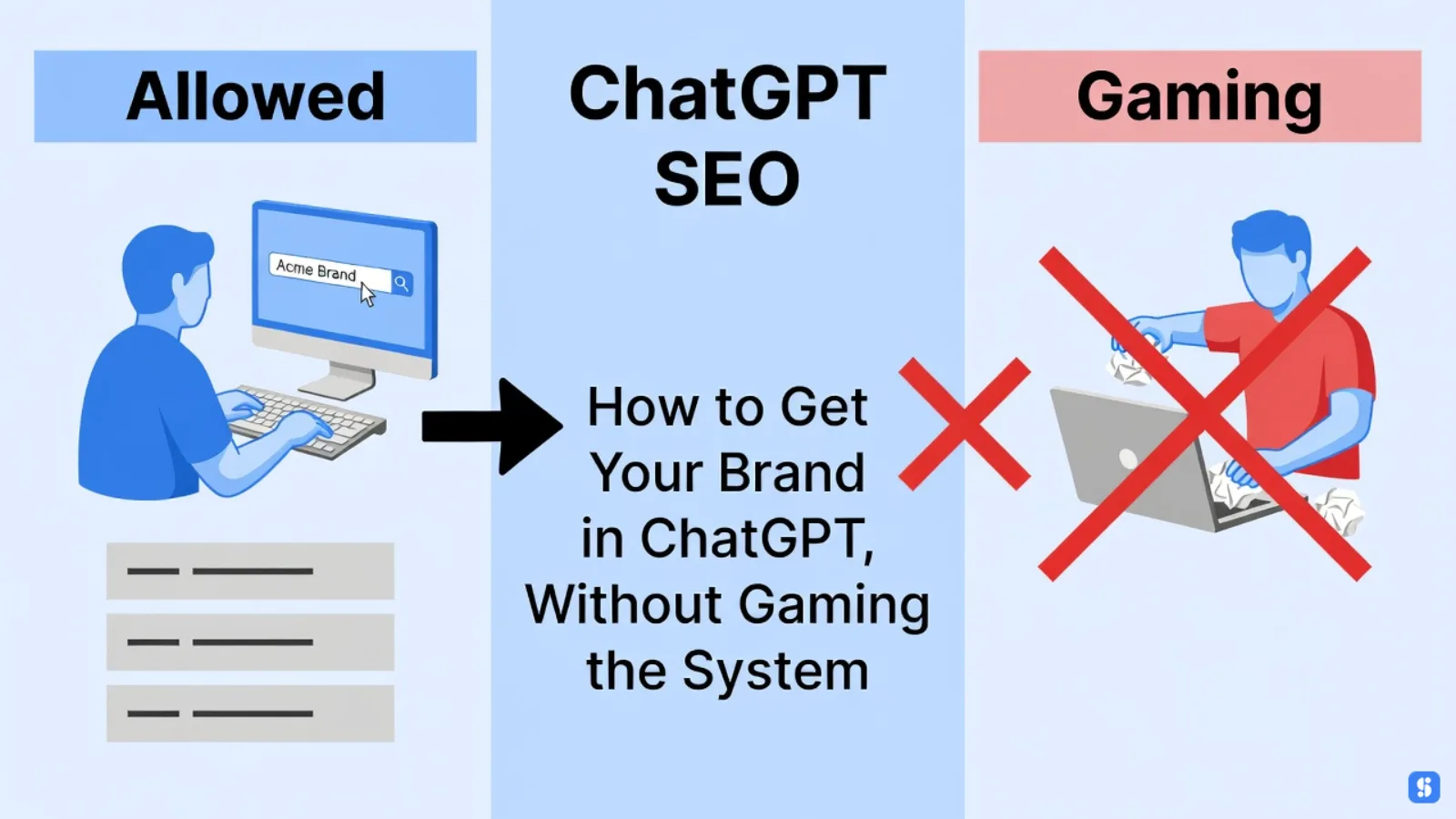
left column labeled 'Allowed' with person typing brand name into search box
Three things matter most before you start:
ChatGPT does not rank pages, it cites sources. Your job is to become a named, trustworthy reference inside the model's answer, not a result on a page.
Entity clarity beats keyword density. The model must know who you are, what you make, and why you are credible. That comes from consistent naming, structured data, and clear descriptions.
You cannot tweak what you cannot measure. Tracking your brand's citation rate in AI answers is the only way to know if changes work, and that tracking is what Azuqe's AI visibility tools do.
For the full mechanics, our Azuqe Help, Guides & tutorials walk through each step.
Why is ChatGPT not Mentioning My Business? the Real reasons
If ChatGPT never mentions your brand, the cause is almost always one of three things: your pages aren't accessible to the model, your brand isn't legible as an entity, or your content is too thin to cite. The practical work of ChatGPT SEO: How to Get Your Brand Mentioned in ChatGPT starts with diagnosing which gap applies to you.
Crawlability and indexing failures
ChatGPT draws on publicly available web content. If a page is blocked in robots.txt, rendered entirely through JavaScript the crawler never executes, or buried behind a login, the model may never see it. You can't get cited in answers the model was never able to read.
Classic SEO fundamentals still do the heavy lifting here. Continuous site audits catch blocked resources, missing meta tags, and rendering issues before they quietly exclude you from AI retrieval. As one analysis of AI visibility notes, most brands that "disappear" from ChatGPT answers aren't being penalized; they're just invisible at the crawl layer (Why ChatGPT Isn't Mentioning Your Business, 5 Reasons).
Missing entity signals
ChatGPT reasons about entities, treating your brand as a distinct concept with attributes, relationships, and a category. If your site never states what you make, who it serves, and how it fits into the market, the model has nothing to anchor you to a user question.
first card with lightbulb icon and 'Key Takeaways' label
Entity signals are the fix: consistent brand name and description across pages, schema markup that defines your product type, and a clear internal structure connecting related topics. Without those, ChatGPT can't confirm what your brand is or when it deserves a mention.
Thin or unstructured content
Even with perfect crawlability, ChatGPT needs something quotable. Generic marketing pages, adjective-heavy copy, and unbroken paragraphs offer no extractable answer, so the model reaches for a competitor who said the same thing more directly.
Structure content around direct questions, concise definitions, and specific details. The pages that get cited in AI answers read like they were written to be quoted. For a systematic walkthrough of auditing these gaps, the Azuqe Help, Guides & tutorials walks through crawl checks and entity setup in order.
How does GEO (Generative Engine Optimization) Differ from Traditional SEO?
When people ask about ChatGPT SEO and how to get your brand mentioned in ChatGPT, the loudest advice usually misses the real change. Generative engine optimization (GEO) is the practice of making your brand the one an AI model chooses to cite in its answer, not just the one that ranks first on a results page. You are optimizing for a mention inside a synthesized response, not a click on a blue link.
From ranking to recommending
Traditional SEO optimizes for position on a list of ten results. GEO optimizes for recommendation: the model decides your brand is the correct answer and says so by name. The mindset shifts from landing page positions to entity signals, the structured facts that tell a model who you are, what you offer, and who you serve. ChatGPT either mentions your brand or it does not. There is no page three to fall back on.
That changes how you measure success. Google rankings are a proxy, but in GEO the proxy is citation: how often and in what context an AI answer names your brand. If you are not tracking actual AI answers, you are guessing. Our Azuqe Help, Guides & tutorials covers how to set that up without switching tools too many times.
What stays the same
What stays the same is the unglamorous foundation. Clear entity signals, schema markup, accurate site structure, and content that directly answers the question are still the base of everything. The difference is that a model reads those signals, composes a single answer, and decides whether your brand deserves the credit. Fine-tune for being understood, not for outranking a competitor by one spot.
What are Entity Signals and why do They Matter for AI Visibility?
Entity signals are the structured details that tell ChatGPT what your brand is, what it does, and how it relates to concepts the model already knows. ChatGPT weighs these signals when deciding whether to name you in an answer, so consistent, well-structured signals earn confident recommendations. ChatGPT SEO: how to get your brand mentioned is less about chasing prompts and more about making your identity machine-readable.
Building a consistent digital footprint
A consistent footprint means your name, description, location, and category line up across your site and directories. Conflicting entries add noise when ChatGPT maps your brand against other sources, so align the taglines on your about page, social profiles, and listings to the same wording. Boring predictability wins here. The model should meet the same brand story everywhere. Azuqe's dashboard tracks where your brand appears across engines, so you can fix inconsistent entries before they cost you a mention.
Schema markup that AI engines actually read
Most schema gets ignored because it is generic. AI engines actually read structured data like Organization, Person, and sameAs to connect your entity to related ones, added via your site's head or a plugin. Use sameAs to link official social handles and profiles where you control naming. On WordPress, check whether your plugin exposes these fields. It is unglamorous work competitors skip, and it is what AI visibility rewards.
How to Make your Content Machine-Readable for AI answer Engines
Most teams improve for ranking and forget the harder half of ChatGPT SEO: how to get your brand mentioned in ChatGPT when the answer is generated, not clicked. ChatGPT and Gemini pull answers from pages they can parse without a human. If your content buries the key claim, the model may reference your brand but misstate what you do. If it can't extract a clean answer, it replaces you with a competitor that bothered to provide one.
Structuring for extraction, not just ranking
Ranking rewards comprehensiveness. Extraction rewards redundancy of the right kind. State the answer to the question in the first two sentences, in plain language, then repeat the core claim in a quote-worthy sentence later. Use your brand name and product name explicitly instead of "we" or "this platform." Models treat exact strings as stronger entity signals than pronouns. The format should survive being stripped of everything else on the page.
The citation-friendly content format
Keep claims self-contained: each product fact, pricing item, and integration statement should read correctly in isolation. Use prose over dense tables for critical facts, and mark up your entity data with Organization and Product schema so the model can resolve who you are. If you mention a number or a caveat, keep it next to the claim, not two paragraphs away.
Test it. Paste a paragraph into ChatGPT and ask it to summarize. If your point survives without context, you have a citable source. If not, restructure. For more on structuring content that performs across engines, check our guides.
Best practices for ChatGPT SEO: what Actually Moves Citation Rates
Most ChatGPT SEO advice about how to get your brand mentioned in ChatGPT overcomplicates this. In our experience, two habits move citation rates more than any schema tweak: publishing consistently and tracking the right score.
Publishing frequency over perfection
ChatGPT pulls from what it can index. A flawless article published quarterly loses to a decent one published weekly, because citation-worthy brands show up across many pages, not one masterpiece.
Edit in public. Improve the post after it's live, add internal links, and keep publishing. Azuqe's content workflow is built for this: the platform drafts articles with real citations in your brand voice, ready to publish, and most users publish their first article the same day they sign up.
You can refine later. You can't get cited for a page that doesn't exist.
Monitoring your unified visibility score
You need one number that tells you whether ChatGPT, Gemini, or DeepSeek actually mention your brand, alongside your Google rankings. Tracking them separately hides the relationship.
Azuqe's Unified SEO & AI Visibility Score does this in one dashboard. When citations dip, you see it immediately, then check the Fix Center for technical issues Google or AI engines may be penalizing.
Our Azuqe Help, Guides & tutorials covers setup if you're new. What gets measured gets mentioned.
Common mistakes that Keep your Brand out of ChatGPT answers
Most ChatGPT SEO work aimed at getting your brand mentioned in ChatGPT fails for three predictable reasons: it borrows tactics from link building, skips technical hygiene, or overreacts to every new AI platform.
Treating AI visibility like link building
The link-building instinct says: earn a mention on a big site, and citations will follow. AI answer engines don't work that way. They ground answers in content that is factual, clearly attributed, and consistently clear about what your brand does. A handful of placements matters less than a body of content that directly answers the same questions users ask ChatGPT, with the same facts every time.
Build citation-worthy pages as the main effort and treat links as one input among several, not the entire game.
Ignoring technical health
If ChatGPT cannot read your page cleanly, it cannot cite it. Broken schema markup, blocked resources, and duplicate content muddy the structured signals AI engines use to map your brand to facts. The same issues quietly hurt Google rankings, and AI answers pull heavily from what search engines have already indexed.
Run continuous site audits instead of one-time cleanups. When the Fix Center flags a problem, you can resolve it in minutes without a developer, and your unified visibility score moves only after the site is actually healthy.
Chasing every new AI platform
Each new engine arrives with a wave of "improve for this model" advice. Most of it is noise. Entity clarity, structured data, consistent brand information, and content that works as a standalone answer matter on ChatGPT, Gemini, and DeepSeek alike.
Track your presence across all of them with one score and put your energy into the fundamentals. For the mechanics, the Azuqe Help, Guides & tutorials cover how to set up unified tracking without rebuilding your workflow per platform.
Frequently Asked questions about getting Mentioned in ChatGPT
Looking for ChatGPT SEO guidance on how to get your brand mentioned in ChatGPT? The short answer is that AI assistants pull from content they can parse, verify, and connect to a clear entity.
How can I get my brand mentioned in ChatGPT?
Make your brand easy to identify, verify, and cite. ChatGPT draws answers from content that clearly states who you are and why you are credible. Publish pages that define your brand in plain language, keep your name consistent across your site and directories, and add structured data so AI can map your products, team, and location to a single entity.
What are citations in the context of AI search?
Citations are the sources ChatGPT lists alongside an answer, often as numbered links. They matter for two reasons. A visible citation builds trust with the user, and ChatGPT favors content it can confidently point to, so pages written to be easily quotable earn more mentions.
How can I track my brand's visibility in AI assistants?
You need a tool that runs the same queries your customers ask and records whether your brand appears. Manual testing works for a handful of prompts, but it does not scale across multiple AI engines. A dedicated AI visibility tracker shows which queries mention your brand, which competitors win those mentions, and where your content gaps are. For walkthroughs on setting this up, see Azuqe Help, Guides & tutorials.
Conclusion: Start with Visibility, not Virality
Most ChatGPT SEO attempts fail because they chase one viral mention. Getting your brand mentioned in ChatGPT consistently is a repeatability problem, not a luck problem. It comes down to clear entity signals, content structured for extraction, and a track record AI engines can safely cite.
So start there. Track where ChatGPT and Gemini already mention you, what they cite, and where you are absent. Then fix what you control: unclear authorship, thin pages, missing schema, and content that never names its own sources.
One viral mention changes nothing. A steady presence in AI answers changes what models can confidently say about you. If you need tooling for that workflow, the Azuqe Help, Guides & tutorials section walks through it.