What is Google AI Mode and why It Changes SEO
Google AI Mode is a conversational search experience that composes a single synthesized answer to your query instead of returning a list of blue links. For anyone doing Google AI Mode SEO, the goal shifts from ranking on page one to getting cited inside the AI response. AI Mode answers don't send traffic the way classic results do: the answer is the destination. This guide covers Google AI Mode SEO: How to Optimize for AI Search in depth.
How AI Mode differs from classic Google search
Classic search matches your query against indexed pages and ranks them by relevance. AI Mode does something closer to reasoning: it pulls information from multiple pages, weighs it, and writes a direct answer with inline citations. (source: State of SEO in the AI Era - CSU Social Media Blog)
The unit of search is no longer a link. It's a claim. Your content can rank well in the traditional sense and still never appear in the AI answer, because the engine isn't looking for the best page, it's looking for the best source for each specific fact. (source: Google AI Search Optimization: AEO and GEO)
Why AI Mode answers replace links
When Google states the answer directly, the click never happens. The user gets what they came for without visiting any site. Impressions no longer translate into visits. (source: 11 ways to make better for Google AI Mode without getting lost...)
This is why optimizing for AI search is not classic SEO with a new coat of paint. You're no longer competing for position one; you're competing to be the cited source behind the answer. The Azuqe Help, Guides & tutorials cover the mechanics in depth, but the shift in mindset is the hard part.
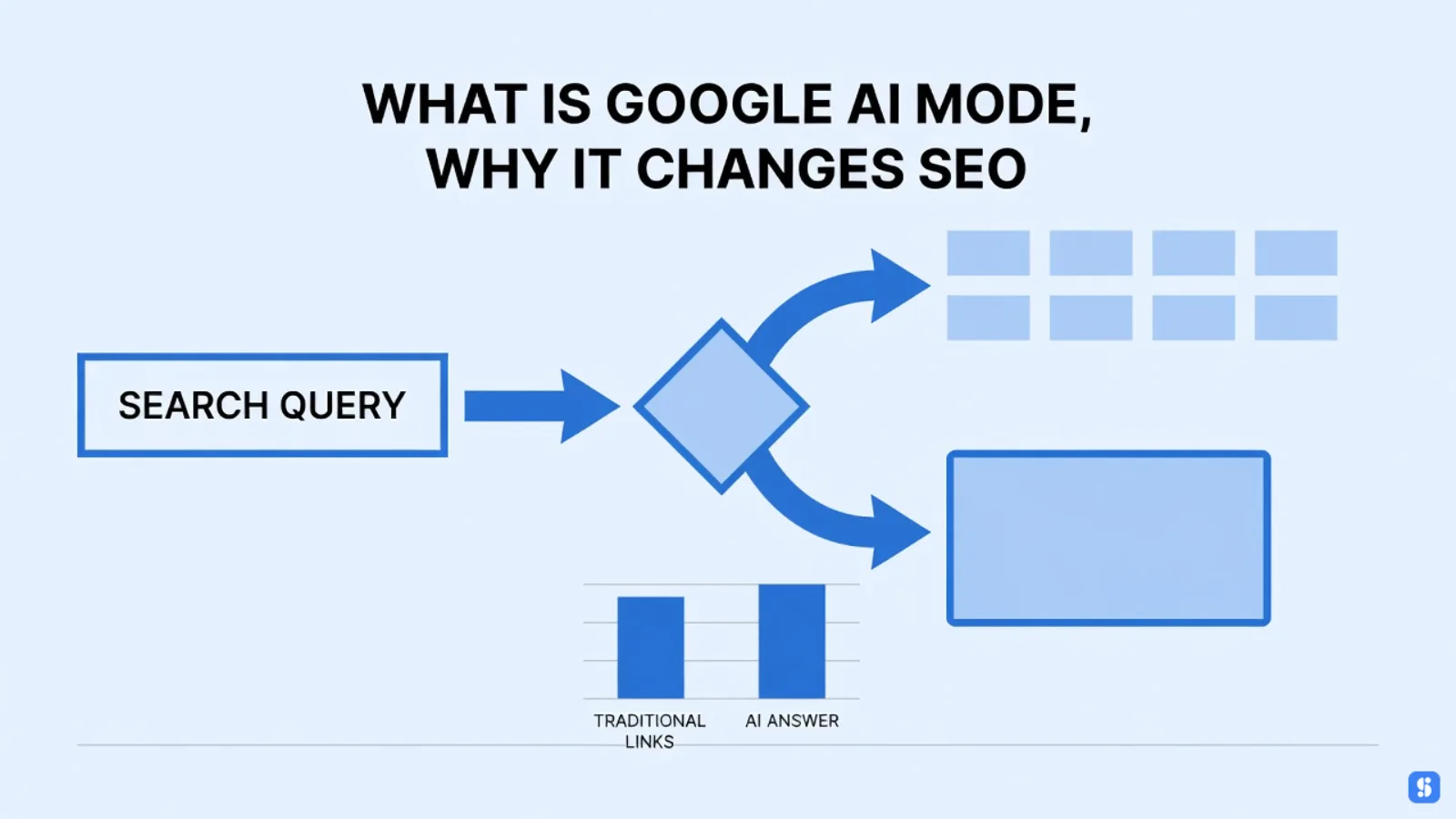
splitter junction between search results and AI answer
Key Takeaways
Google AI Mode SEO, the practice of ranking in Google's AI-generated search answers, comes down to one shift: you are no longer optimizing for a list of links. You are optimizing for whether an AI engine cites you. (source: AI Mode in the USA – a revolution)
AI Mode changes the job from ranking to being referenced. Content needs to be quotable, fact-dense, and structured so an AI can lift a usable answer from it.
The AEO versus GEO distinction matters less than the overlap. Answer Engine Optimization targets question-answer format; Generative Engine Optimization targets inclusion in AI-generated responses. Google AI Mode demands both.
Natural language wins. Write the way people actually ask questions, and answer those questions directly in the first paragraph.
Track visibility in AI engines like you track rankings. If you cannot see whether ChatGPT or Gemini cites you, you cannot improve it.
For the full breakdown, see the Azuqe Help, Guides & tutorials.
How does Google AI Mode Actually Generate answers?
Google AI Mode SEO starts with a hard truth I had to accept after watching dozens of pages get cited while mine sat in the void: Google doesn't rank your page anymore. It retrieves pages, synthesizes an answer from them, and attaches citations. If your page isn't in that retrieved set, you don't exist in the answer.
The retrieval and synthesis process
AI Mode runs through a two-stage pipeline. Stage one is retrieval: Google pulls readable, indexable pages that match the intent of your query. Stage two is synthesis: a language model reads those pages, extracts the claims that answer your question, and rewrites them into one coherent response. The final answer is built from real sources, so making it into the retrieval set is the only way to get cited.
That shifts the ranking bar from pure relevance to parseability. Your page has to be readable as discrete, quotable facts. Unstructured wall-of-text blocks lose to pages with clear headings, definitions, Q&A formatting, and specific claims the model can lift cleanly.
raised central card with star icon
What content qualifies for citation
Three things determine whether AI Mode cites you:
Crawlability: The page must be indexable and renderable. Blocked by robots.txt or buried behind dynamic JavaScript, and you don't exist.
Entity clarity: A page that names its subject, defines terms inline, and uses predictable headers gives the model an anchor to attribute the claim to.
Fact-level specificity: AI Mode prefers concrete, verifiable statements over vague sensory adjectives. "Supports Google Indexing API" gets cited; "amazing features" doesn't.
You can't control the synthesis model, but you control how easily your page gets retrieved and understood. Improve for that.
Google AI Mode SEO: how to Make better for AI Search with Content Structure
Most content that ranks in classic Google fails in AI Mode because it is written to be read, not extracted. Google AI Mode SEO shifts the job from writing persuasive prose to building a page an answer engine can pull a clean claim from. The goal is not to make your content readable, though it should be. The goal is to make it quotable at the sentence level.
Writing for extraction, not just reading
AI engines work by matching user questions to discrete facts, so every paragraph should put the answer in the first sentence and let the rest support it. A reader who already knows the answer can skip ahead; an AI engine that finds it early will cite it. Write self-contained sentences that hold meaning when lifted out of context. Avoid pronouns like "this" or "it" as the subject of a new claim, since the engine has to trace the reference back to know what you mean.
Define every term inline the first time you use it. If you mention "entity resolution" without explaining it, the engine may pass your paragraph over for a source that bothers to define its own terms.
Structured data that helps AI engines
Schema markup helps AI Mode map your page, but structure itself is the bigger lever. Use headers that read like questions, lists that enumerate steps, and tables that compare alternatives. Keep entity names consistent across the page and in your internal links, and link to supporting pages the way you would cite a source in a paper. For a fuller walkthrough of these tactics, see the Azuqe guides on AI search optimization.
The rule that covers all of it: structure your page so the answer is the easiest thing to find, not the most impressive thing to read.
What is the difference between AEO, GEO, and Traditional SEO?
Before you map out any Google AI Mode SEO: How to Improve for AI Search strategy, you need to know which game you're actually playing. AEO, GEO, and traditional SEO are not interchangeable terms, and mixing them up will waste your budget. Answer Engine Optimization (AEO) is the practice of structuring content so answer engines like ChatGPT, Gemini, and Google's AI Mode can pull a direct response from it. Traditional SEO optimizes for blue links. AEO optimizes for the moment a machine decides your page is worth quoting. That means question-based headings, concise definitions near the top, and self-contained paragraphs that still make sense when lifted out of context. The goal is to become the cited source inside an AI answer, not just to earn a spot on page one. Generative Engine Optimization (GEO) is the wider discipline of brand visibility inside generative AI outputs. It covers mentions, citations, entity associations, and the probability that a model references you when it synthesizes an answer. In practice, AEO is a subset of GEO. Getting quoted once is not the same as being consistently referenced across every topic that matters to your business. Traditional SEO still matters, and it is not going anywhere. Google still runs on classic ranking signals, and AI Mode still surfaces traditional results alongside its generated answers. Technical health, page speed, structured data, and backlinks remain the foundation. What has changed is that ranking first no longer guarantees visibility. You now have to earn the citation, not just the click. Treat traditional SEO as the floor, AEO as the way you write, and GEO as the way you measure. Most teams never get past the first one.
How to Track your Brand's AI Visibility
Knowing how to fine-tune for Google AI Mode SEO is one thing; knowing whether it worked is another. Rank tracking will not survive AI Mode. AI Mode synthesizes an answer from sources, and the only position that matters is whether your brand gets cited inside it.
Keyword positions were a proxy for visibility. AI answers are a binary: you are in the response, or you are absent from the conversation.
Why ranking position is no longer enough
Classic SERPs are a predictable ladder. Position 1 means top of page, position 10 below the fold. AI Mode collapses the ladder: a cited brand inside a two-paragraph answer beats any #1 ranking that sits beneath it.
That breaks the old feedback loop. You cannot check your keyword tracker, see a dip, and know whether ChatGPT or Gemini stopped recommending you. Track citation instead.
What a citation ranking dashboard shows you
A citation ranking dashboard tracks where your brand appears in AI-generated answers: which queries mention you, which competitors appear alongside you, and which of your pages the AI cites.
If an AI answer cites your homepage for a question your product page should answer, that is an optimization gap, not a visibility problem. The citation context tells you what to fix next.
To start, run the queries you already rank for through ChatGPT, Gemini, and DeepSeek. Log which brands appear and what the AI cites them for. The baseline will look underwhelming: most brands are invisible in AI answers for the exact queries they dominate in Google.
That mismatch is the competitive data. Track it regularly, and you stop guessing whether your AI visibility efforts work.
Why a Unified SEO and AI Visibility Score Matters
Classic SERP rankings no longer tell you the full story of your search visibility. If you're serious about Google AI Mode SEO: How to Improve for AI Search, you need to track classic rankings and AI answer citations as one unified score.
Combining classic SERP data with AI answer data
A classic SERP position tells you where your page ranks for a keyword. AI answer data tells you whether ChatGPT, Gemini, or Google AI Mode cites your brand when a user asks a relevant question. Those are different signals, and they frequently disagree.
You can rank in the top three on Google and be entirely absent from an AI answer. Or get cited by an AI engine while your page sits on page two. Each number is true, and each alone is incomplete. Combining them into one score stops you from treating two dashboards as separate realities and forces a single question: if someone asks about your space, are you in the conversation at all?
How to read a unified score
Don't fixate on the absolute number. Read the gap. When classic rankings run high but AI visibility lags, your content is written for keywords, not for natural questions. When the reverse happens, your pages already answer queries well while technical issues are likely capping Google performance.
Watch the direction over time. The score's real value is showing whether the gap between classic and AI visibility is closing.
Best practices for Google AI Mode Optimization
Google AI Mode SEO: How to Improve for AI Search starts with technical health, not clever phrasing. AI Mode pulls answers from pages it can actually crawl and parse. If a page loads slowly, renders poorly, or blocks crawlers, no amount of good content saves it.
Technical health as a prerequisite
AI engines read pages the way a detailed indexer does. They want clean HTML, fast server responses, and structured data that tells them which parts of the page are the answer. Schema markup for articles, FAQs, and products gives the AI a map of your content. In our experience this is the least glamorous part of the work and the part that pays for itself fastest.
Content formats that AI engines prefer
AI engines bias toward direct answers. A page that states its conclusion in the first sentence beats a page that spends three paragraphs building to it. Use descriptive headings, lists, and tables. Write in natural, conversational language, because AI Mode queries read like someone asking a question, not typing keywords. Match the question's phrasing.
Continuous auditing over one-time fixes
A single audit is a snapshot. AI engines change how they parse pages, and your site keeps accumulating problems: broken links, orphaned pages, slow assets. The teams that win treat technical SEO as ongoing maintenance, not a launch project. They audit on a schedule and fix what breaks. If you're not sure where to begin, our guides cover the fundamentals. That is the unglamorous truth of ranking in AI search, and the sooner you build the habit, the less catching up you will do later.
Common mistakes Teams Make with AI Search Optimization
Most teams get Google AI Mode SEO wrong because they import the habits of classic search: match the keyword, stuff the page, chase rankings. AI Mode is an answer engine, not a link directory. It composes a response from content it can extract, attribute, and trust, so the page that gets cited is the one that states the answer plainly, in context, and early.
Over-optimizing for keywords instead of answers
A page can rank for a keyword and still never appear in AI Mode, because the answer is buried under keyword variations, filler, and forced heading structures. AI extractors look for a direct, self-contained statement: a sentence that answers the question on its own. Write those sentences, place them near the top of the page, and keep the structure scannable. Keywords still help with retrieval, but they do not win the citation.
Ignoring technical issues that block extraction
AI Mode still pulls from the indexed web. If a crawler cannot render the page, if content loads late via JavaScript, or if redirects and thin pages clutter the site, the answer is effectively invisible. Technical SEO does not disappear in the AI era. It becomes the barrier between your content and the citation, and teams that treat AI optimization as a content-only project miss it entirely.
Treating AI optimization as a one-time project
The third failure is a publish-and-forget mindset. AI Mode's answers shift as models and ranking signals change, and the sources it cites change with them. What earns a citation this quarter may not earn one next quarter. Treat AI visibility as an ongoing program: monitor where you appear, notice when you drop, and update accordingly. For the mechanics of a monitoring workflow, the Azuqe Help, Guides & tutorials cover the specifics.
Frequently Asked questions
These are the questions we hear most about Google AI Mode SEO and how to tweak for AI search, answered directly.
What is Google AI Mode and how does it affect SEO?
Google AI Mode is a conversational search interface that generates a synthesized answer from multiple indexed pages instead of returning a list of blue links. It affects SEO because the goal shifts from ranking position to being cited as a source inside an AI-generated response. You can win the answer even when users never click through.
How do I make better my content for AI Mode?
Tweak for extraction. State the direct answer in the first paragraph, structure content with clean headings, and keep facts specific rather than vague. AI systems cite what they can parse cleanly. Technical fundamentals still gate everything: crawlable pages, sensible internal links, and fast load times determine whether your content is even eligible for an AI answer.
What is the future of SEO in the AI era?
SEO does not disappear; it splits into two tracks. Traditional rankings still drive traffic, but AI visibility becomes its own measurement: how often ChatGPT, Gemini, or DeepSeek cite your brand inside an answer. Teams will track both numbers separately because strong AI citations capture demand that never reaches the classic results page.
How can businesses benefit from AI-driven search?
Businesses gain a second discovery surface. A citation inside an AI answer puts your brand in front of someone at the decision point, often in contexts where traditional search never would have surfaced you. You do not need to rebuild your strategy from scratch, but you do need to track citation rates as deliberately as you track rankings. For step-by-step setup, the Azuqe Help Center covers the practical mechanics.
Conclusion
Google AI Mode SEO: How to Improve for AI Search comes down to one move: write answers a machine can cite without hesitation. The interface is new, but the underlying rule is old. AI engines favor pages that state answers plainly, back them with real sources, and keep the structure scannable.
Skip the AI-specific tricks. No prompt-injection hacks, no schema gymnastics. Real authority comes from content that earns a citation.
Start with a single high-value page. Rewrite it to answer the exact question your customer asks, in natural language, with one clear verdict. Then watch whether it surfaces in AI answers. That loop, not a checklist, is the strategy.
From our experience
In running Azuqe, we've watched clients' organic traffic hold steady while their ChatGPT and Gemini mentions climb, the classic sign that classic SERP rankings no longer tell the full story.
Our Citation Ranking Dashboard shows us which of your pages AI engines actually cite, and we've found that content with clear headings and direct answers gets picked up far more often than long-form fluff.
We've seen the Fix Center resolve hundreds of technical SEO issues automatically, but we'll be honest: our AI Visibility runs only cover ChatGPT, Gemini, and DeepSeek on Pro/Max plans, not the full eight engines our marketing lists.
The unified SEO & AI Visibility Score has been a game-changer for teams juggling Google Search Console and GA4, no more exporting CSVs or guessing which tool's data to trust.
One tradeoff we've observed: monthly billing only, no annual discount, and the free trial covers just your first site, so if you're an agency testing multiple client properties, budget for that upfront.